South Carolina Insurance Proof at a Gate
A question about insurance at an ATV trail gate sounds simple, but the answer depends on what kind of gate you mean. A public trailhead, private riding park and road checkpoint may ask for different things. Here’s how to distinguish an entry pass from insurance proof, what to carry, and when road-use rules can change the answer.
Does a South Carolina ATV trail gate require insurance proof?
There is no single insurance rule that applies to every gate in South Carolina. A gate may control access to a fee-based public trail, a private riding park, or a road where a machine is being operated as a street-legal vehicle. Each setting can have different rules.
For a designated public off-road trail, the key entry requirement is generally the applicable trail pass and compliance with site rules—not an insurance card as a universal state-issued admission document. A pass pays for access where required; it does not prove that a machine is insured. The reverse is also true: having insurance does not replace a required pass.
South Carolina’s National Forest OHV areas have their own access and fee requirements. Check the specific location before heading out, since access rules and conditions can differ by trail or change. South Carolina National Forest OHV Passes explains the public-land pass system, and South Carolina Passes Cover All Four Trails provides related context about the forest trail network.
| Where the gate leads | What to check first | When insurance proof may matter |
|---|---|---|
| Designated public off-road trail | Pass requirements, trail status, machine restrictions and posted rules | If the machine will also be driven on a public road, or if an authority has a separate reason to request proof |
| Private riding park | The park’s current admission, vehicle and insurance rules | The park may set its own insurance or liability conditions |
| Public road or road checkpoint | Whether the vehicle is allowed on that road and meets applicable requirements | For a street-legal machine, proof may be relevant to legal road operation |
| Trailhead parking or staging area | Pass display and parking instructions | Parking there does not by itself make an off-road machine street-legal |
A fee compliance stop at a forest trailhead is not automatically an insurance inspection. Staff or officers may focus on whether the required pass is valid and displayed as directed, and whether riders are following site rules. What a Weekend Fee Compliance Check Looks Like covers the sort of checks a rider may encounter. Do not assume that every interaction will be identical, or that a pass is the only document an officer can ever ask to see.
If you plan to visit a privately operated riding area, read that property’s current rules before paying or traveling. Private venues can establish conditions for entry and operation that are separate from public-land pass rules. South Carolina Private Park Passes and Rules is useful background, but the park’s own current instructions control its admission requirements.
The practical takeaway: do not buy insurance solely because you assume every public trail gate will demand an insurance card. Instead, verify the rules for the specific place, and carry proof if your ride includes public-road operation, your policy or lender requires it, or the venue specifically asks for it.
When insurance proof becomes important
Insurance becomes a more direct concern when a machine is being used on public roads as a street-legal vehicle. South Carolina’s street-UTV rules are a different regime from rules for an off-road quad used only on a trail. A pass for an off-road trail does not authorize road use, and a street-legal plate does not automatically grant access to every trail or private property.
If you are registering or operating a street UTV, check the state’s current insurance requirements and keep proof available in the way the applicable rules require. South Carolina Street UTV Insurance Rules addresses that road-use context, while South Carolina Insurance Proof at Registration concerns the registration process. Registration and gate entry are separate questions: satisfying one does not necessarily satisfy the other.
For an off-road-only ATV or UTV, insurance may still be valuable even when a particular trail gate does not ask to see proof. A policy can help with covered losses such as theft, damage or liability, depending on its terms. Coverage is not automatic for every activity or location. Some policies restrict off-road use, exclude certain vehicles, or treat racing and organized events differently. Ask the insurer to explain the exact coverage for your machine and how it applies on public land, private property and roads.
A useful way to sort out the situation is to ask:
- Is the machine being operated on a public road, or only on an off-road trail?
- Is the place publicly managed or privately operated?
- Does the current site rule specifically require insurance?
- Does the machine’s registration, loan agreement or insurance policy impose a separate requirement?
- Will the route include a road crossing, public-road connection or road travel between trail sections?
If a ride includes both trails and roads, prepare for both sets of requirements. A trail pass addresses access to a designated riding area. Road registration, equipment, licensing and insurance rules apply separately when operating on public roads. Confirm the rules for the exact route rather than relying on what was required at a previous trailhead.
What to carry and how to prepare
A little preparation can prevent confusion at the entrance. Before leaving, confirm whether the site is open, whether your machine is allowed, what pass or permit is needed, and how that pass must be displayed. Public trail requirements and private park policies are not interchangeable.
For an off-road trip, consider carrying:
- The required trail pass or confirmation, displayed or available as the site directs.
- Identification and any documents needed to establish that you are entitled to use the machine.
- Insurance proof if the machine will be driven on public roads, or if the site, insurer or lender requires it.
- The contact information for your insurer, in case you need to confirm coverage.
- A record of the machine’s identifying details, stored separately from the vehicle.
For insurance documents, ask your insurer whether an electronic card is accepted for the situation you anticipate, and keep a paper copy as a backup if practical. Do not assume a phone will have service at a remote trailhead, or that every gate attendant can access a digital file. A paper copy can also be useful if a phone battery fails. Keep documents secure and avoid leaving unnecessary personal information in plain view.
It is also worth separating insurance proof from proof of ownership. They serve different purposes. An insurance card indicates a policy relationship; it does not establish that you own the ATV or have permission to use it. If you are concerned about showing ownership documents on a ride, see South Carolina Proof of Ownership on the Trail. Carry only what is appropriate for your situation and protect sensitive information.
For a private park, contact the operator before the trip if the rules are unclear. Ask whether insurance is required for each rider, each machine, or only certain activities; whether a current card is enough; and whether the policy must meet any specific condition. Get the answer from the park itself rather than relying on an old forum post or another rider’s experience. A venue can change its policies, and requirements may vary between events or riding areas.
If you are visiting from another state, do not assume your home-state requirements settle every South Carolina question. A visiting rider still needs to follow the rules for the South Carolina location and activity. South Carolina Rules for an Out-of-State Machine is a useful related reference.
What to do if someone asks for proof at the gate
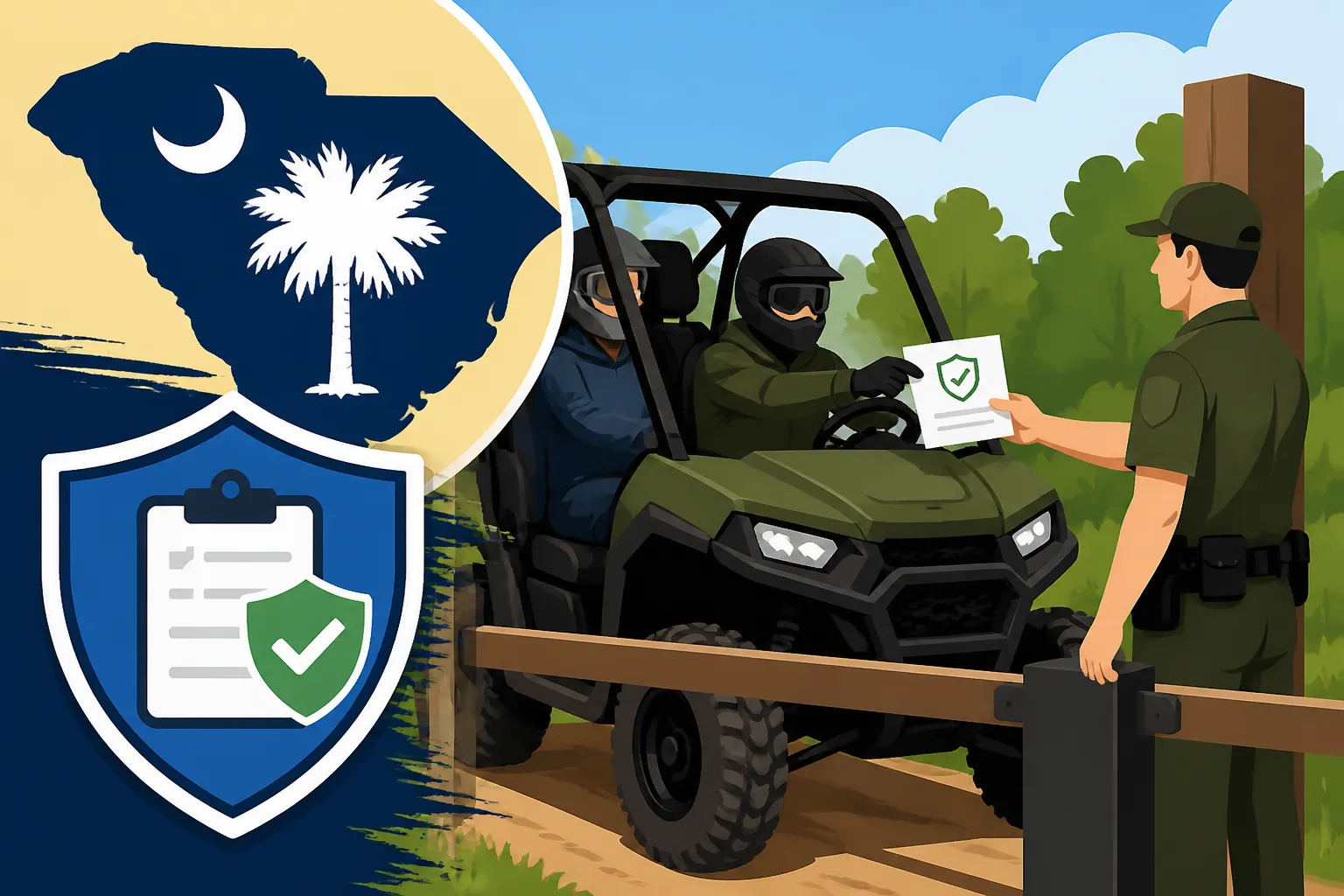
If a gate attendant or officer asks for insurance proof, stay calm and clarify what is being requested. The person may be enforcing a private venue policy, checking a road-use requirement, responding to an incident, or asking about another document entirely. Ask politely whether they need the insurance card, trail pass, registration or proof of ownership.
Then respond based on the setting:
- At a public off-road trail: Show the required pass and follow the posted entry instructions. If asked for insurance, ask which rule or condition applies, especially if the machine is off-road-only. Do not treat disagreement at the gate as permission to ignore a lawful direction.
- At a private park: Follow the operator’s current admission policy. If you do not have a required document, ask whether entry is still allowed or whether you need to return with it.
- On a public road: Treat the interaction as a road-use matter, not simply a trail pass check. Provide the documents required for the vehicle and situation, and contact your insurer if you are unsure what proof is acceptable.
- After a crash or other incident: Exchange the information requested by the appropriate parties and notify your insurer promptly. Preserve relevant details, including the location and circumstances.
If you cannot produce a document, explain that plainly rather than presenting an expired or unrelated document as proof. For a non-urgent question about a public-land fee or access rule, check the responsible agency’s current instructions before the next ride. For a private venue, contact management. For coverage questions, ask the insurer to confirm what the policy covers and what documentation it accepts.
The bottom line is simple: insurance proof is not a universal substitute for a South Carolina trail pass, and an off-road gate does not automatically have the same requirements as a road checkpoint. Verify the rules at the specific destination, carry the documents that match your planned use, and treat public-road operation as a separate legal question.
Disclaimer
This article is for general informational purposes only and does not constitute professional advice. Laws, prices and regulations vary by location and change over time. Consult a qualified professional for guidance on your specific situation.