What a South Carolina Deputy Can Ask to See
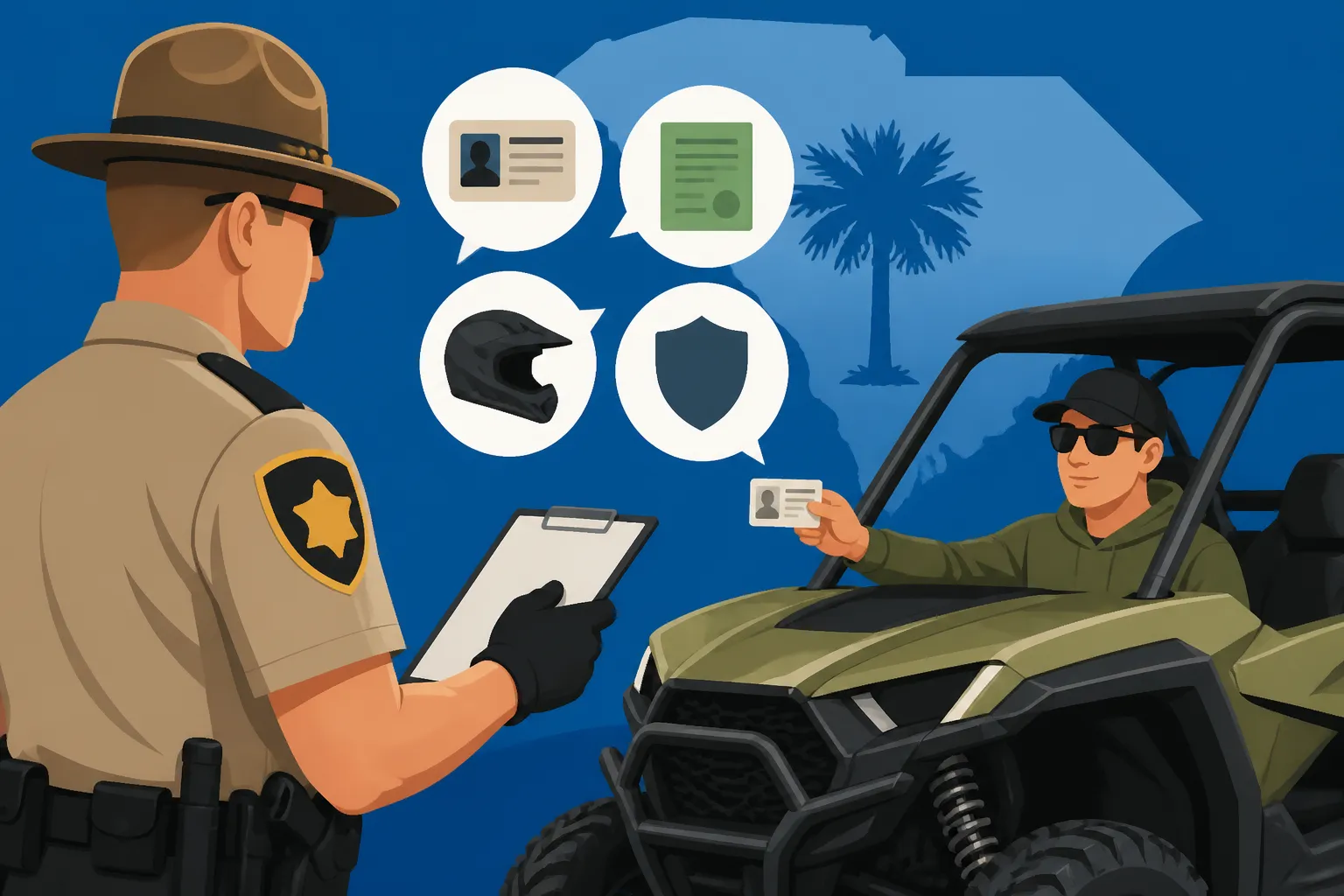
Picture this: You’re out enjoying a perfect South Carolina day on your ATV or UTV, the sun is shining, the trails are calling, and suddenly, you see flashing blue lights in your rearview. Your heart might do a little flip-flop, wondering, "What could they possibly want to see?" It’s a completely understandable anxiety, especially with all the nuances of off-road vehicle laws. This guide is here to demystify what a South Carolina deputy can legally ask to see and what you should be prepared for during an encounter, so you can ride with confidence and peace of mind.
Understanding the Authority of a South Carolina Deputy on Off-Road Trails
When you're out riding, whether it's on designated trails, private land with permission, or even if you're briefly crossing a public road (which has its own strict rules!), it’s wise to understand the scope of a deputy’s authority. They're not just there to catch speeders; they're also ensuring the safety and legal operation of off-road vehicles. Knowing this can help you remain calm and cooperative, making any interaction smoother.
When and Where Deputies Patrol for ATV/UTV Violations
Deputies patrol areas where off-road vehicles are commonly operated or where their operation might cause issues. This includes public lands like national forests (where many of our beloved trails are located, like those in the Sumter National Forest), but also areas adjacent to private property where noise complaints or suspected trespassing might occur. They might also monitor road crossings or areas where vehicles are loaded and unloaded, looking for visible violations or behaviors that could indicate a problem. It’s not about targeting riders; it’s about upholding public safety and land regulations. For example, if you're riding too close to a residential area or on land known for sensitive ecosystems, you might find law enforcement more visible. They're often responding to concerns from landowners, residents, or even other trail users who report unsafe practices.
Consider a scenario: you're enjoying a ride with friends on a popular, though sometimes muddy, trail. A group ahead of you decides to bypass a particularly deep mud hole by creating a new path off the designated trail, tearing up vegetation. Someone reports it. Later, a deputy might be patrolling that very stretch, not necessarily looking for you, but for anyone violating the land use rules. If they then observe you operating your machine in an unsafe manner, or if your machine itself seems to violate an equipment standard, that's when they might choose to initiate a stop. Their presence is often a direct response to issues, not just random checks. They are also present at events or large riding gatherings to ensure compliance and safety, especially since such events can attract a lot of attention.
The Legal Basis for a Stop: Probable Cause and Reasonable Suspicion
Just like with cars on a highway, a deputy can't pull you over on your ATV or UTV without a reason. They need either "reasonable suspicion" or "probable cause." Reasonable suspicion is a lower bar, meaning they have specific, articulable facts that suggest you might be involved in illegal activity. For example, if they see you riding a side-by-side on a paved county road beyond the allowed radius from your home or if your ATV appears to be missing required safety equipment, that could be reasonable suspicion to initiate a stop.
Probable cause is a higher standard, meaning they have enough evidence to believe a crime has been committed or is being committed. If a deputy observes you actively trespassing on clearly marked private property, or sees you riding without a helmet if you're under the legal age, that would likely constitute probable cause for a stop and potential citation. The key is that it's based on observable facts, not just a hunch. Understanding this can empower you; if you believe a stop was initiated without such a basis, it's something to note, though you should always comply politely during the interaction itself. It's about ensuring that law enforcement acts within defined legal boundaries, protecting everyone's rights while also maintaining order.
Your Rights During a Stop
It's natural to feel a bit flustered when stopped by law enforcement, but remembering your rights can help. First and foremost, you have the right to remain silent. You are generally not required to answer questions beyond providing your identity and any documents required by law. You also have the right to ask if you are free to leave; if the answer is yes, you may do so. However, it's always advisable to be respectful and cooperative. Arguing or being confrontational can escalate a situation unnecessarily.
If a deputy asks to search your machine, you have the right to refuse, unless they have probable cause or a warrant. However, if they have probable cause (for example, they see an open container of alcohol or illegal substances in plain view), they may be able to conduct a search. It’s generally best to state clearly and politely, "I do not consent to a search," and then remain silent. If a search proceeds despite your refusal, do not physically resist, but make a note of it. Remember, these general rights apply, but specific circumstances on private vs. public land or in designated off-road areas can sometimes introduce different dynamics. Staying informed, polite, and calm is your best strategy.
Essential Documents and Information a Deputy May Request
While South Carolina doesn't register off-road ATVs, there are still specific pieces of information and documents a deputy might ask for, especially if there's a question about ownership, safety, or legal operation. Being prepared with these can save you a lot of time and hassle.
Proof of Ownership: Why It Matters Even When Optional
Even though [South Carolina Titles Are Optional] for off-road ATVs, demonstrating proof of ownership is incredibly important. A deputy might ask for this to ensure the machine isn't stolen or to verify who is responsible for its operation. This is where a title, even an optional one, becomes invaluable. If you have a title, that's your gold standard. But if you don't, other forms of proof become critical.
For an ATV, you'd ideally have your Certificate of Origin (MCO or MSO) if it's new, or a bill of sale if it's used. Make sure your bill of sale is thorough, including the VIN, seller's and buyer's information, and date of sale. A signed bill of sale, perhaps even notarized, provides strong evidence. You can find templates for a robust bill of sale online, perhaps through services like LawDepot, which offers various legal document templates. Having this accessible, perhaps a laminated copy in a waterproof bag on your machine, can make a world of difference. Without it, you might face questions or even have your machine temporarily impounded while ownership is verified. This is especially true if the VIN appears tampered with or if the machine has been reported stolen. Having your ownership documents in order can help you avoid complications and demonstrate that you are a responsible owner.
Age and Safety Certifications for Riders
South Carolina takes youth safety on ATVs seriously, thanks to [Chandler's Law and South Carolina ATV Rules]. Deputies are well aware of these regulations and will check for compliance, particularly if they see younger riders. Here's what they might ask for:
- Proof of Age: If a rider appears to be under 16, a deputy may ask for identification to confirm their age. The law has strict rules: riders under 6 are prohibited, and those between 6 and 15 must be supervised by an adult at least 18 years old.
- ATV Safety Certificate: Riders aged 6 to 15 must hold an ATV safety certificate, proving they’ve completed an approved safety course. A deputy can and will ask to see this. If you’re a parent riding with a child in this age bracket, ensure they have this certificate on them, or at least you do with easy access. [South Carolina Safety Certificate Requirements] are not just recommendations; they are legal mandates designed to prevent accidents and injuries among young riders. Without it, your child could be cited, and you, as the supervising adult, could face penalties. It's a key piece of paperwork for many families enjoying the trails.
What to Carry if Your UTV is Street-Legal
If you're lucky enough to own a UTV that's been converted and registered for street-legal use in South Carolina, the list of documents a deputy can ask for expands significantly. Since it's now operating like a motor vehicle on public roads, you need to be prepared for all the standard vehicle checks, plus some UTV-specific ones.
- Driver's License: Just like any other vehicle, you must have a valid driver's license to operate a street-legal UTV on public roads.
- Registration and License Plate: Your UTV must be properly registered with the DMV and display a current license plate on the rear. A deputy will absolutely check for this. You'll also need proof of your biennial registration fee payment.
- Proof of Insurance: [South Carolina Street UTV Insurance Rules] require liability insurance, just like cars. A deputy will ask for proof of this coverage. Make sure it's up to date and readily available.
- Proof of Compliance with Street-Legal Equipment: While they might not ask for a physical document, deputies are trained to visually inspect your street-legal UTV for required equipment. This includes things like headlights, taillights, brake lights, turn signals, mirrors, a horn, and a windshield. They're looking to ensure your machine meets all the specifications outlined in [South Carolina Street UTV Requirements Explained].
It's a lot to remember, but for the privilege of driving your UTV on secondary roads, these requirements are non-negotiable. Always keep all these documents in a waterproof holder on your person or securely attached to your UTV.
Machine-Specific Checks and Equipment Compliance
Beyond personal documents, a South Carolina deputy can also inspect your machine itself for compliance with state laws and regulations. This isn't just about looking for violations; it's also about ensuring that vehicles on trails and roads are safe for everyone.
Inspecting for Required Safety Gear and Modifications
Deputies are on the lookout for specific safety equipment and modifications that are either required or prohibited. For off-road ATVs, one critical item is a properly functioning spark arrester. This is especially important in national forests and other wooded areas to prevent wildfires. They might visually check the exhaust system. While helmets aren't universally required for adults on ATVs in South Carolina, they are for riders under 16. [South Carolina Helmet Rules for Young Riders] are strict, and a deputy will enforce them. This means ensuring the helmet meets federal safety standards.
For street-legal UTVs, the list of mandatory equipment is much longer, as mentioned earlier. Deputies will look for properly functioning headlights, taillights, brake lights, turn signals, and a horn. They'll also check for mirrors, seatbelts, and a windshield. Any modifications that remove or disable these safety features could lead to a citation. It’s not uncommon for deputies to conduct spot checks, especially in areas where these vehicles are frequently used. They might also check tire condition, ensuring they are not excessively worn or unsafe.
Checking for Prohibited Equipment or Alterations
South Carolina law, particularly [South Carolina Code Title 50 Chapter 26], outlines several prohibited actions and equipment related to ATVs. For example, removing or altering the age restriction warning labels on an ATV is unlawful. These labels are there for a reason, guiding parents and guardians on appropriate machine sizes for young riders. A deputy could check for these labels. They might also look for modifications that make an ATV excessively loud, especially if riding in residential or environmentally sensitive areas, as noise complaints are a common trigger for law enforcement intervention.
For street-legal UTVs, any alteration that compromises the safety features required for road use would be a point of concern. This could include things like lifted suspensions without proper engineering, or tires that extend excessively beyond the fenders without proper coverage, which can throw debris onto other vehicles. The focus is always on ensuring public safety and preventing practices that could harm others or the environment. Riding a machine that is visibly unsafe or illegally modified is an open invitation for a deputy to initiate a stop.
Understanding Serial Number Verification and Stolen Machine Checks
One of the most critical things a deputy can do during a stop is to verify the machine's Vehicle Identification Number (VIN) or serial number. They will compare this number to your proof of ownership (title, MCO, bill of sale) to ensure they match. This is a primary tool for detecting stolen machines. If the VIN appears to be altered, defaced, or removed, it raises a huge red flag and could lead to the immediate impoundment of your machine for further investigation.
A deputy also has the ability to run the VIN through law enforcement databases to check if the machine has been reported stolen. This is a routine part of many traffic stops involving ATVs and UTVs, especially since these vehicles are unfortunately targets for theft. [How to Check Whether a Quad Was Stolen] is something you should consider before purchasing a used machine, but law enforcement does this as a matter of course. If your machine comes up as stolen, you could face serious legal consequences, even if you bought it innocently. This highlights why having clear, undisputed proof of ownership, such as a formal bill of sale from LawDepot, is so incredibly important for every ATV and UTV owner. Don't underestimate the importance of easily accessible and verifiable VINs.
Common Scenarios Leading to an Encounter and How to Respond
Knowing the rules is one thing, but knowing why a deputy might stop you and how to react calmly can make all the difference. Many encounters stem from a few common scenarios, often related to where and how you’re riding.
Riding on Prohibited Roads or Private Property
This is perhaps the most frequent reason for a deputy to engage with an ATV or UTV rider. South Carolina has very specific rules about where you can and cannot ride off-road vehicles. While street-legal UTVs have more freedom, traditional ATVs are generally prohibited from public roads. [Can You Ride an ATV on the Road in South Carolina?] is a question with a very strict "no" for the vast majority of cases. Briefly crossing a road at a 90-degree angle to get to another trail is often allowed, but cruising down a highway or even a paved county road is not.
Furthermore, riding on private property without explicit permission from the landowner is trespassing, a serious offense. Deputies frequently respond to calls from property owners reporting unauthorized vehicles. [South Carolina Trespass Law for Riders] means you need to have your permission in writing, or at least be able to articulate clearly who gave you permission. If you’re caught riding where you shouldn’t be, a deputy will likely issue a citation, and in some cases, your machine could be impounded. The best response here is honesty and cooperation. Explain where you thought you had permission or why you were on the road. This may not get you out of a ticket, but it can certainly help de-escalate the situation.
Addressing Noise Complaints or Reckless Operation
Off-road vehicles, especially those with modified exhaust systems, can be quite loud. Noise complaints from residents living near popular riding areas are another common trigger for law enforcement patrols. While there isn't a statewide decibel limit specifically for ATVs, local ordinances or general nuisance laws can apply. If a deputy receives a complaint, they might stop riders to address the issue.
Beyond noise, reckless operation is a huge concern for public safety. This includes things like excessive speed for the conditions, unsafe stunts, riding too close to other vehicles or people, or operating the machine under the influence of alcohol or drugs. If a deputy observes you riding in a manner that endangers yourself or others, they will intervene. [South Carolina Fines of $50 to $200] are a real possibility for these types of violations. When stopped for these reasons, acknowledge the deputy's concerns, state your side calmly, and avoid making excuses. Demonstrating a willingness to comply with safety rules and be a responsible rider will go a long way.
What to Do if You're Cited or Your Machine is Impounded
Receiving a citation or having your machine impounded is an incredibly frustrating and stressful experience. If a deputy issues you a ticket, accept it calmly. You can always dispute it in court if you believe it was unwarranted. Ask for clarification on the charges and the process for paying the fine or contesting it. Write down the deputy's badge number and any details you remember about the stop, as these might be useful later.
If your machine is impounded, understand the reason. It could be due to serious violations like suspected theft, operating under the influence, or repeated reckless behavior. Ask the deputy for information on where your machine is being taken, how you can retrieve it, and what fees will be involved. There will almost certainly be towing and storage fees, which can add up quickly. It's crucial to follow the instructions precisely to get your machine back. In some cases, especially if there's a serious legal issue, you might want to consult with an attorney. Again, a comprehensive bill of sale, perhaps generated using a reliable service like LawDepot, along with a title if you have one, will be essential for proving ownership when trying to retrieve an impounded machine. Having your documentation in order is your best defense against such headaches.
Here's a quick reference on what a South Carolina Deputy might look for depending on your machine type:
| Item / Machine Type | Off-Road ATV (No Registration) | Street-Legal UTV | Golf Cart (Permitted Areas) |
|---|---|---|---|
| Proof of Ownership | Bill of Sale / MCO / Optional Title | Title / Registration | Bill of Sale / MCO / Optional Title |
| Driver's License | Not required for operation | Required for operation | Required for operation |
| ATV Safety Certificate | Required for riders aged 6-15 | N/A | N/A |
| License Plate / Decal | N/A (South Carolina Does Not Register Off-Road ATVs) | Required (Rear Plate) | Required (Permit Decal) |
| Proof of Insurance | Not legally required | Required | Not legally required |
| Spark Arrester | Required | N/A | N/A |
| Helmet | Required for riders under 16 | Required for riders under 21 | N/A |
| Headlights / Taillights | Required after dark (if riding) | Required | Required if operating after dark |
| Brake Lights | Not explicitly required | Required | Required |
| Turn Signals | Not explicitly required | Required | Not explicitly required |
| Mirrors | Not explicitly required | Required | Required (rearview) |
| Seatbelts | N/A | Required | Not explicitly required |
| VIN Verification | Yes | Yes | Yes |
Disclaimer
This article is for general informational purposes only and does not constitute professional advice. Laws, prices and regulations vary by location and change over time. Consult a qualified professional for guidance on your specific situation.