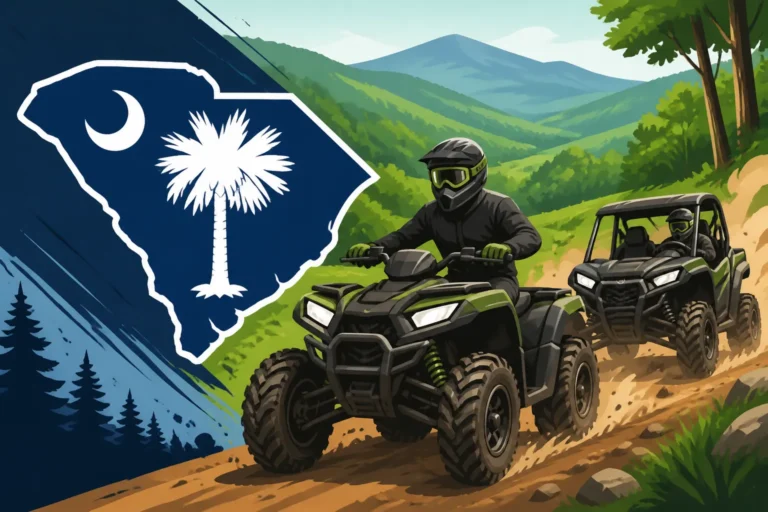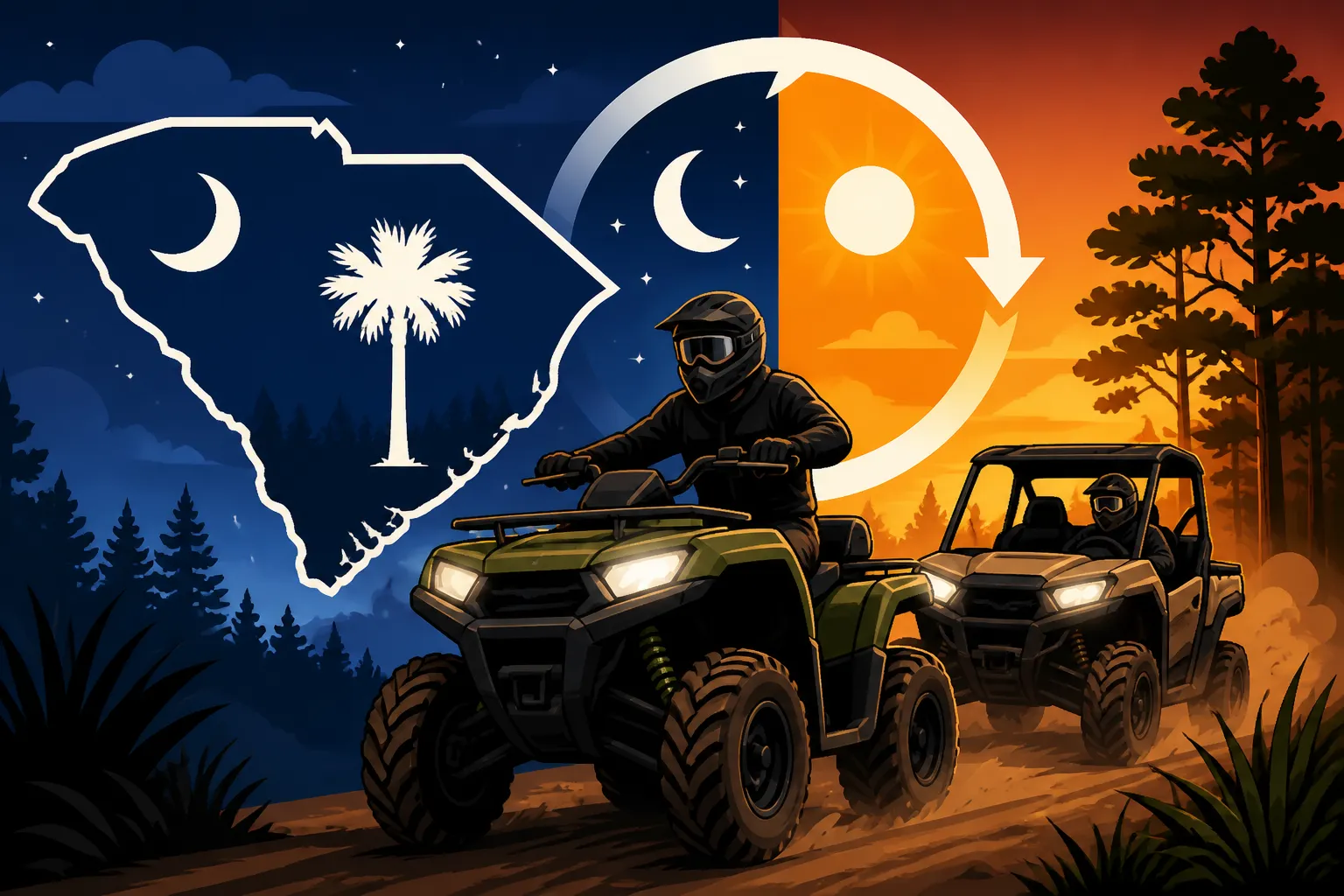
South Carolina Trails Open Around the Clock
A late finish at work, a long drive to the trailhead, or a group ride that runs past sunset can leave you wondering whether South Carolina ATV trails stay open all night. The practical answer is that there is no single statewide schedule for every trail. This guide explains how to check access hours, closures, permits, and nighttime riding risks before you unload.
Are South Carolina ATV trails open around the clock
There is no single statewide schedule
“South Carolina trails” can mean very different places: a motorized trail in a national forest, a privately operated off-road park, or a route on land where you need the owner’s permission. Each may set different hours and access conditions. A trail being open during a particular season does not automatically mean it is open at every hour of the day.
That distinction matters when you are planning a night ride. A forest road may be physically reachable after dark, but that does not establish that a particular OHV trail is open for riding then. A locked gate, posted notice, seasonal restriction, maintenance closure, or local rule can change what is allowed. Private parks often set their own operating schedules and may close trails when the office or riding day ends.
Before you treat “open” as “open all night,” look for a stated daily schedule for the specific trail system. Check whether the information applies to the riding area itself, its entrance road, or only a nearby campground. If you cannot confirm the hours, plan around daylight and contact the managing agency or park rather than assuming late-night access is permitted.
Year-round access does not mean twenty-four-hour access
Trail listings sometimes describe an area as open year-round. That generally speaks to the season, not the time of day. A trail that is available in winter may still have daily hours, temporary closures, or conditions that make riding unsuitable. It may also be closed for maintenance, fire danger, weather, or another land-management reason.
This is an easy detail to miss when you are comparing destinations from home. Imagine your group sees a trail listed as year-round, leaves after dinner, and arrives in the dark. You may find a closed gate, a fee station with no after-hours process, or a trailhead where the posted rules prohibit riding at that time. Even if access is technically available, poor visibility can make a familiar route unexpectedly difficult.
For planning, separate three questions: Is the area open on the date you want to go? Are the trails open at the hour you expect to ride? And is your specific vehicle allowed on those trails? The answer to one does not settle the others. For broader seasonal planning, see [South Carolina Trails Open Year-Round] and check [South Carolina Trail Conditions Before You Haul] before loading up.
How to verify trail hours before you leave
Check the managing agency or park directly
Start with the organization responsible for the land. For a national forest trail, look for current information from the relevant forest or ranger district. For a privately operated park, check that park’s rules and contact information. A map app or an older trip report can help you identify a trailhead, but it may not reflect a temporary closure or a change in access rules.
When reviewing trail information, look for a clearly stated opening and closing time, not just a general “open” label. Also note the date of the notice, the season it covers, and whether it applies to motorized use. A campground, picnic area, or access road nearby can have different hours from the OHV trail itself.
If the page is unclear, ask a focused question: “Can I ride this trail after dark on the day I plan to visit, and is there an after-hours access requirement?” That is more useful than asking whether the area is generally open. You can also ask about vehicle restrictions, pass display rules, and whether recent weather has affected access.
Use maps as a planning tool, not permission
A navigation app can help you locate trailheads, see nearby roads, and plan a route, but a map does not grant permission to ride. onX Offroad can be useful for looking at mapped routes and orienting yourself before a trip. Treat its map information as one part of your preparation, alongside the rules and updates from the land manager.
If you use onX Offroad, check that the route you are viewing is actually intended for your vehicle type. A line on a map can represent a road, trail, or access route with restrictions that are not obvious from the line itself. Compare the map with posted signs and official trail information, and do not ride through a gate or onto land just because the route appears to continue.
Save the details you need before you lose cell service. That might include the trailhead location, your planned return route, the phone number for the ranger district or park, and an offline map. For more trip-planning context, review [South Carolina ATV Trail Map Downloads] and [South Carolina Trailheads With Trailer Parking]. Keep in mind that maps can help you find a place; they cannot confirm that it is open tonight.
Confirm closures and access requirements on the day
A trail that was open last weekend may not be open today. Heavy rain, maintenance, fire conditions, storm damage, or land-management work can lead to a closure with little warning. That is especially frustrating after you have driven from Columbia, Charleston, Greenville, or another part of the state with a trailer in tow. A quick check before departure can save a wasted trip.
Look for notices that identify the affected trail or section, the reason for the closure, and any expected reopening information. Do not assume a closure applies only to the main route or that a nearby trail is a legal detour. Follow signs at the trailhead, too. A notice on the ground may be newer or more specific than information you saw earlier online.
If weather is part of the issue, be cautious even when a trail is technically open. South Carolina clay can become slick, low areas can hold water, and a dry-looking entrance does not guarantee safe conditions farther in. See [South Carolina Trail Closures After Rain] and [Why Forest Trails Close on Short Notice] before deciding that an open trail is a rideable trail.
What to check at South Carolina riding areas
National forest trails
South Carolina has motorized riding opportunities in national forest settings, but each trail system has its own vehicle rules, access conditions, and pass requirements. A route suitable for a dirt bike may not be suitable for a full-size side-by-side. Width limits, surface type, seasonal restrictions, and trail design all affect which machines can use a particular route.
At the trailhead, read the signs before unloading. Check for posted hours, closures, permitted vehicle types, pass requirements, and any seasonal notices. If you arrive after dark, it may be harder to notice a sign, find the correct staging area, or distinguish an open route from a closed one. A headlamp and a quick walk to the information board are safer than trying to interpret signs from the driver’s seat.
Do not assume that a forest pass is the same as permission to ride anywhere in the forest. Passes, trail access, and vehicle eligibility are separate issues. Review [South Carolina National Forest OHV Passes] and [South Carolina's Day and Season Forest Passes] before your trip, then match the pass rules to the trail you plan to use. Keep proof accessible so you are not searching through a glove box at a fee check.
Private parks and other riding properties
Private off-road parks may offer a more structured visit, but they do not all operate on the same schedule. A park can have set entry times, closing times, reservations, separate rules for camping, or restrictions on riding after the office closes. Some properties may allow overnight camping without allowing overnight riding. Confirm those details directly before you book or travel.
Ask whether the stated hours apply to check-in, trail use, vehicle unloading, or all three. If you are arriving late, find out whether you can still enter and where you are allowed to stage. If your group plans to camp, confirm whether the camping area is open and whether quiet hours apply. A reservation for a campsite does not necessarily authorize riding through the night.
Private land also requires permission. A trail that crosses land visible from a public road is not automatically open to the public. Do not use an unmarked track as a shortcut around a closed entrance, and do not follow another rider through a gate unless you know access is allowed. A little advance planning prevents an awkward conversation with a landowner or park staff after a long drive.
| Access detail | What to confirm | Why it matters |
|---|---|---|
| Daily hours | Whether riding is allowed at your planned arrival and departure times | “Open” may not mean open all night |
| Season | Whether the trail is open on your chosen date | Year-round access can still have temporary closures |
| Vehicle type | Whether your ATV, dirt bike, or UTV is permitted | Trails can have width or vehicle restrictions |
| Pass or fee | What you need to buy, display, or carry | A pass may be required even when the entrance is open |
| Camping | Whether overnight camping is allowed and where | Camping permission may not include nighttime riding |
| Current conditions | Whether rain, maintenance, or other notices affect access | Conditions can change after you plan the trip |
Riding after dark safely and legally
Check your lights and gear before sunset
Night riding changes how quickly you can read the ground. A rut, branch, rock, washout, or sharp turn may appear only when it is close. Dust from another machine can reflect light back toward you, and wet surfaces can look deceptively smooth. A route that felt easy in the afternoon can become tiring and difficult after dark, especially if you are unfamiliar with it.
Before you ride, check that your machine’s lights work and that your helmet, eye protection, and other gear are ready. Carry a backup light for walking or handling a breakdown, but do not treat a handheld flashlight as a substitute for required vehicle equipment. Keep your pace low enough to stop within the area you can clearly see, and leave extra space between machines so dust and glare do not overwhelm the rider behind you.
If someone in your group is new to the trail, consider ending the ride before darkness rather than making their first trip a night ride. A beginner may struggle to judge distance, follow trail markers, or keep a consistent pace when visibility drops. Even experienced riders can get turned around when familiar landmarks disappear. Make a return plan while there is still daylight.
Know which rules apply to your machine and location
Rules for off-road riding, public roads, and street-legal UTV use are not interchangeable. A machine’s lights do not make it legal to ride on a road, and an off-road trail’s availability does not mean it is open to highway travel. Check the requirements that apply to your vehicle and the place you are riding, including any age, helmet, equipment, or access rules.
South Carolina’s ATV rules address riding conditions and required equipment, but a trail operator may also have its own rules. Read both. A private park can require equipment or behavior beyond what you expected, while a forest trail can restrict certain vehicle types regardless of whether the machine is otherwise legal to operate.
If you are considering road travel between trail sections, stop and verify the route rather than improvising in the dark. Do not assume a short stretch of pavement is permitted because another rider used it. The rules for street UTVs are distinct from those for an off-road quad; [South Carolina Street UTV Rules From November 2026] is a separate topic from ordinary trail access. For more on after-dark trail considerations, see [South Carolina Riding After Dark].
Plan for a breakdown or a late return
A night ride can turn a small problem into a complicated one. A dead battery, flat tire, broken belt, or stuck machine is harder to deal with when the group is tired and the trail is dark. Before starting, agree on a turnaround time, a meeting point, and what the group will do if someone becomes separated. Tell someone who is not riding where you plan to go and when you expect to return.
Bring the basics for the machine and the people riding it. Depending on the route and your setup, that can include a first-aid kit, water, warm or rain-resistant layers, a tire repair kit, a basic tool kit, and a charged phone or other communication device. Cell service can be unreliable in forested areas, so do not assume you can call for help from every point on the trail.
Keep the group together without pressuring the slowest rider to go faster than is safe. If the trail becomes difficult to follow, visibility drops, or someone is uncomfortable, turn back while the group still has enough light and energy to do so. A missed loop is a small disappointment. A stranded machine or an injured rider on a dark trail is a much bigger problem.
A practical checklist for an after-hours ride plan
Make your decision before you load the trailer
Use a simple yes-or-no check before setting out. First, confirm the exact trail system and the type of machine allowed there. Next, find a current statement about hours and access. Then check for closures, pass requirements, and any weather-related warnings. If one of those pieces is missing, do not treat an assumption as confirmation.
Also think about the drive home. A group that plans to ride until midnight may face fatigue on the highway, especially after a full day of riding and loading machines. Choose a realistic end time and allow room for a slow return to the staging area, gear checks, and trailer loading. If the park or trail system closes earlier than expected, you do not want to discover that while you are several miles from the entrance.
Here is a straightforward order to follow:
- Choose a specific trail system rather than a general destination.
- Confirm the trail’s hours and vehicle restrictions with its manager.
- Check for current closures and weather-related access changes.
- Arrange any required pass, reservation, or permission.
- Review your route and save essential information offline.
- Inspect lights, protective gear, and basic repair supplies.
- Set a turnaround time and share your plan with someone at home.
Have a backup destination and a clear stopping point
If your first choice is closed or has uncertain hours, a backup can keep the day from turning into a frustrating scramble. Choose another legal riding area in advance, and verify its access rules separately. Do not drive from one trailhead to another assuming that a different forest road or nearby property will be open.
Set a firm point at which the group stops riding. That might be a planned time, a particular trail junction, or the moment visibility becomes poor. Agreeing in advance makes it easier to turn around without someone feeling pressured to push on. The plan should work for the least experienced rider in the group, not just the person most eager to keep going.
Keep the most important information easy to find: the managing agency or park contact, your vehicle and pass details, the trailhead location, and the intended return route. onX Offroad can help with route awareness and offline planning, but continue to follow official signs and the land manager’s current instructions. The map is useful when conditions are clear; it should never be used to justify riding through a closure.
Ride with courtesy when others are still on the trail
Late rides can affect other trail users, nearby campers, residents, and wildlife. Keep noise down near staging areas and campgrounds, avoid unnecessary engine revving, and do not idle for long periods beside another group’s campsite. Respect posted quiet hours and any park-specific noise restrictions.
Good trail etiquette is especially important when visibility is limited. Slow down around blind corners, yield when the trail is narrow, and avoid crowding the rider ahead. If you meet a group coming the other way, stop somewhere both parties can pass safely. Do not shine high beams directly into another rider’s face or assume that a moving light means the trail ahead is clear.
Pack out everything you bring in, including broken parts and food waste. Leave gates and barriers as you found them, and report a hazard or damaged sign to the appropriate manager. For more on sharing a route responsibly, see [South Carolina Trail Etiquette Locals Expect]. A considerate group is more likely to be welcomed back, whether it rides in the morning or near closing time.
Disclaimer
This article is for general informational purposes only and does not constitute professional advice. Laws, prices and regulations vary by location and change over time. Consult a qualified professional for guidance on your specific situation.