South Carolina Riding Near Abbeville
Abbeville is a good starting point for exploring South Carolina’s western Piedmont, but finding a legal, open trail for an ATV or UTV takes more than spotting a dirt road on a map. This guide explains what riding options to investigate nearby, how to check access and vehicle fit, and what to plan before loading up and heading out.
Start With the Riding Area Closest to Abbeville
Check Parsons Mountain before planning a longer drive
For riders based in Abbeville, Parsons Mountain is a useful place to investigate first. It is part of the Sumter National Forest trail network and is commonly associated with the Waterloo area. That makes it a more practical starting point for some Abbeville-area riders than trails farther north or east. Still, “nearby” is relative: check the route from your home or meeting point, account for time spent towing, and confirm that the specific trail is open before you leave.
Parsons Mountain is an OHV trail, not a general invitation to ride anywhere in the surrounding forest. Stay on routes that are specifically designated for your type of vehicle, and follow posted signs at trail entrances and intersections. A forest road, logging road, or sandy-looking track may appear rideable without being open to recreational ATV or UTV use. If you want a broader overview of the national forest options, see [South Carolina's Four National Forest Trails].
Before making Parsons Mountain the centerpiece of a weekend, verify trail status, access rules, vehicle restrictions, pass requirements, and any seasonal notices with the responsible forest office. Conditions can change after rain, maintenance work, storm damage, or other closures. A trail that was open during your last visit may not be available for your next one, so treat checking ahead as part of the ride rather than an optional extra.
Keep other western South Carolina options in perspective
Riders willing to tow farther can also research trails around Whitmire and Waterloo. The Enoree area, for example, may make sense for a day trip when you are looking for a different forest setting or want to combine riding with an overnight stay. Distance, road access, vehicle eligibility, and trail conditions matter more than a map’s straight-line measurement. A trailhead that looks close on a screen can require a long drive on two-lane roads with a trailer.
For local comparisons, [South Carolina Riding Near Waterloo] and [South Carolina Riding Near Whitmire] can help you think through other starting points. These areas are not interchangeable: trail length, permitted machine types, surface, nearby services, and camping possibilities can vary. Before choosing one, compare the actual drive from Abbeville, the length and difficulty of the ride, and the rules that apply to the trail you plan to use.
It is also worth separating public-forest riding from private off-road parks. A private park may have its own entry process, vehicle rules, trail ratings, and operating schedule. A national forest trail follows a different set of access and land-management rules. If you are considering a private area, check its own current requirements directly rather than assuming that a forest pass or forest rule applies there.
Match the Trail to Your Machine and Riding Group
Check whether your ATV or UTV is allowed
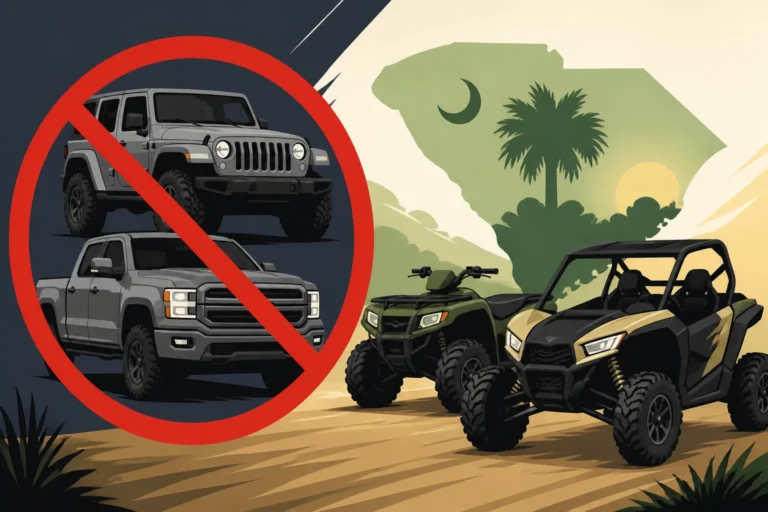
A trail’s label does not automatically tell you whether your machine can use it. Some routes may be suitable only for narrower vehicles, while others may have restrictions on vehicle type or width. A full-size side-by-side can be too wide for a route intended for smaller machines, and a trail may have gates or obstacles that make it unsuitable even when the vehicle technically meets a published limit. Confirm the trail’s vehicle rules before you tow.
Think about your machine’s real dimensions, not just how it feels in the driveway. Add accessories such as mirrors, a roof, a spare tire carrier, or a wider wheel setup when considering whether it will fit. If you are riding with a mixed group of ATVs and UTVs, make sure the planned route works for the largest vehicle and for the least experienced rider. [South Carolina Trails That Allow Side-by-Sides] is a useful topic to check when comparing routes.
Riding a dirt bike brings a different set of considerations. A motorcycle trail may have a narrower tread, tighter turns, or a surface that feels different from a route built for wider machines. Check the trail’s listed vehicle types instead of assuming an OHV designation means every off-road vehicle is allowed. For a starting point, review [South Carolina Trails That Allow Dirt Bikes] alongside the individual trail information.
Choose a route that suits the least experienced rider
A group’s ideal route is not necessarily the one that challenges its most experienced rider. It is the one everyone can ride safely and legally, with enough room to stop, regroup, and handle an unexpected problem. A rocky climb that feels routine to one rider may be intimidating to a newer rider, especially when the trail is slick or the machine is carrying extra gear.
For a family ride, agree on a simple plan before leaving the staging area: who leads, who rides last, where the group will regroup, and what to do if someone needs to stop. Keep newer riders away from pressure to follow faster riders through an obstacle. If the trail becomes harder than expected, turning around is a sensible decision—not a failure to finish.
A rough planning comparison can help narrow your options. It is not a substitute for official trail rules, but it can prompt the right questions before you drive:
| Riding plan | What to check first | Common planning concern |
|---|---|---|
| Short ride near Abbeville | Trail status, distance to the staging area, and allowed vehicle types | A nearby-looking route may not be an open OHV trail |
| Mixed ATV and UTV group | Width rules, trail surface, and whether the full route suits every machine | The widest vehicle may rule out narrower routes |
| Newer riders or family group | Difficulty, stopping areas, supervision, and ride length | A technical section can overwhelm a beginner |
| Longer day trip | Drive time, fuel, food, daylight, and backup options | Towing time can make a planned ride feel rushed |
| Wet-weather outing | Closure notices, surface conditions, and access rules | Mud can damage trails and make recovery difficult |
Plan the Drive, Pass, and Trailhead Details
Verify access before you load the trailer
One frustrating trip begins with a fully loaded trailer and a closed trailhead. Avoid that by checking official trail or forest notices close to your departure, then checking again if heavy rain or storms arrive before the ride. Look for notices about closures, maintenance, permitted vehicle types, and access to the staging area. The trail itself may be open while an access road or part of the route is not.
Build a practical arrival plan. Confirm where trailers can be parked, whether the staging area has room for your group, and whether nearby roads can accommodate a long truck and trailer. A narrow turn, soft shoulder, or crowded lot can create a problem before anyone reaches the trail. If several families are meeting, share the exact trailhead location and a backup meeting point in advance.
Mapping apps can help with orientation, but do not treat a displayed track as proof of public access. onX Offroad can be useful for reviewing routes and planning where you expect to ride, but compare what you see with official forest information and posted signs. A line on a map does not grant permission to cross private property or ride a route that is closed.
Understand passes and other access requirements
Public-land riding may involve a pass or other access requirement. Confirm what applies to the specific trail and whether the pass is tied to an individual, a vehicle, or the tow vehicle. Check how it must be displayed and whether you need to carry a printed copy or other proof. Don’t rely on an old pass, a friend’s pass, or a receipt from a different riding area without checking the rules.
Plan this step before the day of the ride. Cell service may be unreliable at a rural trailhead, and trying to sort out an online purchase after arriving can waste time or leave you without a workable option. For a broader overview of the process, see [How to Buy a South Carolina Forest Pass]. The responsible agency’s instructions should guide your decision for the trail you actually intend to use.
Also check whether other land-management rules affect your plan. Wildlife management areas, private timber properties, and national forest recreation areas can have different access conditions. A hunting license, permission for another activity, or the fact that a road is physically passable does not necessarily mean ATV or UTV riding is allowed. Stay within designated areas and confirm permission directly when land is private.
Prepare for Piedmont Trail Conditions
Expect surfaces and traction to change
A ride around Abbeville can involve more than a single predictable surface. Soil, gravel, roots, rocks, leaves, and water can affect traction differently, and the same stretch can feel entirely different after a dry week or a hard rain. Clay and damp ground can become slippery; dry leaves can hide ruts, roots, or uneven ground. Adjust your speed to what you can see and stop safely for.
Wet conditions deserve special attention. A muddy route may look like an invitation to play, but repeated wheelspin can rut a trail and damage its surface. Deep mud can also turn a minor mistake into a recovery problem, especially for a heavy UTV or a machine without suitable equipment. Check closure notices and avoid riding where the responsible land manager has closed a route or posted a restriction. See [South Carolina Wet Weather Trail Closures] for more on planning around rain.
If a section is too slick or damaged for your group, do not feel obligated to push through it. Stop in a safe place, talk through the options, and turn around if needed. Trying to power through can put riders at risk, cause damage to the trail, or leave a machine stuck where recovery is difficult. A conservative decision early in the ride is usually easier than solving a problem deep into a route.
Prepare the machine and carry useful essentials
Give your ATV or UTV a basic check before leaving home. Look over tires, brakes, steering, lights, fuel, and visible leaks. Secure loose cargo and make sure accessories cannot snag on branches or interfere with controls. For a trailer trip, check the trailer as well: tires, lights, tie-downs, and the way the machine is secured all deserve attention before you pull onto the road.
Carry practical items suited to the ride rather than packing as though you are crossing a wilderness. Water, a first-aid kit, a charged phone, a basic tool kit, and a way to contact your group are useful starting points. Depending on the route and your machine, recovery straps or a winch may help, but only if riders know how to use them safely. Tell someone who is not riding where you plan to go and when you expect to return.
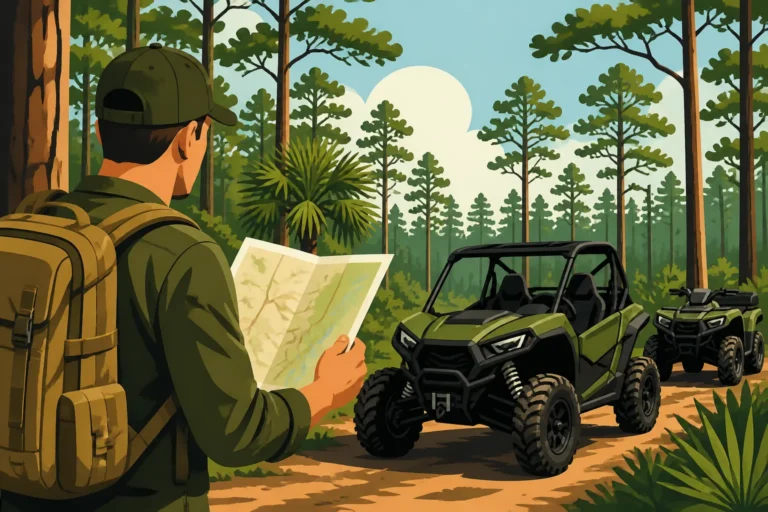
Offline navigation can help when cell service drops, but use it as a backup, not as the authority on access. onX Offroad may help riders keep track of a planned route, while official maps and signs remain essential for understanding designated riding areas. Save the route and meeting details before you leave home, and carry a paper map if the terrain or signal conditions make that prudent. A map is most helpful when everyone in the group knows how to read it.
Ride Responsibly on Public and Private Land
Stay on designated routes and respect local land use
The key rule for a forest ride is simple: stay on routes open to your machine. Do not widen a trail by going around a puddle, create a new bypass around an obstacle, or ride into an unmarked opening because it looks convenient. Those shortcuts can damage vegetation, disturb wildlife, create erosion, and make it harder for land managers to keep trails open.
A route may pass through a landscape that feels remote while still being close to private property, timber operations, or other managed land. Respect gates and signs, and never assume that a locked gate is merely an inconvenience. Ask for permission before riding on private land, and keep a record of any permission you receive if the property owner provides one. A local road or forest access road is not automatically an OHV trail.
Trail etiquette also matters when you meet hikers, cyclists, other motorized riders, or work crews. Slow down, give people space, and follow posted right-of-way guidance. If you encounter logging or maintenance activity, stop where safe and follow instructions. [South Carolina Trail Etiquette Locals Expect] offers more on sharing riding areas without creating unnecessary friction.
Keep the group organized and ride within your limits
Agree on hand signals or another clear way to communicate before leaving the staging area. Riders should know who is leading and who is sweeping at the back, and the group should pause at trail junctions so nobody is left guessing which way to go. If someone stops unexpectedly, the riders behind should be able to alert the rest of the group without creating a pile-up on a narrow trail.
Leave room between machines. Following too closely makes it harder to react to a sudden stop, hidden rut, or branch in the trail. UTV drivers should account for passengers and cargo, and ATV riders should keep enough space to manage turns and changes in traction. Keep speeds controlled, especially near trailheads, blind corners, campsites, and areas where people may be walking.
Finally, treat changing conditions as a reason to adjust the plan. If the group is running behind, weather is turning, a rider is tired, or a machine develops a problem, shorten the route or return to the staging area. Before hauling from Abbeville, check [South Carolina Trail Conditions Before You Haul] and make sure everyone understands the plan. A ride that ends early and safely is better than a rushed finish in fading light.
Make an Abbeville-Area Ride Work for Your Weekend
Build a realistic day-trip schedule
A good day trip starts with a realistic departure time. Count the drive from Abbeville, trailer loading, fuel stops, and the time needed to get everyone ready at the trailhead. If your group hopes to ride a full day, arriving late can make the outing feel hurried and encourage people to ride faster than they should. A shorter route with time to regroup is often a better choice than trying to squeeze in every loop.
Keep a backup plan that is genuinely usable. If your first-choice trail is closed or unsuitable for your vehicle, know whether another area makes sense or whether the safer choice is to reschedule. A backup is not just a second pin on a map; it should include confirmed access, suitable vehicle rules, and a workable drive. Avoid improvising onto an unverified road because the original plan fell through.
For a group travelling from different parts of the county, coordinate fuel, food, and meeting arrangements before the ride. Establish a place to meet that can handle trailers, and make sure everyone has the same trailhead information. Share the expected return time with someone outside the group. Small details like these can prevent confusion when phones lose service or a rider gets separated at a junction.
Consider camping only after confirming the details
An overnight trip can make a longer ride easier, but camping availability and rules vary by location. Check whether camping is allowed where you plan to stay, whether reservations or other arrangements are needed, and how far the campsite is from the riding area. Do not assume you can camp at a staging area or beside a trail simply because there is open ground.
If you are comparing a forest ride with a private park, check lodging and camping directly with the operator or land manager. Ask about quiet hours, fires, pets, vehicle parking, and whether the campsite is accessible to your trailer. [South Carolina OHV Camping With Trail Access] can help you think through the broader options, but the specific site’s instructions should settle the details.
Pack for the overnight conditions and leave the site clean. Secure food and trash, follow fire restrictions, and avoid creating noise that disrupts nearby campers or residents. A well-planned overnight stay can turn a long tow into a relaxed weekend, but it should not depend on assumptions about access or facilities.
Disclaimer
This article is for general informational purposes only and does not constitute professional advice. Laws, prices and regulations vary by location and change over time. Consult a qualified professional for guidance on your specific situation.