Riding Out of Waterloo
Waterloo can be a handy place to begin planning an off-road day in Laurens County, but it is not itself a guarantee of legal ATV or UTV access. The key is separating public roads, private timberland, and designated riding areas before you unload. This guide explains how to plan from Waterloo, check trail access, and avoid a wasted trip.
What riding out of Waterloo really means
Waterloo is a starting point, not an open trail system
“Riding out of Waterloo” can sound like a route begins right in town and continues onto nearby back roads. That is an easy assumption to make when you see unpaved roads or broad stretches of wooded land on a map. But a dirt surface does not automatically mean an ATV or UTV route is open to the public.
Before planning a ride, decide whether you mean a legal ride based near Waterloo or a ride directly from your property onto public roads. Those are different things. A machine that is legal on a designated trail is not automatically allowed on a county road, a forest road, or a private timber road. For help finding established riding areas around the state, start with South Carolina ATV Trails: Where to Ride.
A sensible plan treats Waterloo as your place to meet, fuel up, check equipment, or stay overnight, then trailers the machine to an area where off-road use is specifically allowed. That extra step can feel inconvenient, especially if a road looks quiet and unused. It is still safer than finding out at a locked gate that the road is private or closed to recreational vehicles.
Separate roads, trails, and private property
Use three questions to assess any route: Who owns or manages the land? Is motorized recreation permitted there? Is your particular machine allowed on the route? You need clear answers to all three before riding. A county road, a U.S. Forest Service road, and a privately maintained timber road can look similar on a phone screen while having very different access rules.
Pay close attention to Wildlife Management Areas, or WMAs. A hunting area is not automatically an ATV riding area, and holding a hunting license does not by itself authorize off-road vehicle use. Review South Carolina WMA Riding Is Prohibited and confirm the land manager’s rules for the specific property you have in mind.
Private land needs the owner’s permission, even when there is no obvious fence or gate. Timber company roads can be especially misleading: they may appear open but still be restricted, and permission can depend on the property, season, or activity. If a route crosses land you do not own, get permission before you ride rather than relying on an old map label, a neighbor’s recollection, or the fact that tire tracks are already visible.
How to find a legal riding area from Waterloo
Compare established riding destinations before choosing a route
For a managed trail experience, look into designated OHV riding areas rather than trying to connect local roads into an informal route. Enoree OHV Trail is one of the state’s named riding destinations to investigate. Before loading up, check Enoree OHV Trail in South Carolina for the trail’s location, access rules, permitted vehicle types, and current operating information.
Other named areas may be worth comparing depending on the kind of ride you want. South Carolina’s Four National Forest Trails can help you identify forest trail options, while South Carolina OHV Camping With Trail Access is useful if you want to build an overnight trip around riding. A trail that fits your machine and skill level may not be the closest one, but it is usually a better choice than an unverified route.
| If your priority is… | What to check before you commit | Why it matters |
|---|---|---|
| A short day ride | Drive time, gate access, operating status, and parking | A closed entrance or full staging area can undo the plan |
| A side-by-side route | Vehicle-width limits and trail designations | Narrow trails may not allow full-size UTVs |
| A forest ride | Pass rules, trail closures, and land-manager notices | Forest access can change with maintenance or conditions |
| An overnight trip | Campground rules, reservations, and trailer parking | Camping access and riding access may be managed separately |
| A route shown on a map | Ownership, permission, and official access rules | A mapped road is not proof of public riding rights |
Avoid assuming every trail is open to every machine. Some routes may have width restrictions or exclude full-size vehicles. A youth quad, a narrow ATV, and a wide four-seat UTV can face different access limits at the same destination. Verify the rules for your exact machine, not just the general label “OHV trail.”
Use maps to plan, not to grant permission
A map app can help you understand the area around Waterloo, organize a trailer route, and identify roads that need further checking. Tools such as onX Offroad can be useful for reviewing mapped routes and land boundaries, but a line on a screen is only a planning clue. It does not grant permission to cross private land or prove that a road is open to ATVs.
When looking at a route, compare mapping information with the land manager’s current rules and posted signs. If a route approaches a gate, a property boundary, or a road with unclear status, stop and verify before riding. If you still cannot establish that access is allowed, choose a designated riding area instead.
Use onX Offroad as one layer in your planning, not the final authority. Map data may not show a recent closure, a temporary restriction, or a local rule affecting a particular road. Save the official address and directions for your destination, note the location of the staging area, and download any available maps before leaving home. Cell service can be unreliable in wooded areas, so a route that only exists on your phone while connected to the network is a fragile plan.
Prepare for the trip before you leave Waterloo
Confirm the details that can spoil a ride
Trail status can change after heavy rain, maintenance work, storm damage, or seasonal restrictions. Call or check the relevant land manager’s information shortly before you leave, and review South Carolina Trail Conditions Before You Haul. This is particularly worthwhile when you are towing from Waterloo: a quick check at home is much easier than discovering a closure after a long drive with a trailer.
Check whether your destination requires a pass, what the pass applies to, and how it must be displayed or carried. Do not assume the same pass covers every trail, every rider, or every vehicle. For a general overview, see South Carolina Forest Pass Cost, then confirm the current requirements for the specific trail you plan to visit.
It also helps to check the forecast for the riding area rather than relying only on conditions in Waterloo. A trail can be wet or muddy even if the sky at home is clear. Rain may affect traction, increase erosion, or lead to a closure. Read South Carolina Trail Closures After Rain and respect signs or barriers at the entrance. Riding around a closure can damage the trail and put you on the wrong side of the land manager’s rules.
Pack for the ride and the return trip
Before loading, walk around the machine and check the basics: tires, brakes, controls, lights, fuel, and any visible leaks or loose parts. Bring the tools and recovery gear appropriate for your machine and route, plus drinking water, weather-appropriate clothing, and a first-aid kit. If you are riding with others, agree on a meeting point and what the group will do if someone gets separated.
Think through the trailer side of the trip too. Confirm that the machine is secured, the trailer is road-ready, and the tow vehicle has room for the gear you intend to bring home muddy. A small amount of preparation can make the return from a dusty or wet trail less stressful. Keep a plan for washing the machine that does not send mud or debris into a storm drain or onto someone else’s property.
A navigation app such as onX Offroad can help you keep track of a planned route, but bring a backup plan for dead zones. Save key information offline where possible, keep the trailhead address written down, and tell someone at home where you expect to ride. These steps matter most when the group is unfamiliar with the area or the route passes through remote forest.
Ride responsibly and make the day easier for everyone
Respect gates, signs, and local access
A closed gate is not an invitation to find another way in. It may mark private property, a restricted work area, or a route that is temporarily unavailable. Turn around when access is unclear. If you have written permission to use private land, carry it with you and follow any conditions the owner has set.
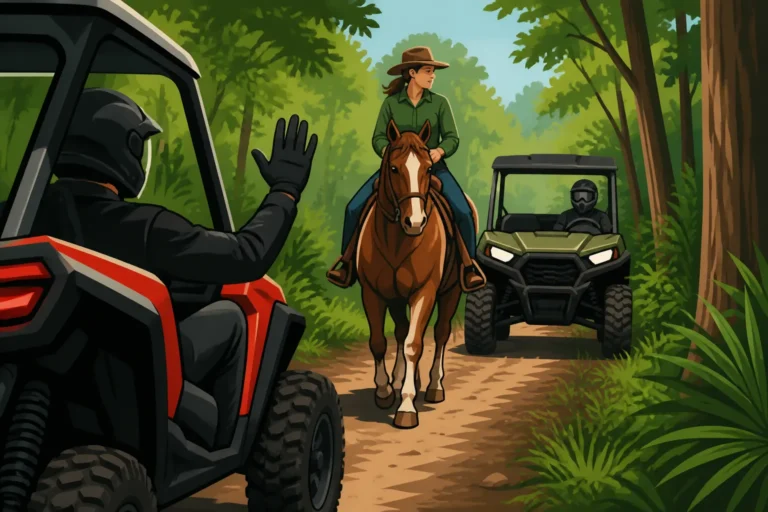
Stay on authorized routes and avoid widening trails around mud holes or obstacles. Riding off the marked path can damage vegetation and create new ruts that make the route harder to maintain. Follow posted speed limits, keep noise reasonable near homes and camps, and give hikers, horses, cyclists, and other trail users space. For more on the habits expected at shared riding areas, see South Carolina Trail Etiquette Locals Expect.
Do not assume an unmarked shortcut is harmless. It may cross a property line, disturb a work site, or lead to a road where your vehicle is not permitted. If a planned route depends on several uncertain links between roads, revise the plan before the ride rather than making access decisions on the trail.
Choose a ride that matches your group
A fun day is not necessarily the longest or most difficult loop. For a first visit, choose a destination with clear access rules and trails suitable for the least experienced rider in the group. A beginner who is trying to keep up with a fast group may take risks, while an advanced rider may become frustrated if the route is too restrictive. Talk through the plan before starting and agree that anyone can ask for a slower pace or a break.
For UTV groups, check trail width and any vehicle-size limits before leaving Waterloo. For ATV groups, consider rider experience, fuel range, and whether young riders need adult supervision or other safety documentation. Carry the gear required for your ride and follow the rules set by the trail manager. If you are unsure whether a machine or rider is eligible, ask before making the trip.
A simple plan usually works best: choose one confirmed destination, identify its staging area, verify access and conditions, and set a reasonable turnaround time. Keep a second destination in mind only if you have also checked its rules. That way, a closure does not leave the group improvising on roads or land where riding may not be allowed.
Plan a reliable ride day
A Waterloo-based ride can be enjoyable when the destination is confirmed and the route to it is treated as travel, not as permission to ride every road along the way. Verify who manages the land, whether your vehicle is allowed, and whether conditions have changed. Then make the trailer, safety, and navigation plans before you leave.
If the information is incomplete, pause and ask the land manager or property owner. Choosing a known riding area may take more planning than turning onto the nearest dirt road, but it protects your day, your machine, and access for other riders. For more trip-planning ideas, browse South Carolina Trail Conditions Before You Haul before the trailer is hitched.
Disclaimer
This article is for general informational purposes only and does not constitute professional advice. Laws, prices and regulations vary by location and change over time. Consult a qualified professional for guidance on your specific situation.