Forty-Four Sites With Water and Power
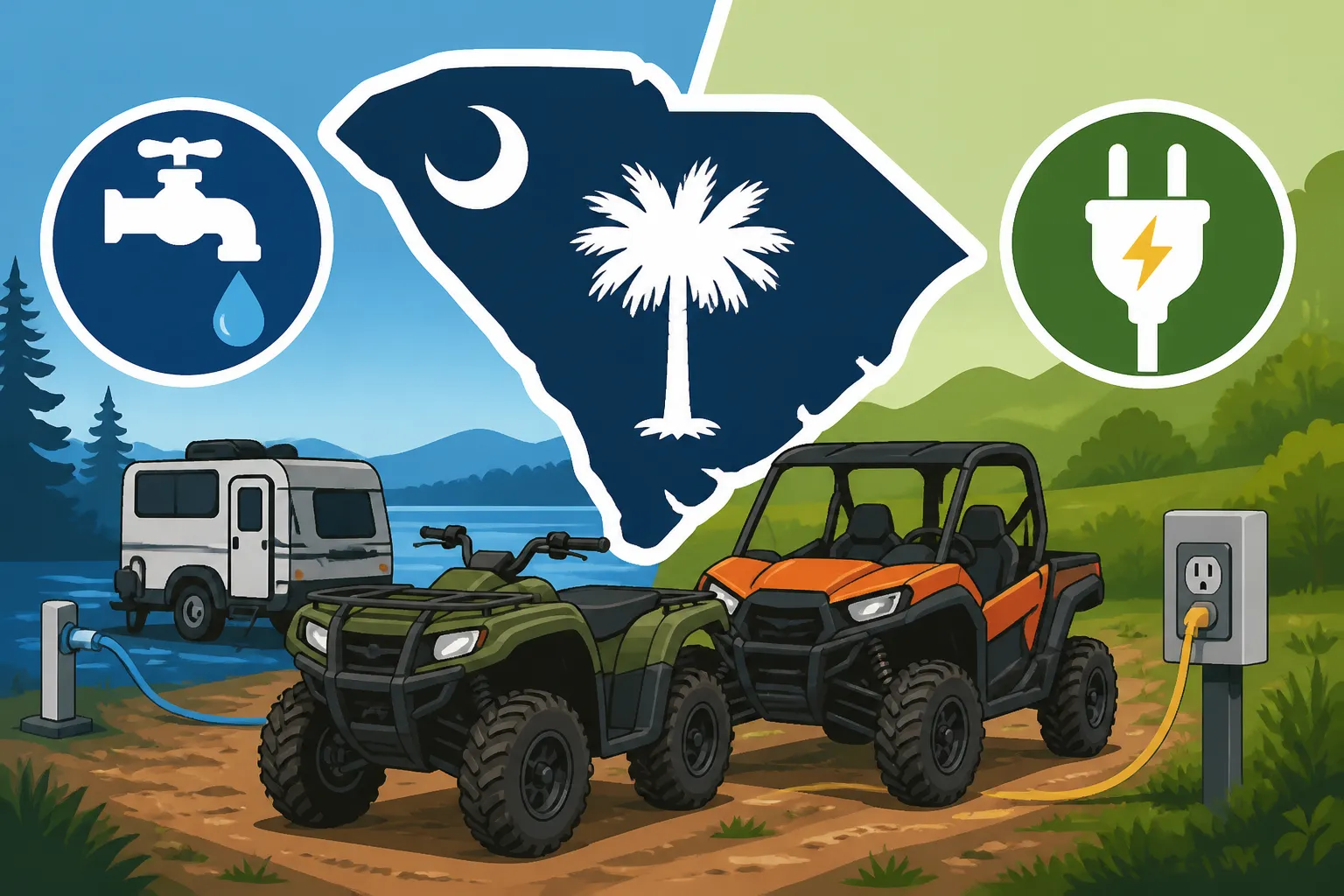
A riding weekend can unravel before the first trail if your campsite cannot handle your rig, your trailer, or a night without reliable power. Carolina Adventure World in Winnsboro offers 44 sites with water and power, giving riders a practical base near the park’s trail system. Here’s what to check before booking and hauling your ATV or UTV.
What the 44 water-and-power sites offer
A campground base beside the riding area
Carolina Adventure World is a private riding park near Winnsboro, South Carolina, known for a large network of trails and off-road routes. Its 44 sites with water and power can suit riders who want to camp close to the activity instead of driving between a distant campground and the trailhead each day. The sites are often a useful middle ground between primitive tent camping and a cabin stay.
Hookups can make a multi-day trip more comfortable, especially if you’re bringing an RV, charging devices, or traveling with family. But the phrase “water and power” doesn’t automatically mean a site includes sewer service, a picnic table, a fire ring, or a particular electrical connection. Check the campground’s current site details before you reserve, and ask about anything your setup depends on.
The park’s scale is another reason to plan the campground and riding details together. You can learn more about the riding footprint in [Carolina Adventure World's 2,600 Acres] and [Carolina Adventure World's 100 Miles]. Those figures can help set expectations, but they don’t replace checking which trails are open to your machine and what the park’s current access rules require.
Who may find a hookup site useful
These sites can be especially handy for riders who are staying more than one night, traveling with children, or bringing a larger setup. If you arrive after a long tow, having a place to park the RV and settle in near the park can take some pressure off the first evening. The next morning is easier when helmets, riding clothes, food, and gear are already organized at camp.
A hookup site may also suit a group where not everyone wants to spend the whole day on the trails. Someone can rest at camp, prepare food, or take a break while others ride, depending on the campground’s rules and the group’s plans. If your party includes both RV campers and tent campers, ask whether the available site types can accommodate the whole group together or nearby.
Still, hookups are only one part of the decision. Think about the length and width of your rig, whether you’re towing a separate trailer, and how you’ll arrange the ATV or UTV once you park. A site that works for a compact camper may feel tight with a large motorhome and a machine trailer, so ask about site dimensions and parking arrangements instead of assuming every site fits every combination.
What to confirm before booking
Before committing, contact the park or check its official booking information for details that can change. Confirm the site’s dimensions, the type of electrical hookup, whether water is provided at each site, and whether sewer service is available. Ask how many vehicles and trailers the reservation accommodates, and whether extra parking is close by or separate.
It’s also worth checking what the reservation includes. A campsite reservation and permission to ride may be handled separately, and the park may have distinct rules for vehicle access, passes, check-in, and trail use. Review [Carolina Adventure World's Vehicle Passes] and [South Carolina Riding Areas That Take Reservations] as part of your preparation, then confirm the current requirements directly with the park.
| What to check | Why it matters |
|---|---|
| Site length and width | Your RV, tow vehicle, and trailer all need room |
| Electrical hookup type | Your rig must be compatible with the available connection |
| Water and sewer details | Water service does not necessarily mean a sewer hookup |
| Parking limits | Extra vehicles or trailers may need a separate space |
| Reservation inclusions | Camping access and riding access may have different requirements |
| Current trail access | The route you want may not suit every machine or be open that day |
| Check-in and quiet rules | Arrival timing and campground expectations affect your plans |
Plan the ride before you tow
Match the route to your machine and group
A large trail network doesn’t mean every route is appropriate for every rider. Before you go, think about the machine’s width, the riders’ experience, and the kind of terrain everyone is comfortable handling. A narrow trail can be a poor fit for a full-size side-by-side, while a route with challenging sections may be stressful for a beginner or young rider.
Ask which trails allow your ATV or UTV and whether the park uses different routes or designations for different vehicle types. Don’t rely on a general trail-mileage total to make that call. The park’s rules, posted signs, and current trail information should guide where you ride. For broader trip ideas, [South Carolina Trails With Camping] can help you compare riding areas where overnight stays are part of the plan.
If your group has mixed experience, agree on a realistic pace before setting off. A more confident rider may be eager to cover distance, while a newer rider may need frequent stops to get comfortable with the machine and terrain. Decide who will lead and who will follow, establish a place to regroup if the party gets separated, and avoid pressuring anyone to ride beyond their ability.
Check conditions and navigation before departure
Trail conditions can shift with rain, maintenance, events, or other park operations. A route that looked straightforward when you planned the trip may be muddy, closed, or unsuitable by arrival. Check directly with the park before leaving and again when you check in. [South Carolina Trail Conditions Before You Haul] is a helpful reminder to make that check part of the towing plan, not something you leave until you reach the gate.
A mapping tool such as onX Offroad can help you think through route planning and keep useful map information available when cell service is unreliable. Before the trip, explore the area and save any information you expect to need offline. Treat the park’s current map, directions, posted signs, and staff guidance as the authority for permitted routes; a general mapping app should not be used to assume a trail is open or legal to ride.
It’s sensible to carry a paper map or a written note of key directions as a backup. Phones can lose signal, batteries can run low, and a map app may not show a temporary closure. If you use onX Offroad, test the map access before loading the trailer, and make sure everyone in the group knows how to find the campground or meeting point without relying on one person’s phone.
Prepare the trailer and riding gear
A smooth weekend starts with a tow vehicle and trailer that are ready for the trip. Check tire pressure, lights, tie-down points, and the trailer’s connection before departure. Make sure each machine is secured properly, with straps in good condition and enough room to load and unload without blocking another vehicle. If you expect to arrive after dark, plan where you can safely stop and handle unloading.
Pack for riding as well as camping. Bring helmets and other protective gear appropriate to the park’s rules, along with water, basic tools, a first-aid kit, and any machine-specific supplies you may need. In warm, humid weather, schedule breaks and keep drinking water close; a day on the trail can feel more demanding than it looks from the campground.
Navigation is useful for organizing a ride, but a group plan matters just as much. Use onX Offroad or another navigation option to review the general area ahead of time, then agree on a route and regroup points that comply with park directions. Tell someone at camp roughly where the group expects to ride and when you plan to return. That simple step helps prevent a small navigation mix-up from becoming an unnecessarily long search.
Make the campsite work for your group
Set up with the trailer and machines in mind
When you arrive, take a moment to look at the site before unloading. Confirm where your RV, tow vehicle, and trailer can sit without blocking the road or neighboring campers. If the space feels too tight for the whole setup, ask park staff about the correct parking arrangement rather than leaving a trailer in an unapproved area.
Keep riding gear and tools organized so that daily departures don’t turn into a hunt for gloves or tie-downs. A simple routine helps: return helmets to one spot, keep keys together, and store muddy gear separately from bedding and food. If you’re traveling with children, establish a clear boundary around parked machines and trailers, and supervise them near moving vehicles.
Campsite comfort also depends on how you use the hookups. Bring the cords, hoses, adapters, and other equipment your setup requires, but confirm compatibility before your trip. Be considerate about cords and hoses crossing walkways or neighboring spaces, and follow the park’s instructions for water and electrical service.
Build in time for check-in, meals, and cleanup
It’s tempting to plan a full day of riding immediately after arrival, especially when you’ve traveled a long way. In practice, check-in, parking, unloading, and getting familiar with the campground can take longer than expected. Consider arriving with enough daylight to get settled without rushing, and save your first ride for after you know where the entrance, meeting point, and return route are.
Meals are easier when you decide ahead of time whether you’ll cook at camp, bring prepared food, or leave the campground for a meal. Keep food stored securely and follow the park’s rules for cooking, fires, and waste. If you return with muddy machines, use only the cleaning or wash areas permitted by the park; don’t assume a water hookup at your site is intended for washing equipment.
Before departure, give yourself time to pack and inspect the campsite. Check for trash, forgotten gear, and any loose items that could shift in the trailer. Look over the machines for obvious damage or leaks, secure the load, and confirm that the trailer lights work before pulling out.
Have a backup plan for changing conditions
Even a carefully planned weekend can change. Rain may affect trail conditions, a machine may need repair, or a campground detail may differ from what you expected. Keep a flexible itinerary and know which activities your group can enjoy if riding time is reduced. If you’re using onX Offroad, remember that it supports your planning; it does not replace checking with park staff about closures, route restrictions, or safety concerns.
If your campsite needs are specific, call ahead rather than arriving with assumptions. That’s especially important for larger RVs, multiple trailers, accessibility needs, or groups hoping to camp close together. A quick conversation can clarify whether the site configuration is suitable and what you need to bring.
The 44 water-and-power sites give riders a convenient camping option near Carolina Adventure World, but a good stay depends on matching your rig to the site and your machine to the permitted trails. Confirm campsite details, riding access, and current conditions before you tow, and keep the park’s directions at the center of your plan.
Disclaimer
This article is for general informational purposes only and does not constitute professional advice. Laws, prices and regulations vary by location and change over time. Consult a qualified professional for guidance on your specific situation.