South Carolina Season Passes Are Per Person
A South Carolina forest season pass can be easy to misunderstand: it may look like a vehicle permit, but it is issued to a person. That distinction matters when friends share a machine, a family rides together, or one owner brings a second ATV. Here’s how to think about who needs a pass, what it covers, and what to check before heading out.
What “per person” means for a South Carolina season pass
A season pass for riding on South Carolina national forest OHV trails is tied to the individual rider, not a particular ATV, UTV, or household. If you buy one, it is for your use. It is not a vehicle pass that everyone in your group can share, and it does not automatically cover another rider who climbs onto your machine.
That distinction is easiest to see in a group. If three people each operate or ride on machines on a trail system that requires a pass, plan for each person who needs trail access to have the required pass. One person’s season pass does not turn into a family pass because the group arrived in one truck or owns one ATV.
A season pass may be useful across multiple trips, but it still belongs to the person named or otherwise identified under the pass rules. The Forest Service’s current purchase and display instructions determine how the pass is issued and what proof you need to carry. Before you buy, read those instructions rather than assuming the pass works like a state vehicle registration or a private park vehicle sticker.
The per-person rule also has a practical consequence: the pass usually follows the rider when that person changes machines. If you ride your own quad one weekend and drive a friend’s UTV on a later trip, your individual pass may still be the relevant pass for you, subject to the current terms. Your friend’s pass, however, does not become yours just because you are using their vehicle.
That is why it helps to keep three separate questions straight:
- Who is riding? A season pass is associated with an individual rider.
- What machine is being used? The machine may have its own trail, width, equipment, or access restrictions.
- Where are you riding? A Forest Service pass does not replace the rules for a private park, a state road, private land, or a wildlife management area.
The pass is a recreation-access requirement, not a license plate, title, insurance policy, or proof that a machine is allowed on every trail. For more on the scope of the forest pass, see South Carolina Passes Cover All Four Trails. If you are still deciding which permit type fits your plans, South Carolina Day and Season Forest Passes explains the basic distinction.
Who needs a pass, and which kind should you choose?
The first step is to identify everyone who will ride, then identify the places you plan to visit. Don’t start with the number of machines in the trailer. A truck carrying two ATVs and four riders is still a four-person planning problem, not simply a two-vehicle one.
A day pass and a season pass serve different trip patterns. A day pass is designed for a limited riding visit, while a season pass is intended for repeated use during its valid period. The exact dates, purchase options, prices, and display rules can change, so check the current official instructions before paying. Do not rely on an old screenshot, a friend’s receipt, or a past season’s details.
| Your situation | What to check | Common mistake |
|---|---|---|
| One person expects to ride several times | Whether an individual season pass covers the planned trips and locations | Assuming it is attached to one ATV |
| Several people ride together | Whether each rider needs a separate pass | Buying one pass for the whole group |
| A rider is borrowing a machine | Whether the rider has their own valid pass and the machine is permitted | Treating the owner’s pass as transferable |
| You are visiting for one outing | Whether a day option is available and how it must be associated with the visit | Assuming a day pass follows the person in the same way as a season pass |
| A child is coming along | Whether the child needs a pass, even if an adult is supervising | Assuming age or passenger status automatically removes the requirement |
| You plan to visit a private riding park | The park’s admission and vehicle rules | Assuming a forest pass covers private-property riding |
For a single rider making several trips, a season option may be simpler than repeating a day purchase. For someone planning just one outing, a day option may be a better fit. But the best choice depends on the trip schedule and the exact validity terms, not just the name of the pass. Check when the season starts and ends, whether it is valid at the specific trail system you plan to use, and whether the same pass format applies to every visitor in your group.
A pass for national forest OHV trails also does not necessarily function as admission to a private park. A private operator can set its own entry fees, age rules, vehicle requirements, and pass conditions. Likewise, a forest pass does not make an ATV street legal or authorize riding on a public road. If your plan includes road use, check the separate rules for that vehicle and route.
Account for children and passengers
Families should settle the pass question before leaving home, especially when a child will ride as an operator or passenger. The answer may depend on how the current pass program defines the person using the trail and the specific age or passenger rules that apply. Don’t assume a child is covered by a parent’s season pass, and don’t assume a child is exempt simply because an adult is present.
Confirm the requirements for each child in your group using the official pass instructions and the trail’s current rules. Do South Carolina Kids Need a Pass? is a useful next read if you are planning a family outing. Separately, remember that a pass does not override age, supervision, helmet, passenger, or machine-size restrictions. Those are safety and access rules of their own.
Keep the pass separate from machine eligibility
A valid pass does not guarantee that your machine can use every route. Some trails have size or vehicle-class limits, and trail conditions or closures can change. A wide side-by-side, a dirt bike, and a youth quad may not have the same access even when their riders have valid passes.
Before hauling, check the current trail information for the specific site, including vehicle-width limits, permitted machine types, closures, and any equipment requirements. A pass addresses access fees; it does not substitute for a trail map or an eligibility check.
How to buy and prepare the pass
Buy through the authorized sales channel named in the official instructions. The reference information for South Carolina forest passes identifies online sales, so don’t expect to settle the matter by putting cash in an old trailhead fee tube or by buying a pass from an unrelated marketplace. The sales method and available pass options can change; confirm them before your trip. See South Carolina Passes Sold Only Online for more on the online purchase process.
Use this simple routine for each rider:
- List everyone who expects to ride. Include adults and children, operators and any passengers whose status needs to be checked.
- Choose the correct pass type for each person. Compare the day and season options against your actual plans.
- Read the official validity and display instructions. Check the covered trail locations, dates, identification details, and whether a printed or digital copy is accepted.
- Complete the purchase for the right rider. Enter information carefully, especially if the pass is tied to an account or individual identity.
- Save proof of purchase. Keep the confirmation where you can retrieve it without relying on a weak signal at the trailhead.
- Prepare the required display. Follow the current instructions for where and how to show the pass.
- Check again before departure. Verify trail status and any temporary changes to access or display rules.
Pay close attention to the information entered during purchase. A small mistake in a name, account, or other identifying detail can make it harder to show that a pass belongs to the rider standing at the checkpoint. If you notice an error, contact the official seller or program support before the ride rather than hoping an officer or ranger will be able to sort it out at the gate.
You can keep a digital confirmation on your phone, but it is sensible to have a backup. Forest roads and trailheads may have limited or no cellular service. Save the pass information for offline viewing, and, if the official instructions call for a printed copy, print it before leaving. A screenshot is not a substitute for the required pass format if the rules specify a different form.
A clear document sleeve can help protect a paper pass from mud or rain. If you shop for one through Amazon or another retailer, treat the sleeve as storage only: the retailer is not issuing your forest pass. The pass itself must come through the authorized channel and meet the official requirements.
It is also worth keeping each person’s pass records separate. If multiple riders use one household account, make sure each purchase is assigned or documented as the program requires. A single email receipt showing several charges may not, by itself, make it obvious which rider holds which pass. Save each confirmation in a way that is easy to match to the right person.
Sharing machines, making repeat trips, and displaying proof
The most common source of confusion is the difference between sharing a machine and sharing a pass. Several riders can take turns on one ATV, but that does not necessarily mean they can take turns using one person’s season pass. If the pass is individual and non-transferable, the person riding must have their own valid pass when required.
The reverse is also important: a season pass issued to one rider should not be treated as a permit for every machine that rider owns. The pass may follow the person, but machine eligibility and other trail conditions still apply. If you bring two machines on separate trips, ask whether the current pass program has any machine-specific conditions and follow the display requirements for each visit.
The distinction is summarized in South Carolina Passes Are Non-Transferable. A simple test helps: if the person who bought the pass is not the person riding, do not assume the pass can be handed over. If the person who bought the pass is riding a different eligible machine, do not assume the pass has become invalid solely because the machine changed. In both cases, the written current rules are what matter.
When a rider uses more than one machine
A season pass is attractive for riders who use different machines over the course of a season. But don’t infer from “per person” that every machine is automatically acceptable. Before taking a second machine, confirm that it is permitted on the intended trail and that the program does not require a particular display or vehicle association.
If you keep multiple machines, a practical approach is to store the pass with your riding documents and check the display instructions each time you load. Keep the machine’s own paperwork, any required equipment, and the pass proof in separate, easy-to-find places. This avoids a common trailhead scramble in which the rider has a valid pass but cannot produce it in the expected form.
For a trip where a different family member rides the second machine, treat that family member as a separate rider for pass planning. Household ownership does not make an individual pass transferable. If you want a more specific answer about a second vehicle, see [South Carolina Pass for a Second Machine].
Display and proof are not the same question
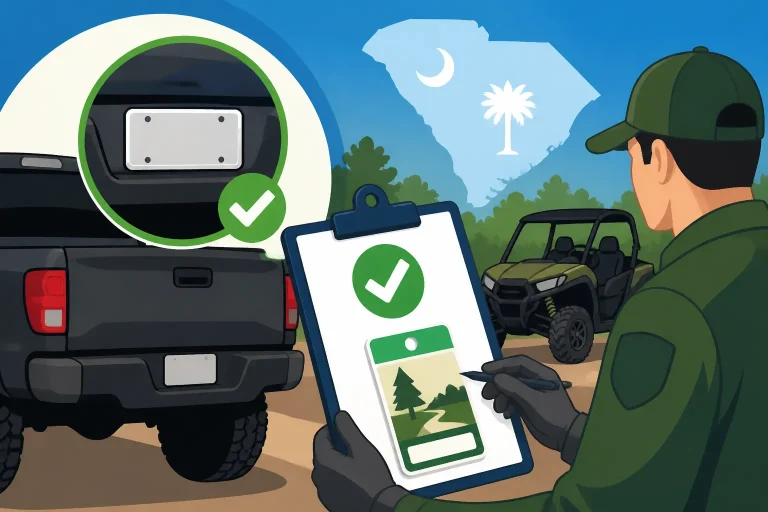
A rider may have purchased a valid pass and still run into trouble if it is not displayed or available as required. The official instructions determine whether proof belongs on the tow vehicle, in a particular location, or in another format. Don’t assume a photo on a phone is enough, and don’t assume that a printed pass should be attached to the ATV unless the directions say so.
Annual and day passes may have different display arrangements. The listed guidance for annual passes refers to display in a tow vehicle, while day-pass instructions may connect the purchase to a vehicle plate. Those details are not interchangeable. Follow the instructions for the specific pass you purchased. For more on the annual display requirement, see South Carolina Annual Passes Displayed in a Tow Vehicle. For the day-pass arrangement, see South Carolina Day Passes Tied to a Plate.
If you are carrying paper proof, protect it from water and keep it visible where the official directions require. A document sleeve from Amazon can keep a printed page from getting soaked in a truck cab, but it does not change where the pass must be placed. If the requirement is to display it in a designated spot, a sleeve tucked into a backpack will not meet that requirement.
A phone is a useful backup, not always a dependable primary plan. Batteries run down, screens crack, and service can disappear in the forest. Before you leave, download or save the confirmation if possible, fully charge the phone, and carry a printed copy when the program calls for one. If you use a clear holder bought through Amazon for the paper copy, make sure it does not obscure required information such as a code or identifying details.
Common mistakes and a pre-ride checklist
Most pass problems are avoidable. They happen when riders assume a pass is attached to a household or vehicle, use an old pass format, or wait until they reach a trailhead to learn that the purchase must be completed online.
Watch for these mistakes:
- Buying one pass for a whole group. If the season pass is per person, each rider who needs one must have their own.
- Lending your pass to a friend. An individual pass is not a general-use family or club permit.
- Confusing forest access with private park admission. Private parks set their own requirements.
- Assuming the pass makes a machine eligible. Width, type, equipment, and closures still matter.
- Relying on a screenshot without checking the rules. The required proof may need to be printed or displayed in a specific way.
- Waiting until arrival to purchase. Online-only sales and limited connectivity can leave you unable to complete the transaction at the trail.
- Treating a day pass like a season pass. The two may use different identification and display rules.
- Assuming a parent’s pass covers a child. Check the rule for each person, including young riders and passengers.
- Keeping only one person’s confirmation for a group. Save clear proof for each pass holder.
A final check before loading the trailer can be brief:
- Identify every person who will ride.
- Confirm each person’s required pass and validity dates.
- Match each pass to the correct individual.
- Check the trail’s current vehicle and closure information.
- Follow the correct display instructions for the pass type.
- Save the confirmation offline and print it if required.
- Bring identification or other supporting information if the official instructions call for it.
- Keep the pass proof accessible without relying on cell service.
For riders who travel to different South Carolina forest trails, don’t assume that a pass purchase settles every question about the site. Check the specific trail before each trip, especially after heavy rain, maintenance work, or a seasonal change. The pass may be valid while the trail itself is closed, or the trail may be open only to certain machine types.
If you ride only once, compare the day option with the season option and read the conditions carefully. If you expect to go repeatedly, a season pass can reduce repeated purchase steps, but it does not remove the need to check trail access or carry proof. In either case, the key is simple: the pass belongs to the rider, while the machine and the trail each have their own requirements.
Disclaimer
This article is for general informational purposes only and does not constitute professional advice. Laws, prices and regulations vary by location and change over time. Consult a qualified professional for guidance on your specific situation.