Where to Stage a Big Carolina Group
A large ride can unravel before the first trail begins: trailers arrive together, the parking area fills, and riders who expected to meet at the trailhead discover there is nowhere safe to turn around. This guide compares practical staging options around South Carolina, explains how to organize a big group, and helps you choose a meeting point that fits your machines, trailers, and ride plan.
Choose a staging area that fits the whole convoy
Private riding parks are often easiest for large groups
If your group includes several trucks, trailers, side-by-sides, and riders who have never met, a private riding park is often the simplest starting point. Parks such as Carolina Adventure World near Winnsboro and Gulches ORV Park near Waterloo are established riding destinations, rather than small forest trailheads. That generally makes them more natural places to ask about group arrival logistics, parking, camping, and access to multiple riding areas.
Still, “private park” does not automatically mean “unlimited parking” or “space for a big event.” Before you announce a meetup, contact the park and explain the size of your group, how many tow vehicles and trailers you expect, what types of machines you’re bringing, and whether you plan to camp. Ask where the group should check in and whether everyone needs to arrive together. If the park requires separate waivers, passes, or vehicle check-in, build that into your arrival plan rather than letting a line form at the entrance.
A larger destination can also give a group more flexibility if riders have different abilities. Some may want a relaxed warm-up while others prefer more challenging terrain. Review the park’s current trail information and rules with the group before the ride; don’t assume all trails are appropriate for every machine. For details about terrain and planning at the Winnsboro-area destination, see Carolina Adventure World’s 100 Miles of Trail. For a group considering the Waterloo area, Gulches ORV Park Is Built for Full-Size Rigs offers useful context about the park’s riding focus.
Public forest trailheads need a more conservative plan
Public OHV trailheads in the Sumter National Forest can be excellent starting points, but a small trailhead parking area is not a good place to improvise a large convoy. Enoree OHV Trail near Whitmire and Parsons Mountain OHV Trail near Abbeville are examples of public riding areas where you should check access details, current operating information, and parking suitability before inviting a large group. A trail that works smoothly for two trucks may become difficult when a dozen arrive at once.
Do not treat a nearby road shoulder, gate entrance, or turnout as overflow parking. A vehicle left in the wrong place can block other visitors, interfere with emergency access, or create a hazard for people towing trailers. If the official staging area cannot comfortably handle your expected vehicle count, split the group into scheduled arrival waves or choose a more suitable location. The practical guide South Carolina Trailheads With Trailer Parking can help you think through trailer access, while South Carolina’s Four National Forest Trails gives broader context for public-forest riding options.
| Staging option | Best fit | Main planning concern |
|---|---|---|
| Private riding park | Large groups, mixed machine types, or a full-day gathering | Confirm group arrangements, parking, entry requirements, and camping directly with the park |
| Public forest trailhead | Smaller, coordinated groups familiar with the area | Verify trail access, parking space, and current conditions before departure |
| Off-site meeting point | Convoys that need to gather before entering a riding area | Get permission to use the lot and avoid blocking customers, traffic, or private access |
| Split arrival waves | Groups too large for one orderly arrival | Assign a lead rider and clear arrival times for each wave |
South Carolina staging options to consider
Carolina Adventure World near Winnsboro
Carolina Adventure World can make sense when your group wants a destination with a broad riding setup rather than a short trailhead visit. Its location near Winnsboro may also work for riders coming from different parts of the state, depending on where the group is traveling from. The key advantage of choosing a destination designed for recreational riding is that you can ask the people managing the property how to handle a group, instead of trying to fit a large gathering into a public lot that was not arranged for it.
Call or check the park’s official information before setting a date. Ask about the best entrance and arrival window, whether group members can check in individually, what parking is available for tow vehicles and trailers, and whether reservations are needed for camping or other facilities. Get specific about your headcount: “twenty riders” may mean ten trucks, while “twenty machines” may mean a much larger convoy. Ask whether there are restrictions for your machine type and whether the trails you plan to use suit the least-experienced riders in the group.
A private park can also help reduce the pressure to keep every rider on the same pace. You can set a central meeting point, establish check-in times, and regroup without expecting every participant to navigate a remote forest road at once. Even so, the group should agree on a route and a return time before heading out. If several people are unfamiliar with the property, use the park’s own map and rules as the source of truth; a third-party mapping app such as onX Offroad can help riders orient themselves, but it should not replace posted signs or park instructions.
Gulches and other private riding areas
Gulches ORV Park near Waterloo is another option to investigate if your group includes full-size off-road vehicles or riders looking for a different terrain experience. As with any private area, the important question is not simply whether the park accommodates your machine. It is whether the planned arrival, parking, and ride format work for the group you actually have. A club outing, family gathering, and informal convoy can each need a different arrangement.
Before committing, confirm which machines are allowed, how the park handles admission and check-in, and whether camping or overnight parking is available for your dates. Ask whether you need to reserve anything in advance and what happens if weather affects the ride. Be especially clear about the size of your vehicles and trailers. A side-by-side and its tow rig take up very different amounts of space, and a group can underestimate its footprint when it counts riders instead of trucks.
If you’re comparing several private areas, make a short checklist and give each location the same information. Include your approximate arrival window, number of tow vehicles, number and type of machines, expected overnight needs, and whether any riders are minors or beginners. That makes it easier to compare answers and prevents the group from planning around assumptions. For broader advice on coordinating people and machines, see South Carolina Group Ride Planning and South Carolina Trail Etiquette Locals Expect.
Make the arrival and meetup work smoothly
Count vehicles, trailers, and machines separately
The most common planning mistake is counting people but not the equipment they bring. A group of fifteen riders might arrive in five trucks, or in fifteen separate trucks. Those are entirely different parking problems. Before choosing a staging area, ask every participant whether they are towing, riding in someone else’s vehicle, or arriving without a trailer. Then make three rough totals: tow vehicles, trailers, and machines.
Ask one person to collect the information and keep a shared list. For example, if several riders are meeting in the Columbia area before continuing to a trail, arrange the cars into a few planned vehicles instead of letting everyone drive separately. If people are coming from Charleston, Greenville, or the Upstate, a second meeting point may be more sensible than sending every vehicle to a single location. Do not use a business parking lot as a staging area unless you have permission. A convenient-looking lot can be busy, privately managed, or unsuitable for trailers.
For public trailheads, compare your group’s total footprint with the actual space available rather than relying on a map pin or an old social media photo. Look for a safe way to enter, park, unload, turn around, and leave without blocking other visitors. If you cannot establish that the lot will work, choose another option or divide the group into smaller waves. South Carolina Trail Etiquette Locals Expect is relevant here: being considerate begins in the parking area, not only on the trail.
Set a meeting point and a backup plan
A good meetup plan names one primary location, one arrival window, and one backup. Send the address or map pin well ahead of time, along with instructions about where to park and who to contact if someone is delayed. If the official trailhead has limited space, designate an alternate location only when you have permission to use it and know that trailers can safely enter and exit.
Give the group a cutoff time for leaving the staging area. Without one, the earliest arrivals may sit for an hour while everyone else navigates unfamiliar roads. Consider a lead vehicle and a sweep rider, especially when the group includes people who have not ridden together. The lead rider should know the intended route, and the sweep rider should be able to help if someone stops or falls behind. Agree in advance on where the group will regroup if riders become separated.
For navigation, onX Offroad may be useful for reviewing routes and sharing a general plan among riders. Download or prepare the information you need before entering an area where cellular service may be unreliable. Carry a backup plan as well, such as a printed map or written directions to the staging location. A phone map is a helpful tool, but it should not be the only way a rider can find the group or return to the parking area. More practical guidance is available in Carrying a Paper Map in a Carolina Forest and Cell Dead Zones in a Carolina Forest.
Check access, safety, and ride-day conditions
Confirm trail rules and current access before traveling
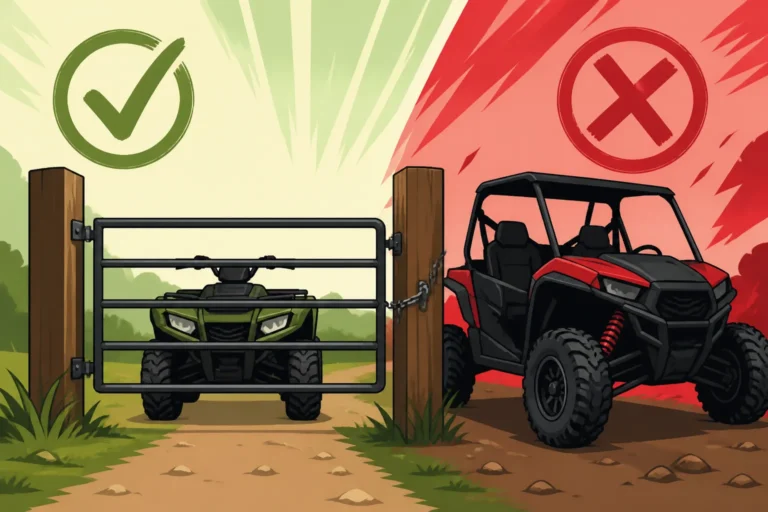
A staging location is only useful if the riding area is open to your machines and suitable for the group. Confirm the trail’s current status, access rules, vehicle limitations, and any pass or permit requirements before you haul. Public forest trails and private parks do not necessarily follow the same rules, and an area that welcomes one type of off-road machine may not allow another. Do not assume a side-by-side can use a trail just because ATVs or motorcycles can.
Conditions can also change the practical size of your ride. Heavy rain may make some routes muddy or lead to temporary closures, while a busy weekend can make a small parking area harder to use. Check the relevant land manager or park before setting out, and have an alternate destination if the original plan no longer works. If your ride includes a public forest trail, South Carolina Trail Closures After Rain and South Carolina Wet Weather Trail Closures provide useful planning context.
Make sure the group understands that a map route is not permission to ride everywhere. Stay on authorized routes, follow signs, and respect gates and private property. If you’re unfamiliar with local access, verify it rather than relying on a line drawn in a mapping app. onX Offroad can support route planning, but riders should still follow the land manager’s instructions and use posted information to confirm where riding is permitted.
Keep the group together without blocking everyone else
Before unloading, choose a spot where riders can gather without crowding the entrance or preventing other visitors from parking. Keep trailers, ramps, and machines within the designated area. If the lot is busy, unload efficiently and move vehicles only where parking is allowed. A staging area is shared space; arriving early does not give one group the right to occupy every convenient spot.
Give the group a short safety and logistics briefing before starting. Confirm who is leading, who is riding sweep, what to do if someone has a mechanical problem, and where the group will meet if separated. Match the pace to the least experienced rider, not the fastest machine. If riders want different levels of difficulty, divide into smaller groups with clear meeting times rather than letting faster riders disappear down the trail.
Finally, leave room for the next group. Pack out trash, secure loose equipment, and avoid prolonged idling near other visitors. If you have organized a particularly large gathering, ask the park or land manager whether a special arrangement is needed rather than treating a public trailhead as an event venue. Good planning makes the ride easier for your group and more considerate for everyone else who came to enjoy the trails.
Disclaimer
This article is for general informational purposes only and does not constitute professional advice. Laws, prices and regulations vary by location and change over time. Consult a qualified professional for guidance on your specific situation.