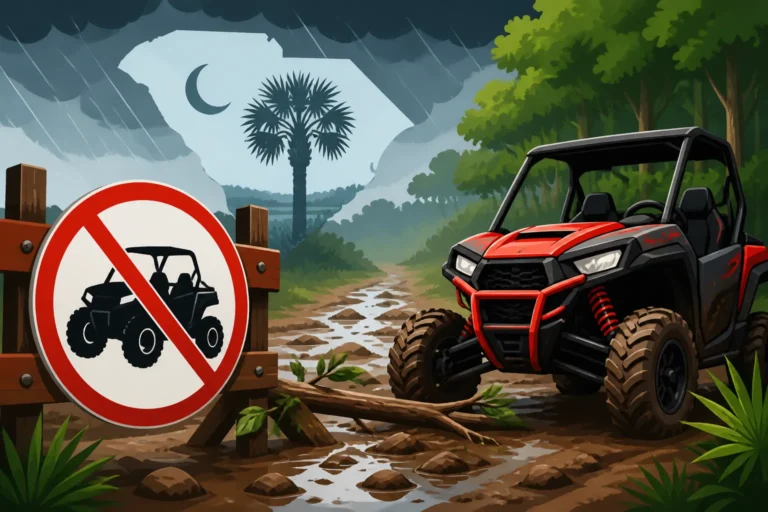
Riding Out of Whitmire
Leaving Whitmire with an ATV or UTV can feel straightforward until you reach a forest road and realize it may not be an open riding trail. This guide explains how to plan a legal ride near Whitmire, what to check before heading toward the Enoree OHV Trail, and how to avoid common problems with machine width, passes, weather, parking, and navigation.
Where to ride near Whitmire
Start with the Enoree OHV Trail
Whitmire, in Newberry County, is a practical starting point for exploring riding opportunities in the Enoree area of Sumter National Forest. The Enoree OHV Trail is the key nearby destination to investigate, but do not assume that every dirt road or forest track between town and the trail is open to off-highway vehicles. A route that looks rideable on a phone map may be a forest road, a closed track, private property, or a road with restrictions.
Before you load up, check the official trail information for the trail’s current operating status, permitted vehicle types, access directions, and pass requirements. Trail access and rules can differ from one riding area to another, so general knowledge of South Carolina riding rules is not enough to confirm that a particular route is open. For a closer look at the area, see Enoree OHV Trail in South Carolina and South Carolina’s Four National Forest Trails.
It also helps to think of Whitmire as a convenient base rather than a guarantee of door-to-trail riding. You may need to tow your machine to a designated trailhead and ride only on signed, approved routes. Don’t unload at an informal pull-off just because it seems close to a trail. A legal staging area makes it easier to park without blocking traffic, unload safely, and begin your ride where vehicle use is allowed.
Check what kind of machine the trail allows
A trail’s name or location does not tell you whether it accommodates your particular machine. Some forest OHV trails have a width limit that rules out many side-by-sides, even when those machines are legal and registered for other kinds of travel. Measure your machine at its widest point, including accessories, and check the official trail restrictions before you go. The details in South Carolina’s 50-Inch Trail Width Limit can help you understand why width matters.
| Before you leave Whitmire | What to confirm | Why it matters |
|---|---|---|
| Machine type | Whether ATVs, UTVs, motorcycles, or other vehicles are allowed | A trail may be limited to certain vehicle classes |
| Width | The posted maximum and how your machine measures | A side-by-side may be too wide for a narrow trail |
| Trail status | Whether the route is open and operating | Weather, maintenance, or other conditions can prompt closures |
| Pass or permit | Whether you need one and how it must be displayed | Requirements may apply even when access appears unattended |
| Staging | Where trailers and tow vehicles may park | Informal parking can block access or create a safety issue |
| Navigation | A current map plus a backup | Forest roads and cell coverage can be confusing or limited |
This check is especially important if your group is bringing a mix of machines. A narrow ATV might fit a route that a wider UTV cannot use. If the group discovers the mismatch at the trailhead, the options are unpleasant: split up, change plans, or turn around after towing all the way from Whitmire. Review South Carolina Trails That Allow Side-by-Sides when comparing destinations for a UTV.
Plan the trip before you haul
Confirm access, passes, and trail conditions
A little checking before departure can prevent a frustrating drive with a loaded trailer. Look for current information from the land manager about closures, trail conditions, vehicle rules, and passes. Don’t rely only on an old social media post, a map pin, or a friend’s memory of a ride from a previous season. Forest roads may be open to ordinary travel while a specific OHV trail is closed, or a trail may be open only under certain conditions.
South Carolina National Forest OHV areas can have pass requirements. Confirm which pass applies to your riding plan, who needs one, and whether it must be carried or displayed in a particular way. A pass for one location or person may not automatically cover a different rider or a different type of access. See South Carolina National Forest OHV Passes and South Carolina Passes Are Non-Transferable before assuming a pass from another trip will do.
Weather deserves a separate check. Heavy rain can make trails muddy, damage surfaces, or lead to temporary closures. South Carolina clay can be slick when wet, and a route that felt easy in dry weather may become harder to control after a downpour. If conditions are questionable, check for an official closure rather than trying to judge from a forecast alone. The practical guidance in South Carolina Trail Conditions Before You Haul and South Carolina Trail Closures After Rain is useful when deciding whether to go.
Map the route and prepare for weak cell service
Navigation matters even on a relatively short ride. Forest roads can intersect, names may not be obvious on the ground, and a wrong turn can take you away from the designated trail system. Use a current map, note the route to the staging area, and save the information you need before leaving an area with reliable service. onX Offroad can be one option for reviewing routes and saving navigation details, but compare any app information with official forest maps and posted signs.
Do not make a phone app your only navigation plan. Download or otherwise save the map for offline use if your chosen tool supports it, bring a charged phone, and consider carrying a paper map as a backup. Even when a map shows a road, that does not mean motorized riding is permitted there. Treat signs and land-manager directions as more authoritative than an unverified route line. For more on planning around signal gaps, see Cell Dead Zones in a Carolina Forest and Carrying a Paper Map in a Carolina Forest.
Give someone who is not riding with you a basic plan: where you intend to stage, which trail area you expect to use, and when you plan to check in. This is a simple precaution for any remote outing, especially when a group may separate or a machine breaks down. Keep your route conservative if you are unfamiliar with the area. A map app such as onX Offroad may help you stay oriented, but it cannot replace a clear turnaround plan or awareness of posted restrictions.
Ride legally and safely in the forest
Stay on designated routes and respect access boundaries
Being in a national forest does not mean you can ride anywhere within its boundaries. Stay on routes designated for your vehicle and obey closure signs, gates, and posted restrictions. Don’t cross private property or use an unsigned track as a shortcut. A route that appears on an app may not be an approved OHV trail, so check the map and signs together rather than relying on either one in isolation.
Wildlife management areas are not a fallback riding option simply because they have dirt roads or open-looking land. South Carolina restricts ATV use in WMAs, and hunting access does not automatically create permission to ride. Likewise, permission to ride on private land needs to come from the landowner or an authorized manager. If a route leaves a designated trail system, stop and verify access instead of assuming the next section is open.
Good trail etiquette helps protect access for everyone. Slow down near other riders, hikers, horse users, and trailhead areas. Avoid spinning tires, cutting corners, or widening muddy sections around puddles. If you meet a group on a narrow trail, ease off the throttle and pass carefully when there is room. More practical reminders are in South Carolina Trail Etiquette Locals Expect.
Match your preparation to the ride
Before unloading, walk around the machine and check the tires, brakes, lights, fuel, and basic controls. Bring water, a first-aid kit, a tool kit suited to your machine, and a way to contact your group if riders get separated. Wear a helmet and protective gear appropriate to the vehicle and conditions. For a UTV, make sure every occupant has a proper seat and uses the machine’s safety equipment as intended.
In a group, agree on a few simple rules before starting: who leads, who rides last, where to regroup, and what to do if someone takes a wrong turn. Keep the pace comfortable for the least experienced rider, and don’t pressure anyone to attempt an obstacle they are unsure about. On an unfamiliar trail, turning around is a sensible choice—not a failure.
Use onX Offroad or another navigation option as a planning aid, not as permission to ride. If the map and a sign appear to disagree, stop and resolve the conflict before continuing. Keep an offline map or paper backup available, and make sure at least one other rider knows how to use it. That small bit of preparation is far more useful than trying to find a signal after the group has already become separated.
Make Whitmire your base, not your only plan
Build a flexible day around the trail
A good riding day starts with realistic expectations. Allow time to reach the trailhead, unload, review the rules, and get everyone ready before riding. If the trail is closed or the staging area is full, have a backup destination that you have already checked for machine eligibility, access rules, and pass requirements. Do not improvise by riding an unmarked forest road or entering nearby land without permission.
Before setting out, make sure your tow vehicle and trailer can park without blocking the staging area or a gate. Keep the unloading zone clear, secure loose gear, and avoid leaving valuables visible. If you arrive and find that the site is crowded, wait for a safe opening rather than unloading in a travel lane. The planning tips in South Carolina Trailheads With Trailer Parking can help you think through the practical side of getting a machine to the trail.
Keep an eye on changing conditions during the day. If rain starts, visibility drops, or a trail becomes difficult to navigate, head back toward the staging area rather than pushing on. Check that everyone has enough fuel and water for the return trip, and regroup before leaving the trail system. If your group is unfamiliar with the area, set a clear meeting point in advance in case riders become separated.
Use nearby riding guides to compare alternatives
The Enoree area is a natural first place to investigate from Whitmire, but it may not suit every machine or every group. A wide side-by-side, a new rider, or a group looking for a different style of terrain may need another destination. Compare permitted vehicle types, trail difficulty, facilities, and current access information before choosing. South Carolina ATV Trails: Where to Ride is a useful starting point for weighing options around the state.
If you are considering a different forest trail or private riding area, treat it as a fresh trip plan. Confirm its rules directly instead of assuming that a pass, machine setup, or riding habit that works near Whitmire will apply elsewhere. Check whether reservations, separate fees, camping arrangements, or different equipment restrictions are involved. The most reliable ride is usually the one where the group knows the rules before leaving home.
For a Whitmire outing, the key is to pair local knowledge with current trail information: confirm that the Enoree route is open, verify that your machine is allowed, arrange proper staging, and carry a backup map. That approach helps turn a vague plan to “ride near town” into a safer, more predictable day on a designated trail.
Disclaimer
This article is for general informational purposes only and does not constitute professional advice. Laws, prices and regulations vary by location and change over time. Consult a qualified professional for guidance on your specific situation.