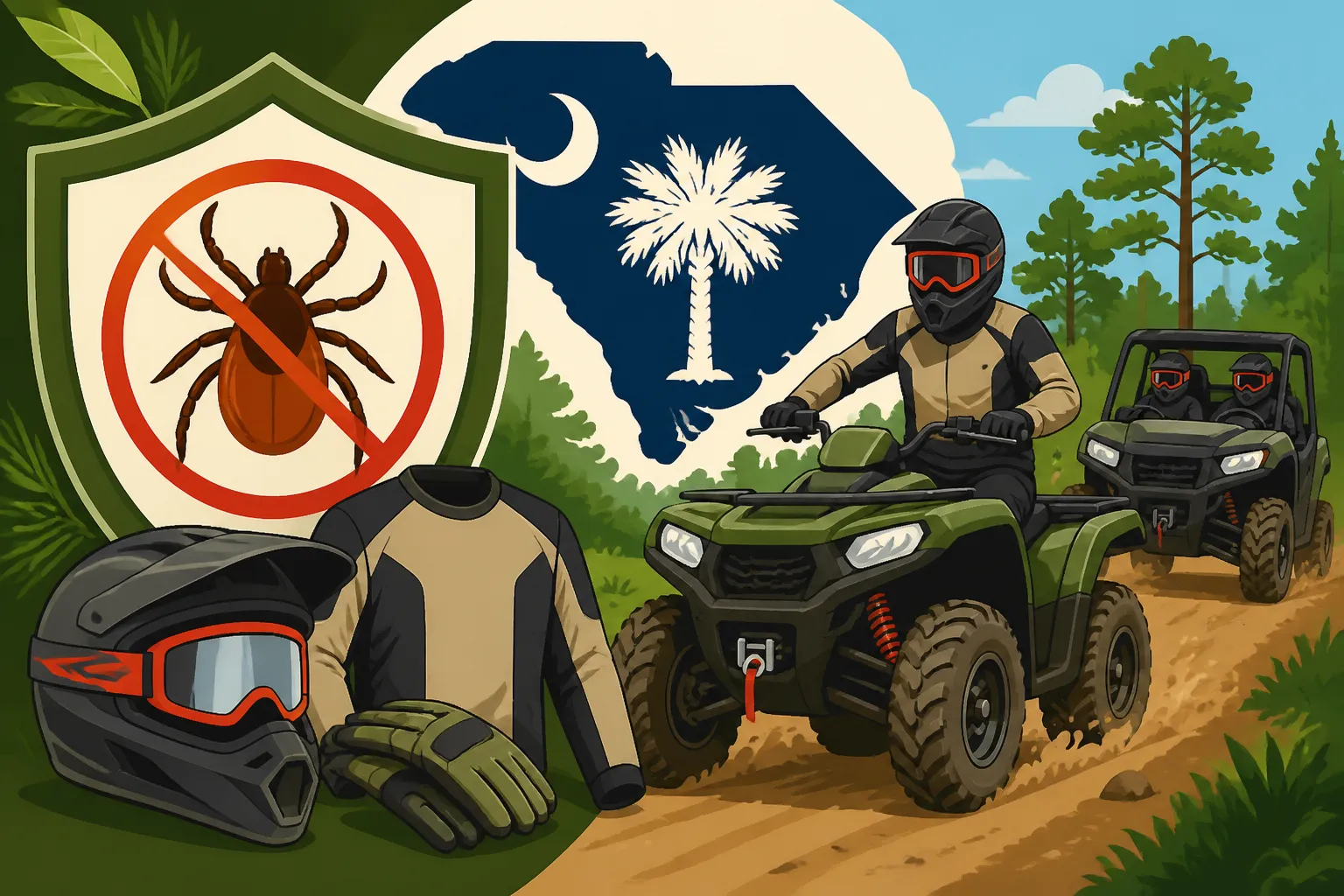
South Carolina Tick Season and Riding Gear
South Carolina riders can pick up ticks while pushing through brush, stopping beside a trail, or unloading a quad at the trailhead. The risk is not limited to deep summer, and ordinary riding clothes can leave gaps around cuffs, waistbands, and collars. This guide explains when ticks are active, what to wear, how to check yourself and your gear, and what to do after a bite.
When South Carolina riders are most likely to encounter ticks
Tick activity changes with weather, not just the calendar
Ticks can be active across much of the year in South Carolina, especially when temperatures are mild. Warm, humid conditions help make outdoor encounters more likely, but a cool morning does not guarantee a tick-free ride. Spring and summer are often especially busy periods, while fall rides can still bring exposure in leaf litter and brush. Mild winter days may also catch riders off guard.
The practical takeaway is to treat tick checks as part of every ride rather than a seasonal chore. If you ride in the Sumter National Forest, near the Francis Marion National Forest, or on a private trail system bordered by woods, tall grass, or leaf-covered ground, prepare for ticks even if the route itself looks open. The same is true when you step off the trail to take a break or help another rider.
The changing conditions of the year affect other parts of a ride, too. If you are adjusting your clothing for [South Carolina Riding in Spring] or [South Carolina Riding in Summer], keep tick protection in the plan alongside heat management and hydration. During warmer months, lightweight, breathable clothing can cover more skin without making a ride miserable.
Habitats matter as much as the month
Ticks are commonly found in wooded edges, tall grass, brush, and leaf litter. A trail can be relatively clear in the center but lined with vegetation that brushes against your legs or sleeves. Exposure can happen while walking around a stuck machine, taking a break at the edge of a trail, or reaching into brush to retrieve a dropped item.
That is why a short stop can create more exposure than the ride itself. A rider who stays on a well-used trail may still brush past vegetation while parking, checking a map, or helping a friend. When possible, stop in a clear, open spot rather than sitting in tall grass or leaning against brush. Keep jackets, helmets, gloves, and bags off the ground when you can.
Trail conditions and access deserve attention before leaving home. [South Carolina ATV Trails: Where to Ride] can help you think through where you plan to go, while [South Carolina Trail Closures After Rain] is a useful reminder that route conditions and access can change. An app such as onX Offroad may help with route planning, but a map is not a substitute for posted rules, landowner permission, or checking current trail access.
What to wear for tick protection on an ATV or UTV ride
Cover the places ticks can reach
Clothing works best when it reduces exposed skin and closes the gaps where ticks can crawl. Lightweight long pants, long sleeves, tall socks, and closed-toe boots offer more coverage than shorts and low-cut shoes. Tuck pant cuffs into socks or boots, and close sleeve cuffs when the trail becomes brushy. A neck gaiter can help protect the collar area, but it should not interfere with safe helmet fit or visibility.
Light-colored clothing can make ticks easier to spot during a quick check. It does not repel them, but noticing one crawling on a sleeve gives you a chance to remove it before it reaches skin. Choose fabrics that are comfortable enough to keep on: riders who overheat or feel restricted are more likely to roll sleeves up or leave cuffs open.
For an ATV ride, clothing often needs to handle dust, mud, and movement as well as tick exposure. On a UTV, riders may feel sheltered inside the cab and loosen layers, but ticks can still be picked up while getting in and out, walking around the machine, or helping with a recovery. The routine matters for every rider, not only the person driving.
Use repellents and treated clothing carefully
Some people use an insect repellent on exposed skin and clothing treated with a product labeled for that purpose. Follow the product label closely: application directions vary, and a product intended for clothing should not automatically be used on skin. In particular, permethrin-treated clothing products are for clothing and gear, not for applying directly to the body. Keep treated items away from pets until they are dry if the label directs you to do so.
Repellent is an extra layer, not a replacement for coverage or checks. Apply skin products only as directed, avoid eyes and mouth, and take particular care when applying repellent to children. If you are unsure which product is suitable for a child, or how to use it safely, ask a healthcare professional or pharmacist.
Heat and humidity make this balance tricky. Riders planning [South Carolina Riding in Fall] may be comfortable in longer layers, while a humid summer ride can make heavy clothing feel unbearable. Lightweight fabrics, ventilation, and planned water breaks can help; [Packing for Carolina Humidity] has related preparation ideas. Adjust layers before entering brush rather than waiting until you are already in it.
| Riding situation | Practical clothing choice | Extra check to make |
|---|---|---|
| Open trail with little brush | Long pants, closed shoes, and socks | Check cuffs and waistband after breaks |
| Brushy or overgrown section | Long sleeves, tucked cuffs, and tall boots or gaiters | Look over sleeves and lower legs as soon as you clear the brush |
| Hot, humid day | Lightweight, breathable coverage and scheduled water breaks | Check exposed areas where clothing shifts |
| UTV ride with frequent stops | Keep long layers on when leaving the cab | Inspect seats, floor mats, and bags before packing up |
How to check for ticks during and after a ride
Do quick checks at sensible stopping points
A tick check does not need to interrupt every mile. Make it part of natural pauses: after a brushy section, before lunch, or when you reach the staging area. Look over exposed skin and clothing, especially around socks, boot tops, cuffs, and the waist. If you spot a tick crawling on clothing, remove it carefully and check nearby areas before carrying on.
Buddy checks can help with places that are difficult to see alone, such as the back of the neck and shoulders. Ask first and keep the check matter-of-fact. Riders who are uncomfortable with a full check can inspect clothing and use a mirror or phone camera for hard-to-see areas. Parents should help children check thoroughly after a ride rather than relying on a quick look at the arms and legs.
Make the same routine part of your broader trail preparation. [First Aid on a Long Carolina Loop] offers related thinking for handling minor problems away from home, and [Bug Spray in a Carolina June] covers another common warm-weather nuisance. A small first-aid kit can include fine-tipped tweezers and a sealable container or bag, but it should not take the place of a proper body check.
Check your body, clothing, and riding gear
After returning to the truck or camp, check your body from head to toe. Pay attention to the hairline and scalp, behind the ears, around the neck, under the arms, at the waist, around the navel, behind the knees, and between the legs. These areas can be easy to miss when you are tired and eager to get home. A shower soon after the ride can help you spot ticks that are still crawling, but it does not replace a careful check.
Inspect clothing before bringing it into the house, especially if it brushed against vegetation. If you have a dryer available, follow the care instructions for your clothes and gear; heat can help kill ticks on dry clothing. Do not put delicate, wet, or specialty riding gear through a drying cycle unless its care label allows it. Keep muddy clothes separate from clean gear while you sort them out.
Ticks can also travel on equipment. Check gloves, jackets, helmets, gaiters, backpacks, seat covers, and floor mats. A tick on a helmet does not mean it has bitten anyone, but setting gear down on a bed or couch before checking it can create a new problem at home. If you use onX Offroad to plan routes, treat that as a route-planning tool rather than a tick-safety system: your clothing and post-ride check still do the protective work.
What to do if you find a tick
Remove an attached tick promptly and carefully
If a tick is attached, use fine-tipped tweezers to grasp it as close to the skin as possible. Pull upward with steady, even pressure. Avoid twisting or jerking, which can make removal harder. Afterward, clean the bite area and your hands with soap and water or an appropriate skin antiseptic.
Do not try to burn the tick, smother it with petroleum jelly, or use nail polish or other substances to make it detach. These methods can waste time and may irritate the skin. If the mouthparts remain and cannot be removed easily with clean tweezers, avoid digging deeply into the skin. A healthcare professional can advise you about what to do next.
You can save the tick in a sealed container or take a clear photo if you want to show a healthcare professional what it looked like. Do not crush it with bare fingers. Note the date of the bite and where on your body you found it. Those simple details may be useful if you later develop symptoms.
Watch for symptoms and seek medical advice when needed
After a bite, pay attention to how you feel over the following days and weeks. Fever, chills, headache, muscle aches, unusual fatigue, or a rash can be reasons to contact a healthcare professional, particularly if you have recently been in tick habitat. Not every tick-borne illness causes the same symptoms, and a rash may not always appear. Do not wait for a perfect “bull’s-eye” pattern before asking for medical advice.
Tell the clinician about the bite, when it happened, where you were riding, and whether you removed the tick yourself. If you saved it or took a photo, mention that as well. Seek urgent care for severe symptoms such as difficulty breathing, confusion, fainting, or rapidly worsening illness.
A tick bite does not automatically mean you will become sick, so try not to panic. Prompt removal and attentive symptom monitoring are sensible steps. If you develop concerning symptoms, a clinician can assess your situation and recommend appropriate care rather than relying on guesswork or online descriptions.
Make tick prevention part of your ride routine
A dependable routine is easier to follow than trying to remember every precaution once you are already dusty, tired, and ready to load up. Before the ride, choose coverage that suits the weather, apply any repellent according to its label, and pack tweezers. During the ride, avoid resting in tall grass and check exposed clothing after brushy sections. At the end, inspect your body, clothes, and equipment before heading home.
If you ride with a group, agree on a simple break routine. One rider can remind everyone to check cuffs and socks after a particularly overgrown stretch. Parents can check children before they climb into the truck, and UTV groups can inspect seat areas and bags while unloading. These small habits are especially useful during [South Carolina Hunting Season and Trail Access], when riders may be spending more time around wooded edges and vegetation.
Good preparation should make the ride more comfortable, not turn it into a source of anxiety. Cover up where practical, use repellents safely, check thoroughly afterward, and pay attention to symptoms. That approach lets you focus on the trail while taking a realistic view of the tick exposure that comes with riding in South Carolina.
Disclaimer
This article is for general informational purposes only and does not constitute professional advice. Laws, prices and regulations vary by location and change over time. Consult a qualified professional for guidance on your specific situation.