South Carolina Trails Within Two Hours of Charleston
Finding legal ATV or UTV riding near Charleston can be frustrating: a nearby forest trail may have strict width limits, while many familiar public lands do not allow recreational quad riding at all. This guide explains the closest practical options, what machines they suit, and what to check before loading up in Mount Pleasant, North Charleston, or downtown Charleston.
The closest riding option near Charleston
Wambaw Cycle Trail is the first place to investigate
For riders starting in Charleston, the Wambaw Cycle Trail in Francis Marion National Forest is the most relevant public off-highway trail to check first. It is in the forested area north of Charleston, in the direction of Huger and McClellanville, making it more convenient than riding areas in the Upstate. Drive time depends on your starting point, traffic, and the route you take, so treat “within two hours” as a planning estimate rather than a guarantee.
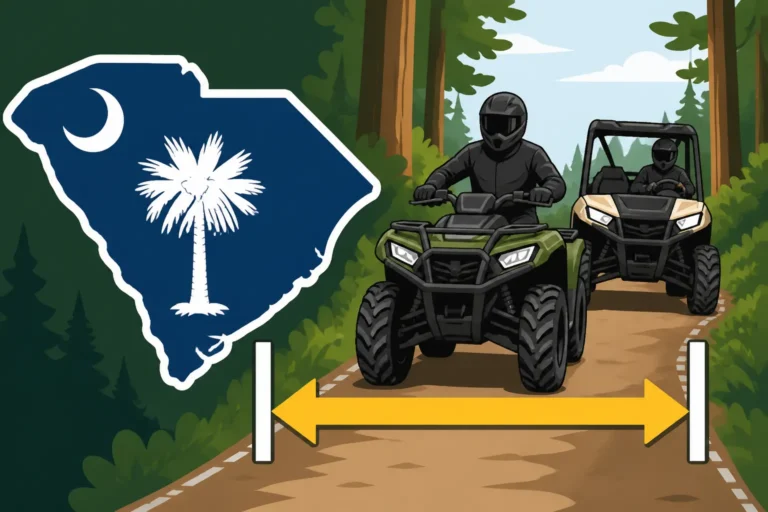
The important catch is that Wambaw is not an unrestricted trail system for every machine. It is intended for motorcycles and appropriately sized ATVs, with restrictions that can rule out wider machines. Do not assume a side-by-side will fit simply because it is sold as a compact UTV. Check the current width limit, vehicle rules, trail conditions, and any posted restrictions before setting out. For broader context, see [South Carolina's Wambaw Cycle Trail] and [South Carolina Trails That Allow Side-by-Sides].
Wambaw can be a good match for a rider with a suitable quad who wants a forest-trail experience without driving across the state. It is not a promise of a particular terrain difficulty or trail condition on the day you arrive. Forest roads, sandy sections, and narrow passages can feel very different after rain or seasonal maintenance. If you are new to the area, plan for a conservative first ride and leave time to turn around if a route feels unsuitable for your machine or skill level.
A close trail is not necessarily a fit for every ATV or UTV
The key question is not only “How far is the trail?” It is “Is this trail open to my exact vehicle?” A youth quad, a narrow recreational ATV, a dirt bike, and a full-size side-by-side may all have different access rules. A trail’s name or the word “OHV” on a map does not automatically mean every off-road vehicle is allowed.
Before you travel, confirm the trail’s permitted vehicle types and width limits. Pay attention to signs at the entrance as well as the forest’s current notices. If you are comparing Wambaw with other forest routes around the state, [South Carolina's Four National Forest Trails] gives useful context, while [South Carolina Trails That Ban Full-Size Vehicles] can help explain why a large UTV may have fewer nearby choices.
It is also worth separating ATV trail access from general access to public land. A wildlife management area, timber road, or forest road is not automatically an ATV riding area. South Carolina riders should not treat a map line or an open-looking gate as permission to ride. In particular, review [South Carolina WMA Riding Is Prohibited] before planning a route through wildlife management land.
| Riding option | Approximate fit for a Charleston trip | Best suited to | Main thing to confirm |
|---|---|---|---|
| Wambaw Cycle Trail in Francis Marion National Forest | The closest public trail option to investigate | Motorcycles and eligible, suitably narrow ATVs | Current vehicle, width, pass, and closure rules |
| Other national forest OHV trails | Often a longer drive from Charleston | Machines that meet each trail’s rules | Distance, vehicle eligibility, and current operating status |
| Carolina Adventure World near Winnsboro | May fall outside a strict two-hour drive, depending on origin and traffic | Riders seeking a larger private riding area | Current park access, machine rules, reservations, and fees |
| Public roads or wildlife management areas | Not a substitute for an authorized ATV trail | Not appropriate unless a specific legal exception applies | Whether riding is explicitly permitted |
Plan the Charleston-to-trail trip before you load up
Check access, passes, and closures
A smooth ride often depends on a few checks made at home rather than at the trailhead. Confirm that the trail is open, that your machine is allowed, and that you understand the pass or permit requirement. Public-land access rules can be different from the rules at a private riding park, so do not assume that a pass for one destination works at another. [South Carolina Passes Cover All Four Trails] is a useful starting point for understanding forest-pass coverage.
Check for temporary closures before driving north. Rain, maintenance, fire danger, or other forest conditions can affect access, and a trail that was open on your last visit may not be open now. This matters especially if you are coordinating a group, towing a trailer, or planning a full day around a specific trail. Use [South Carolina Trail Conditions Before You Haul] and [South Carolina Trail Closures After Rain] as reminders to verify conditions close to your departure.
Mapping apps can help you orient yourself, but they are not the final authority on access. A tool such as onX Offroad may help you examine routes and plan a general approach, but confirm boundaries and restrictions with official trail information and on-site signs. A mapped road can be private, closed, or off-limits to motorized recreation. Do not let a colored line on a screen override a gate, a posted notice, or an area’s stated rules.
Match your machine and your group to the trail
Write down your ATV’s width and compare it with the trail’s posted limit. If you are riding a UTV, check the actual measurement rather than relying on a model name or a dealer’s description such as “trail width.” Accessories, wheels, tires, and other modifications can affect the overall measurement. When the rules are unclear, ask the managing office before making the drive.
Then consider the people riding with you. A narrow, winding trail may be tiring for a beginner or stressful for a large group moving at different speeds. New riders often have more fun when they agree in advance to take an easy pace, stop at safe pullouts, and keep the group together. If children are coming along, check the applicable age, supervision, passenger, and safety requirements before you leave. You can review [South Carolina Safety Courses for Riders 15 and Under] for information about youth safety-course requirements.
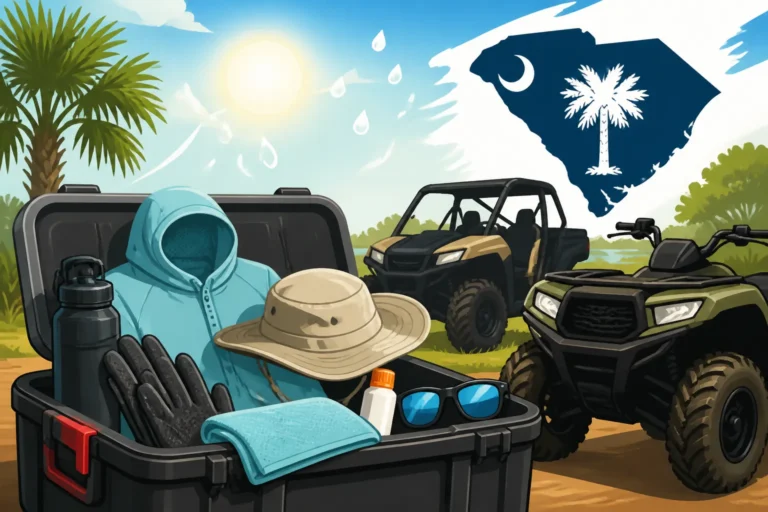
For your first visit, keep the plan simple: arrive with enough daylight to unload, inspect the machine, and understand the trail layout before riding far from the staging area. Carry water, basic tools, a charged phone, and a paper backup for navigation. Mobile reception can be inconsistent in wooded areas, and a navigation app is most useful when you have prepared for it to be unavailable.
Make the ride work for your schedule and vehicle
Build in time for Charleston traffic and trailhead logistics
A map estimate from downtown Charleston may look different from the real trip starting in West Ashley, James Island, North Charleston, or Mount Pleasant. Traffic around the Charleston-area bridges and major routes can add time, especially on a weekend or holiday. Add the time needed to connect a trailer, stop for fuel, park, unload, and handle any entry requirements. A destination that appears to be an easy morning outing can become a rushed trip if you plan only for windshield time.
For Wambaw, start early enough that your group is not forced to rush through the first ride. Before unloading, confirm you are at the correct access point and that your vehicle fits the rules for that trail. If the parking or staging area is busy, be considerate while unloading and avoid blocking other visitors. Keep your group’s meeting point clear in case riders separate briefly or someone needs to return to the vehicle.
Bring a backup plan that does not depend on riding an unauthorized nearby road if the trail is closed or unsuitable. That might mean postponing the ride, visiting a permitted private park on a different weekend, or using the day for another outdoor activity. A disappointing change of plans is still better than a trespass problem or a long drive with nowhere legal to ride.
Know when a longer drive may be the better choice
If you own a wide UTV, the closest public option may not meet your needs. In that case, it can be more practical to plan a longer trip to a riding area that explicitly welcomes your machine than to try to squeeze into a trail system with restrictive dimensions. Carolina Adventure World near Winnsboro is one private riding destination riders may compare when looking beyond the immediate Charleston area, but do not assume it falls within a strict two-hour drive from your particular neighborhood. Check the route, park hours, rules, and current entry details before making plans.
Private parks and national forest trails are different experiences. A private park may offer a broader range of vehicle types or facilities, but it sets its own entry, age, passenger, and equipment rules. A forest trail offers a different kind of public-land ride and may have narrower vehicle limits or fewer services. [South Carolina Private Park Passes and Rules] can help you understand why it is important to check a park’s specific policies rather than relying on another rider’s memory.
If camping is part of your plan, confirm that the campground is open and that it is actually convenient for your chosen trail. A campground in the same general region may still require extra driving, and camping access does not itself grant permission to ride on nearby roads or land. For planning ideas, see [South Carolina Trails With Camping]. It is also sensible to check whether your riding destination has fuel, wash facilities, or food nearby instead of assuming those services will be available at the trailhead.
A practical checklist before heading out
Do these checks the day before
Use this short checklist to reduce the chance of reaching the forest and discovering a preventable problem:
- Confirm the trail is open and check for current closures or weather-related restrictions.
- Verify that your exact vehicle type is allowed, including any width limit.
- Check the required pass or permit and how it must be displayed or carried.
- Review the route from your actual Charleston-area starting point and allow for traffic and trailer stops.
- Inspect tires, brakes, lights, fuel, tie-downs, and the trailer before leaving home.
- Pack water, basic tools, first-aid supplies, and a backup navigation option.
- Tell someone where you are going and when you expect to return.
A quick vehicle inspection can prevent an avoidable interruption. Look for loose tie-downs before leaving, then check them again after the first stretch of highway. At the trailhead, walk around the machine before riding: look for low tires, leaks, loose cargo, and anything that could catch on brush. Those few minutes are especially worthwhile when you have driven from Charleston and want to make the most of your time on the trail.
Ride with respect for other visitors and the forest
Stay on authorized routes and follow posted signs, even if a side road looks tempting. Keep your speed appropriate for visibility and trail conditions, leave room between machines, and slow down when passing other riders or pedestrians. If you meet hikers, horseback riders, or another group on a narrow section, communicate calmly and give them space. [South Carolina Trail Etiquette Locals Expect] offers more guidance for sharing a trail responsibly.
Avoid riding through standing water or around a closure barrier. A detour can widen a trail, damage the surrounding land, or put your group somewhere you are not permitted to be. Pack out trash, secure loose items, and avoid unnecessary noise near homes or camps. A good visit is not only about completing a loop; it is also about leaving the area in a condition that keeps access available for the next group.
For Charleston-area riders, the practical takeaway is to investigate Wambaw first if you have a permitted motorcycle or appropriately sized ATV, and to check every restriction before loading. If you ride a larger UTV, expect to compare farther-away destinations rather than assume the nearest forest trail will accommodate it. Careful planning may feel like extra work, but it is far less aggravating than towing across the Lowcountry only to find that your machine cannot legally use the route.
Disclaimer
This article is for general informational purposes only and does not constitute professional advice. Laws, prices and regulations vary by location and change over time. Consult a qualified professional for guidance on your specific situation.