Can You Ride an ATV on the Road in South Carolina?
It’s a common frustration for many South Carolina ATV and UTV enthusiasts: you’ve got a fantastic machine, perfect for tearing up trails or helping around the farm, but getting to that prime riding spot often means a short hop on a public road. The big question is, can you legally ride your ATV or UTV on the pavement in the Palmetto State? This guide is here to clear up the confusion and lay out exactly what’s allowed, what’s not, and the exciting new changes on the horizon for side-by-sides.
The Harsh Reality: Why Most ATVs Can't Just Hit the Pavement in South Carolina
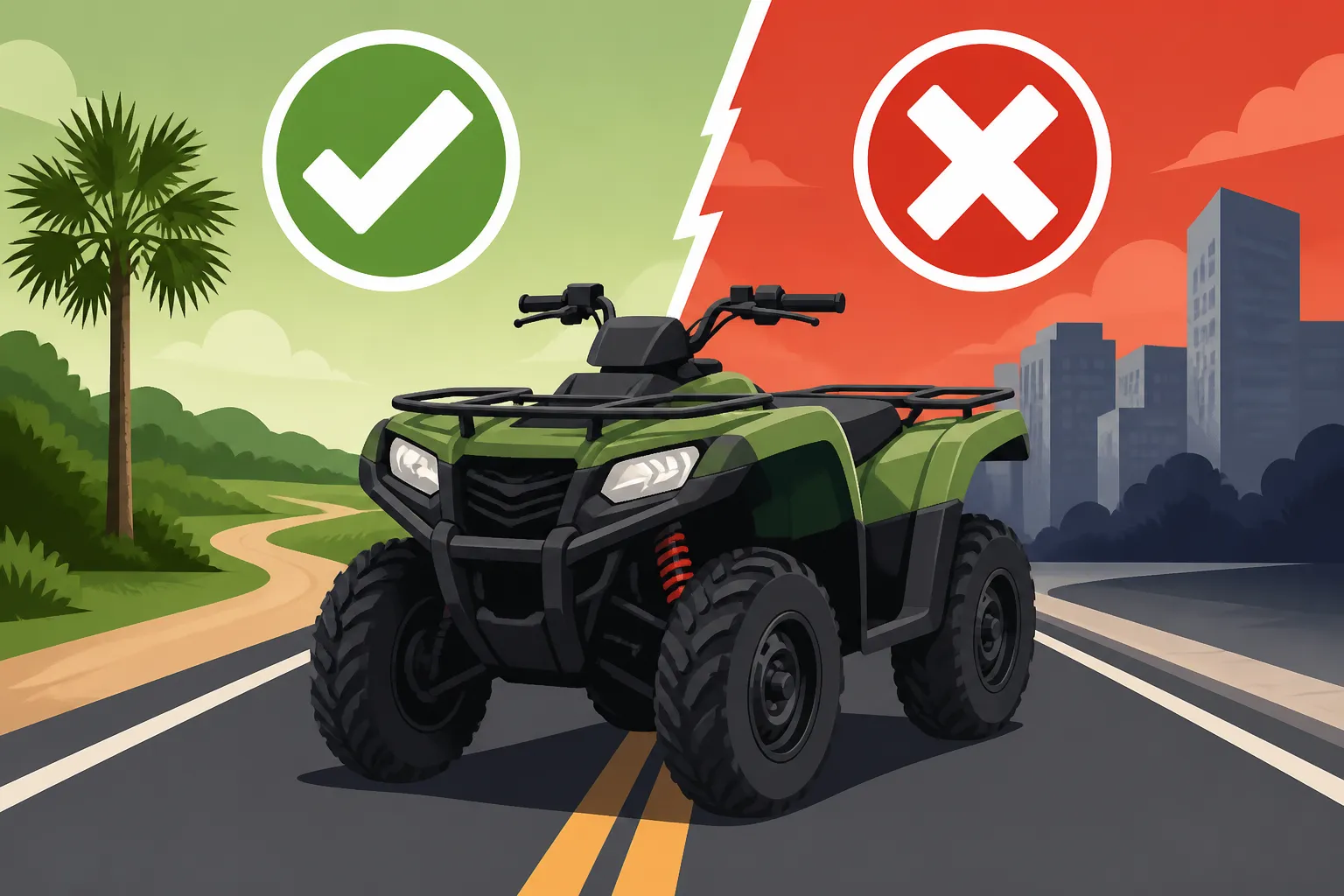
For years, the answer for most traditional ATVs, dirt bikes, and even many side-by-sides in South Carolina has been a pretty firm "no" when it comes to riding on public roads. It’s a bitter pill to swallow when you just want to cross a street to reach another section of your property or get to a nearby trail, but the law has been quite clear.
Understanding the Off-Road Designation
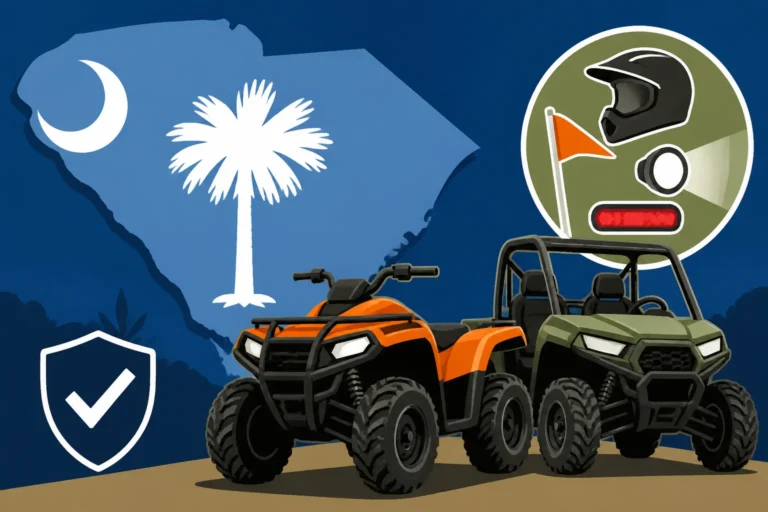
The primary reason traditional ATVs and many UTVs are banned from public roads is their fundamental designation as "off-road vehicles." They are designed and manufactured specifically for unpaved terrain, like dirt trails, mud bogs, and open fields. This design philosophy means they typically lack the standard safety equipment required for street-legal vehicles, such as proper headlights, brake lights, turn signals, and mirrors. They also often have tires that are aggressive and not suitable for sustained asphalt use, affecting handling and stopping power on paved surfaces. Imagine trying to stop a large, knobby-tired quad quickly on a wet highway – it’s just not built for it.
South Carolina law, like that in many other states, distinguishes sharply between vehicles meant for highway travel and those meant for everything else. This distinction isn't just about what feels right; it's codified in statutes that define what constitutes a motor vehicle for highway use. Traditional ATVs, even large utility models, typically fall outside these definitions, meaning they don't qualify for standard license plates and registration that would permit road use. This is why you often see signs explicitly prohibiting ATVs on paved roads, county by county, or within specific town limits. It’s not personal; it’s just the law defining their purpose. [South Carolina Code Title 50 Chapter 26] lays out many of these distinctions.
Limited Exemptions for Off-Road Machines
While the general rule is strict, there are a few very narrow exceptions where an off-road ATV might briefly touch a public road, though these are far from general road legality. These situations are almost always tied to specific, temporary needs rather than routine travel.
For instance, an ATV might be allowed to cross a public road if it's necessary to get from one section of a farmer's property to another, or to access a hunting lease that is split by a road. Even in these cases, the crossing must be done at a right angle, with extreme caution, and usually only on secondary roads with low speed limits. This isn't a license to ride down the road; it's a bare minimum allowance for practical land management. [South Carolina Rules for Riding a Farm Road] addresses some of these scenarios.
Another exemption might exist for official use by law enforcement or emergency services, but this doesn't apply to the average recreational rider. You might see a game warden on an ATV briefly on a paved road, but they are operating under a different set of permissions. Essentially, if you’re not engaged in agriculture, forestry, or official duties, and your machine doesn’t meet specific street-legal criteria, those knobby tires need to stay off the asphalt. Trying to skirt these rules can lead to fines ranging from $50 to $200, as detailed in [South Carolina Fines of $50 to $200], and nobody wants that kind of hassle after a fun day of riding.
The Game Changer: South Carolina's New Street-Legal UTVs
Here's where things get interesting and a lot more hopeful for side-by-side owners! For years, UTV owners in South Carolina have felt left out, watching other states embrace street-legal side-by-sides. But thanks to a significant legislative change, Act 164, South Carolina is finally stepping into the modern age, allowing certain UTVs to be registered and ridden on many public roads. This is a huge shift from the old rules and opens up new possibilities for how and where you can enjoy your machine.
Act 164 and the November 2026 Shift
The big news is South Carolina's Act 164, which was signed into law and will allow for the registration of street-legal utility terrain vehicles (UTVs) starting November 18, 2026. This isn't just a minor tweak; it's a complete overhaul of how UTVs are classified and permitted for road use. Prior to this, UTVs were essentially treated the same as ATVs when it came to road access, meaning they were almost universally prohibited from public highways. The new law recognizes the versatility and growing popularity of UTVs and creates a specific class for them, distinct from traditional ATVs or even low-speed vehicles.
This means that come November 2026, if your UTV meets certain criteria, you'll be able to get a proper license plate and enjoy a whole new level of freedom. This change means you might finally be able to drive your side-by-side to a gas station, a local store, or even connect to different trail systems without having to trailer your machine everywhere. It’s an exciting prospect for many riders who’ve been waiting patiently for this kind of legislation. If you're planning ahead, knowing about [South Carolina Street-Legal UTV Registration Arrives] is crucial.
Specific Requirements for Street-Legal UTVs
Of course, becoming street-legal isn't as simple as just slapping a license plate on your current UTV. The new law outlines specific equipment requirements that your machine must meet to qualify for registration. These requirements are in place to ensure the safety of both the UTV operator and other vehicles on the road, bringing UTVs up to a standard similar to other street-legal vehicles.
Here’s a general rundown of what your UTV will likely need:
- Headlights and Tail Lights: These must be fully functional and clearly visible, similar to those on a car.
- Brake Lights: Essential for signaling stops to drivers behind you.
- Turn Signals: Both front and rear, to indicate your intentions when turning or changing lanes. Many aftermarket companies, like SuperATV, offer complete kits that include turn signals, horns, and other street-legal necessities, making the conversion much easier.
- Mirrors: A rearview mirror and at least one side-view mirror will be mandatory.
- Windshield: A DOT-approved windshield.
- Horn: A functional horn for signaling.
- Seatbelts: For all occupants, matching the machine's seating capacity.
- Tires: Must be DOT-approved tires, meaning they are designed for road use and can handle highway speeds. Aggressive off-road tires might not make the cut.
- Vehicle Identification Number (VIN): Your UTV must have a legible VIN.
- Insurance: Proof of liability insurance will be required, just like for any other registered motor vehicle. This is non-negotiable for road legality and you can learn more about this at [South Carolina Street UTV Insurance Rules].
- Age and License: Riders must be at least 17 years old and possess a valid driver’s license. [South Carolina Street UTV Age of 17] outlines these age restrictions.
The law also specifies certain dimensions and weight limits. Generally, a street-legal UTV will need to be no more than 80 inches wide and weigh no more than 4,000 pounds. These limits are in place to ensure the UTV can safely share the road with other vehicles.
Where Street-Legal UTVs Can Be Ridden
While the ability to register your UTV for road use is a massive step forward, it's important to understand that there will still be limitations on where you can ride. Street-legal UTVs will primarily be allowed on secondary roads with posted speed limits of 55 mph or less. This means that major highways, interstates, and some high-speed primary roads will likely remain off-limits. The intent is to allow UTVs in environments where they can safely integrate with traffic without impeding flow or creating hazards due to speed differentials.
Some municipalities may also have the authority to further restrict UTV use within their jurisdictions, so it’s always wise to check local ordinances. However, the general allowance for secondary roads opens up a vast network of routes, making it far easier to access trails, move between properties, and enjoy your machine in new ways. Keep an eye out for [South Carolina Street UTV Rules From November 2026] for the most up-to-date information as the effective date approaches.
Golf Carts: The Other Road-Legal Off-Roaders
Before the new UTV law, golf carts were really the only "off-road" type vehicles with specific provisions for road use in South Carolina. While they certainly don't offer the power or ruggedness of an ATV or UTV, they serve a vital purpose in many communities, especially coastal towns and neighborhoods with lower speed limits. If you live in one of these areas, a golf cart might be your go-to for quick errands.
Obtaining a South Carolina Golf Cart Permit
To legally operate a golf cart on public roads in South Carolina, you absolutely must obtain a golf cart permit from the Department of Motor Vehicles (DMV). This isn't optional, and ignoring it can lead to a quick ticket. The permit is essentially what gives your golf cart its limited road legality, acting in a similar way to a registration, though with much more restrictive rules.
Getting a permit is fairly straightforward. You'll need to present proof of ownership (like a bill of sale), proof of liability insurance for the golf cart, and a valid driver's license. The permit typically costs a nominal fee and is valid for a period of time, after which it needs to be renewed. This renewal usually involves replacing your decal every five years, as covered in [South Carolina Golf Cart Decals Every Five Years]. It’s a simple process, but it’s critical to complete it before you ever hit the pavement. For detailed steps, check out [South Carolina Golf Cart Permit Steps].
Radius Rules and Speed Limits for Golf Carts
The key restrictions for golf cart use revolve around a specific radius and maximum speed limits. A permitted golf cart is generally allowed to operate on secondary roads with a speed limit of 35 mph or less. However, the most important rule is the "10-mile radius rule." This means you can only operate your golf cart within a 10-mile radius of your home or the address listed on your permit. This is a crucial distinction from street-legal UTVs, which won't have this radius restriction.
Furthermore, golf carts are typically restricted to daylight hours only, unless the golf cart is equipped with proper headlights and taillights. Even then, many localities have specific ordinances. They are not allowed on primary highways or interstates under any circumstances. These rules are designed to ensure golf carts are used for local travel in low-speed, low-traffic environments, minimizing interactions with faster-moving vehicles. For more on these critical limitations, refer to [South Carolina Golf Cart Road Rules] and [South Carolina's 10-Mile Radius Rule].
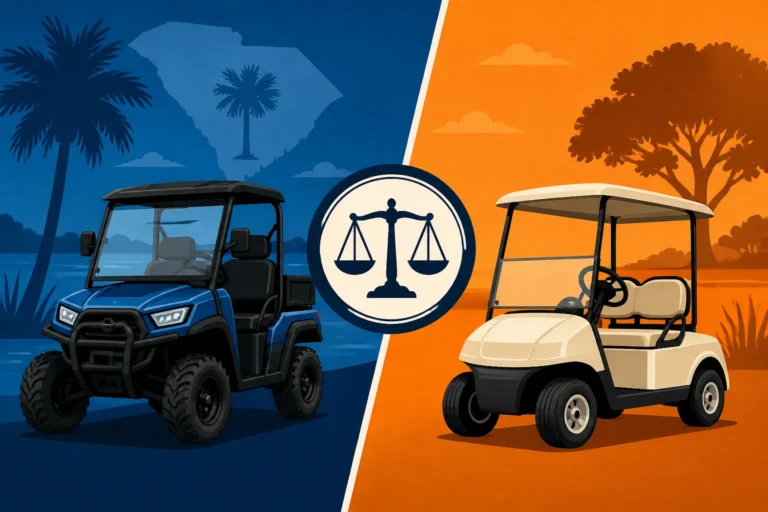
Table: Comparing South Carolina's Road-Legal Options
| Feature | Traditional ATV (Off-Road Only) | Street-Legal UTV (Post-Nov 2026) | Golf Cart (Permitted) |
|---|---|---|---|
| Road Legality | Generally No (except brief crossings) | Yes, with registration and specific equipment | Yes, with permit and strict limitations |
| Primary Use | Off-road trails, farm, private land | Trails, farm, private, and public roads | Local transport, neighborhoods, golf courses |
| Registration | Not required for off-road use | Required (after Nov 2026) | Permit required |
| License Plate | No | Yes (after Nov 2026) | No (uses permit decal) |
| Minimum Age | Varies by machine/location for off-road | 17 (valid driver's license) | 16 (valid driver's license) |
| Equipment | Minimal (lights vary) | Headlights, brake lights, turn signals, horn, mirrors, windshield, seatbelts | Headlights, taillights (for night use) |
| Speed Limit | N/A | Generally 55 mph or less on secondary roads | Generally 35 mph or less |
| Radius Rule | N/A | No | Yes, within 10 miles of home |
| Insurance | Not state-mandated for off-road use | Required (liability) | Required (liability) |
| Night Riding | N/A | Yes, with proper lighting | Often daylight-only, check local ordinances |
Navigating the Rules: Practical Advice for South Carolina Riders
Understanding the letter of the law is one thing, but putting it into practice requires a bit of foresight and awareness. Whether you’re a long-time resident or just visiting the Palmetto State, knowing how to legally and safely operate your machine is key to avoiding issues and maximizing your enjoyment.
Always Carry Proper Documentation
This might sound like a no-brainer, but it's surprising how many riders forget or simply don't have the right paperwork with them. If you’re operating a street-legal UTV (after November 2026) or a permitted golf cart on public roads, you need to carry your driver’s license, proof of insurance, and your UTV registration or golf cart permit. A deputy or state trooper can, and likely will, ask to see these documents during a routine stop or if you're involved in an incident. [What a South Carolina Deputy Can Ask to See] details the types of documents you should have. Being able to produce them quickly and easily can make any interaction much smoother.
It’s also a good idea to have some form of proof of ownership for your machine, whether it's the title (even though [South Carolina Titles Are Optional] for ATVs, it's still good to have) or a bill of sale, especially if your UTV is still relatively new. Even for off-road only machines, having a [South Carolina Proof of Ownership Without a Title] can save you a lot of headaches if there's ever a question about where your quad came from. Keep these documents in a waterproof pouch on your machine, or even a digital copy on your phone, to ensure they're always accessible.
Be Aware of Local Ordinances and Jurisdictional Differences
While state law provides the overarching framework, individual counties and municipalities in South Carolina can (and often do) enact their own specific ordinances regarding ATV, UTV, and golf cart use. This is particularly true for golf carts, where a town might have stricter rules about speed or areas where they can operate. What's perfectly legal in one town might be forbidden just a few miles down the road.
For instance, a coastal town might have very specific regulations about golf cart use on certain streets, near the beach, or during peak tourist season. Similarly, once street-legal UTVs are fully implemented, you might find some cities restricting their use on specific high-traffic boulevards, even if the state law generally permits them on secondary roads. Always do your homework before you ride in a new area. A quick call to the local sheriff's office or city hall can save you from an unexpected citation. The general rule of thumb is: if you’re unsure, assume it’s not allowed on the road.
Disclaimer
This article is for general informational purposes only and does not constitute professional advice. Laws, prices and regulations vary by location and change over time. Consult a qualified professional for guidance on your specific situation.