South Carolina Golf Cart Decals Every Five Years
Riding a golf cart around your neighborhood or to the local store can feel like the quintessential South Carolina lifestyle, but the rules around their operation, especially that little decal, can sometimes feel a bit like a mystery. Many folks get confused about how often they need to update that small sticker, leading to unintended laps in their permit or, worse, a chat with local law enforcement. This guide is here to clear up all that confusion, walking you through everything you need to know about your South Carolina golf cart decal, particularly its five-year renewal cycle.
Understanding South Carolina's Golf Cart Regulations
South Carolina has a wonderfully unique approach to golf carts. They're not quite full-fledged vehicles that require traditional registration and titling like your car or even a street-legal UTV, but they're also not completely unregulated. It's a sweet spot that allows for convenient local travel while still ensuring some level of accountability and safety. However, this middle ground can also be a source of bewilderment for new residents or those just getting into the golf cart lifestyle.
The Basics of Operating a Golf Cart in South Carolina
In the Palmetto State, a golf cart generally refers to a motor vehicle that is designed and manufactured for operation on a golf course for sporting or recreational purposes, and is not capable of exceeding 20 miles per hour. This speed limit is critical because it differentiates a standard golf cart from what the state calls a "Low-Speed Vehicle" (LSV), which can go up to 25 mph and has different rules entirely. Golf carts are typically allowed on secondary roads with a posted speed limit of 35 mph or less, and usually within a four-mile radius of your home or business. You can read more about the specific geographic limitations in [South Carolina Golf Cart Radius and Speed Rules].
Unlike ATVs, which have [South Carolina Does Not Register Off-Road ATVs], golf carts do require a permit to be operated on public roads. This permit isn't a "registration" in the same way a car is registered, nor does it typically involve a "title" like a quad might, though proof of ownership is certainly required when you apply. The decal is essentially your visible proof that you've met the state's requirements for operating your golf cart on public thoroughfares. It's a common misconception that because golf carts aren't "titled" in the traditional sense, they don't have any paperwork requirements, but that couldn't be further from the truth.
Why a Decal, Not a Plate or Title?
The decision to use a decal for golf carts instead of a traditional license plate or requiring a full title stems from their primary design and intended use. Golf carts are, first and foremost, recreational vehicles designed for low-speed, short-distance travel, often in controlled environments like golf courses or planned communities. The state views them differently than off-road vehicles like ATVs, where [South Carolina Titles Are Optional] but full street registration isn't usually an option, or street-legal UTVs, which get a full license plate and all the trimmings.
The decal serves as a simpler, less bureaucratic method of ensuring compliance for these specific types of vehicles. It indicates that the golf cart owner has applied for and received permission to operate their cart on approved public roads, has the necessary insurance, and has paid the associated fee. It’s a pragmatic solution that keeps administrative overhead low while still providing authorities a quick visual cue that a golf cart is legally allowed on the road. Without a system like this, it would be much harder for law enforcement to distinguish between a golf cart legitimately traveling to a nearby store and one being operated unlawfully. It’s about balance: acknowledging their limited road use without subjecting them to the same exhaustive requirements as a full-size car.
The Five-Year Decal Period Explained
The "every five years" rule for South Carolina golf cart decals is one of those facts that many people either forget, misunderstand, or simply don't know until they get pulled over or try to renew. It's a relatively long period, which is great for convenience, but it also means it's easy to lose track of when your current decal is set to expire.
What "Every Five Years" Really Means for Your Decal
When the state says your golf cart decal needs to be renewed "every five years," they mean exactly that: once you've been issued a decal, it's valid for a full five-year period from its issuance date. For example, if you obtain your decal on July 1, 2024, it will be valid until June 30, 2029. This isn't tied to the calendar year, nor does it automatically reset based on the date you bought the cart. It's strictly about the date the permit was issued. This can be a bit tricky because, unlike vehicle registrations that often align with your birth month, there isn't always a personal milestone to remind you.
Keeping track of this date is entirely the owner's responsibility. The DMV typically doesn't send out reminders for golf cart decal renewals, so it's crucial for you to note the expiration date when you first receive your decal. I always recommend setting a reminder on your phone or marking it on a physical calendar far in advance, perhaps six months before it expires. That way, you have plenty of time to gather your paperwork and complete the renewal process without any last-minute stress or, worse, an accidental lapse in your permit. Knowing this fixed cycle helps you budget for the [South Carolina Golf Cart Permit Fees] every half-decade.
Why the Five-Year Cycle?
The five-year cycle for golf cart decals in South Carolina is a considered choice that balances administrative burden with public safety and revenue generation. Compared to annual renewals, a five-year period significantly reduces the administrative workload on the state's Department of Motor Vehicles (DMV). Imagine processing hundreds of thousands of golf cart renewals every single year – it would be an enormous drain on resources. A longer cycle allows the DMV to focus its efforts elsewhere, streamlining operations.
From the owner's perspective, a five-year renewal is incredibly convenient. It means less frequent trips to the DMV, fewer forms to fill out, and less often that you need to remember to update your permit. This convenience encourages compliance, as it's not a constant hassle. While it might be easy to forget the expiration date over such a long period, the benefits of infrequent renewal generally outweigh this minor drawback for most owners. It also provides a steady, albeit less frequent, stream of revenue for the state, which helps cover the costs associated with managing the program and enforcing golf cart regulations. This approach differs quite a bit from some states that might require annual inspections or more frequent permit updates for similar vehicles, highlighting South Carolina's distinct, owner-friendly stance on golf carts.
Steps to Obtain or Renew Your Golf Cart Decal
Getting your first golf cart decal or renewing an existing one might seem daunting, but it's a relatively straightforward process once you know what to expect. The key is to arrive prepared with all the necessary documents to avoid multiple trips to the DMV.
Initial Application for a New Golf Cart Decal
When you're applying for your very first golf cart decal, whether for a brand new machine or one you just bought and is new to you, you'll need to gather a few essential items. First, you'll need proof of ownership. For a new golf cart bought from a dealer, this will usually be a certificate of origin or a bill of sale. If you purchased it privately, a clear, signed bill of sale detailing the cart's make, model, year, and serial number is crucial. Speaking of private sales, if you're ever in that situation, a service like LawDepot can provide customizable bill of sale templates that ensure all the necessary information is included, making your DMV visit much smoother.
Next, you'll need proof of liability insurance for the golf cart. Just like with a car, you need to show that you're covered in case of an accident. While [Does an Off-Road Quad Need Insurance in South Carolina?] notes that it isn't always mandatory for ATVs, it absolutely is for golf carts on public roads. You'll also need a completed application form, usually Form GC-2, available on the DMV's website or at any branch office. Finally, be prepared to pay the [South Carolina Golf Cart Permit Fees]. The process is simpler than [South Carolina Title Applications at the DMV] for a car or even a street UTV, but it still requires diligence. Take your documents to any South Carolina DMV office, and they'll process your application. Once approved, you'll receive your decal to affix to the front of your golf cart, usually on the driver's side.
Renewing Your Existing Decal After Five Years
Renewing your golf cart decal after its five-year run is very similar to the initial application, but often a bit quicker since the state already has your information on file. The most important thing, as mentioned, is remembering when it's due! Since the DMV likely won't send you a reminder, mark that date down somewhere prominent. When it's time to renew, you'll generally need:
- Your existing decal information: Having your current permit number handy will speed things up.
- Proof of current liability insurance: Even if your insurance hasn't changed, you'll need to show updated proof.
- A completed renewal application form: This might be the same form as the initial application or a specific renewal version.
- The renewal fee: Again, plan for the [South Carolina Golf Cart Permit Fees].
You can typically handle renewals at your local DMV branch. The process is designed to be efficient for repeat customers. If your decal was lost or damaged during its validity period, don't wait for the five-year renewal. You'll want to address that immediately to avoid issues, as operating without a visible, valid decal is a no-go. The good news is that [South Carolina Golf Cart Permit Renewal] is usually a very smooth experience once you have your paperwork in order. Just ensure all your information, especially your address, is current with the DMV to avoid any hiccups.
Common Issues and Misconceptions About Decals
Despite the straightforward nature of the golf cart decal system, several common scenarios and misunderstandings often trip up owners. Being aware of these can save you a lot of hassle and potential fines.
Moving House and Your Golf Cart Decal
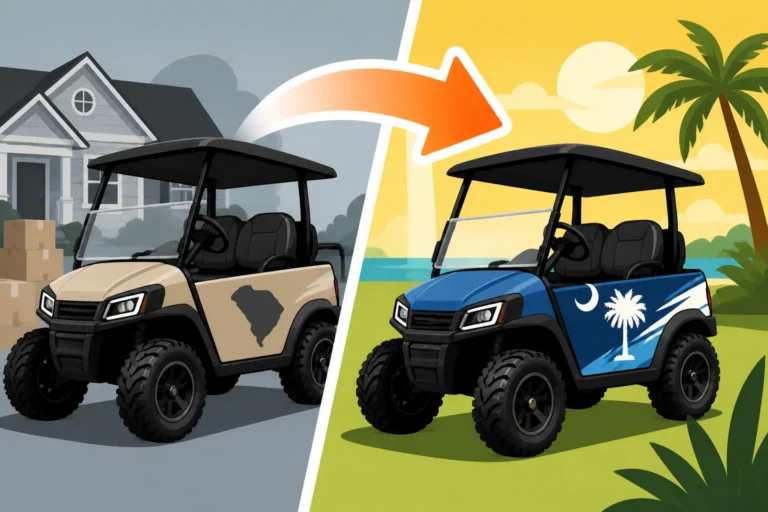
Moving to a new home within South Carolina can impact your golf cart decal, especially concerning the crucial 4-mile radius rule. The permit allows you to operate your golf cart within a 4-mile radius of your registered address. If you move, that 4-mile zone shifts. While you might not need an entirely new decal just for an address change, it's absolutely critical to update your address with the DMV. This ensures that the 4-mile rule is correctly applied from your new residence.
Failing to update your address means that if you're stopped by law enforcement, your decal might appear valid, but your operational area could be incorrect, potentially leading to a citation. Imagine you moved from one side of Charleston to the other; your old 4-mile radius would be completely irrelevant. Some owners even wrongly assume they need to get a new permit altogether. The DMV primarily needs to have your correct residential information on file. So, while it might feel like a small detail, updating your address is a necessary step to maintain full compliance and ensure your golf cart remains legal on the roads around your new home. This is precisely why [Moving House Means a New Cart Decal] points to the necessity of updating your information.
Decals for Used or Privately Purchased Golf Carts
Buying a used golf cart from a private seller introduces a unique set of considerations for your decal application. Unlike purchasing from a dealership, where they typically handle some of the initial paperwork, a private sale puts the onus entirely on you, the buyer, to secure the necessary documentation. The most critical piece of paper here is a robust bill of sale. This document should clearly identify the seller and buyer, the date of the sale, the golf cart's make, model, year, and its unique serial number. Without this, proving ownership to the DMV can become a real headache.
Sometimes, sellers might not have a formal title for the golf cart, as [South Carolina Proof of Ownership Without a Title] is a common scenario for these machines. In such cases, the bill of sale becomes even more vital as your primary proof of ownership. If the seller doesn't have a bill of sale readily available, consider using a template from a reputable source. For instance, LawDepot offers templates for bills of sale that can be customized to include all the essential details required by the South Carolina DMV, ensuring a smooth transfer of ownership and subsequent decal application. Always verify the serial number on the bill of sale matches the one on the cart itself. This proactive step prevents you from inadvertently purchasing a golf cart that might have a questionable ownership history, making your decal application much easier.
Consequences of an Expired or Missing Decal
Operating a golf cart on public roads in South Carolina without a current, visible decal is not just frowned upon; it's a violation of state law, and it comes with real consequences. Imagine you're cruising to the neighborhood pool on a sunny afternoon, feeling the breeze, only to be pulled over by an officer who notices your decal expired six months ago. What seems like a minor oversight can quickly escalate into a citation.
The penalties for operating a golf cart with an expired or missing decal can include fines, which can range from [South Carolina Fines of $50 to $200] or even higher, depending on the specific circumstances and local ordinances. Beyond the monetary cost, it can also lead to inconvenience, taking time out of your day to deal with the officer and potentially appearing in court. More importantly, it can put you in a precarious position if you're involved in an accident. While insurance is mandatory, an expired decal could complicate claims, suggesting you were operating the vehicle unlawfully. It’s always best to ensure your decal is current and properly displayed, not just to avoid fines, but to ensure you're fully compliant with all state regulations, keeping your local rides worry-free and safe.
Beyond the Decal: Important Golf Cart Operating Rules
While getting and renewing your decal is a critical first step, it’s only one piece of the puzzle for legal golf cart operation in South Carolina. There are several other rules that govern where, when, and how you can drive your golf cart on public roads. Understanding these rules is just as important as having that valid decal.
The 4-Mile Radius and Speed Limits
The 4-mile radius rule is perhaps one of the most talked-about and sometimes misunderstood aspects of golf cart operation in South Carolina. Essentially, your golf cart permit allows you to operate your cart on secondary roads and highways within a four-mile radius of your home or business. This isn't just a suggestion; it's a hard and fast rule. Exceeding this radius can lead to a citation, even if your decal is perfectly valid. This rule is designed to keep golf carts primarily within local communities and off major thoroughfares where their low speed could pose a safety hazard. It means you can generally use your cart for quick trips to the grocery store, neighbor's house, or community center, but not for longer commutes or inter-town travel.
Hand-in-hand with the radius rule is the speed limit restriction. Golf carts are generally permitted only on roads where the posted speed limit is 35 mph or less. This is a crucial safety measure. Golf carts are not built for higher speeds; they lack many of the safety features of standard automobiles, and their slower pace makes them a hazard on faster roads. Always be mindful of the posted speed limits on the roads you plan to travel. If a road segment temporarily increases to 45 mph, even if it's within your 4-mile radius, your golf cart likely shouldn't be on it. These rules are detailed further in [South Carolina Golf Cart Permit Rules], and they're fundamental to safe and legal operation.
Daylight Operation and Other Equipment Requirements
Another key regulation for golf carts in South Carolina is that they are generally restricted to daylight hours only. This means from roughly half an hour after sunrise to half an hour before sunset. This rule is in place because many golf carts, especially older models, are not equipped with adequate lighting systems – headlights, taillights, and turn signals – to be safely visible during periods of low light or darkness. Trying to navigate a golf cart after dark, even with some makeshift lights, puts you and others on the road at significant risk. The visibility is simply not there, making it an easy target for accidents. This rule underscores the recreational and local nature of golf cart use.
While full vehicle equipment standards don't apply, golf carts must still have basic operational equipment. This includes functional brakes that can safely stop the vehicle, a steering mechanism that allows for proper control, and tires in good condition. If your golf cart is equipped with headlights, taillights, and turn signals, these must be in working order, even if you are only operating during daylight hours. However, it's important to differentiate these rules from those for Low-Speed Vehicles (LSVs) or street-legal UTVs, which have much more stringent equipment requirements and can be operated after dark. For a standard golf cart, the emphasis remains on daylight-only operation for safety. These specifics are often laid out in [South Carolina Golf Cart Daylight Rules] and are vital for every owner to know.
Here's a quick comparison of the key aspects of initial golf cart decal application versus renewal:
| Feature | Initial Application for New Decal | Renewal of Existing Decal (Every Five Years) |
|---|---|---|
| Eligibility | New golf cart owner, first-time permit seeker, or buying a used cart without a current decal. | Existing decal holder whose five-year permit is expiring. |
| Primary Document | Proof of ownership (Bill of Sale, MCO), application form. | Existing permit number/decal information, application form. |
| Proof of Ownership | Required (e.g., dealer MCO, detailed private sale bill of sale – consider using LawDepot for templates). | Generally not required again, as ownership is already on file, but maintain records. |
| Proof of Insurance | Mandatory, current liability insurance policy. | Mandatory, current liability insurance policy. |
| Application Form | South Carolina Form GC-2 or similar. | South Carolina Form GC-2 or similar. |
| Fee | Applicable [South Carolina Golf Cart Permit Fees]. | Applicable [South Carolina Golf Cart Permit Fees]. |
| Where to Apply | Any South Carolina DMV branch office. | Any South Carolina DMV branch office. |
| Reminders | No reminders for initial application. | No reminders typically sent by DMV for renewal; owner responsible for tracking. |
| Decal Display | Must be affixed to the front of the golf cart, usually driver's side. | Must be affixed to the front of the golf cart, usually driver's side. |
| Change of Address | Update your address at the time of application. | If you've moved, update your address with the DMV, as the 4-mile radius relies on this. |
| Consequences of Lapse | Illegal operation, fines, complications with insurance if involved in an incident. | Illegal operation, fines, complications with insurance if involved in an incident. |
Disclaimer
This article is for general informational purposes only and does not constitute professional advice. Laws, prices and regulations vary by location and change over time. Consult a qualified professional for guidance on your specific situation.