South Carolina Safety Certificate Lookup
A missing ATV safety certificate can turn a routine ride or equipment check into a scramble, especially when a young rider completed the course months ago. South Carolina riders often need to know whether a certificate can be found online, who can replace it, and what proof to carry. The practical answer: start with the course provider, then confirm what documentation the state accepts.
What a South Carolina safety certificate proves
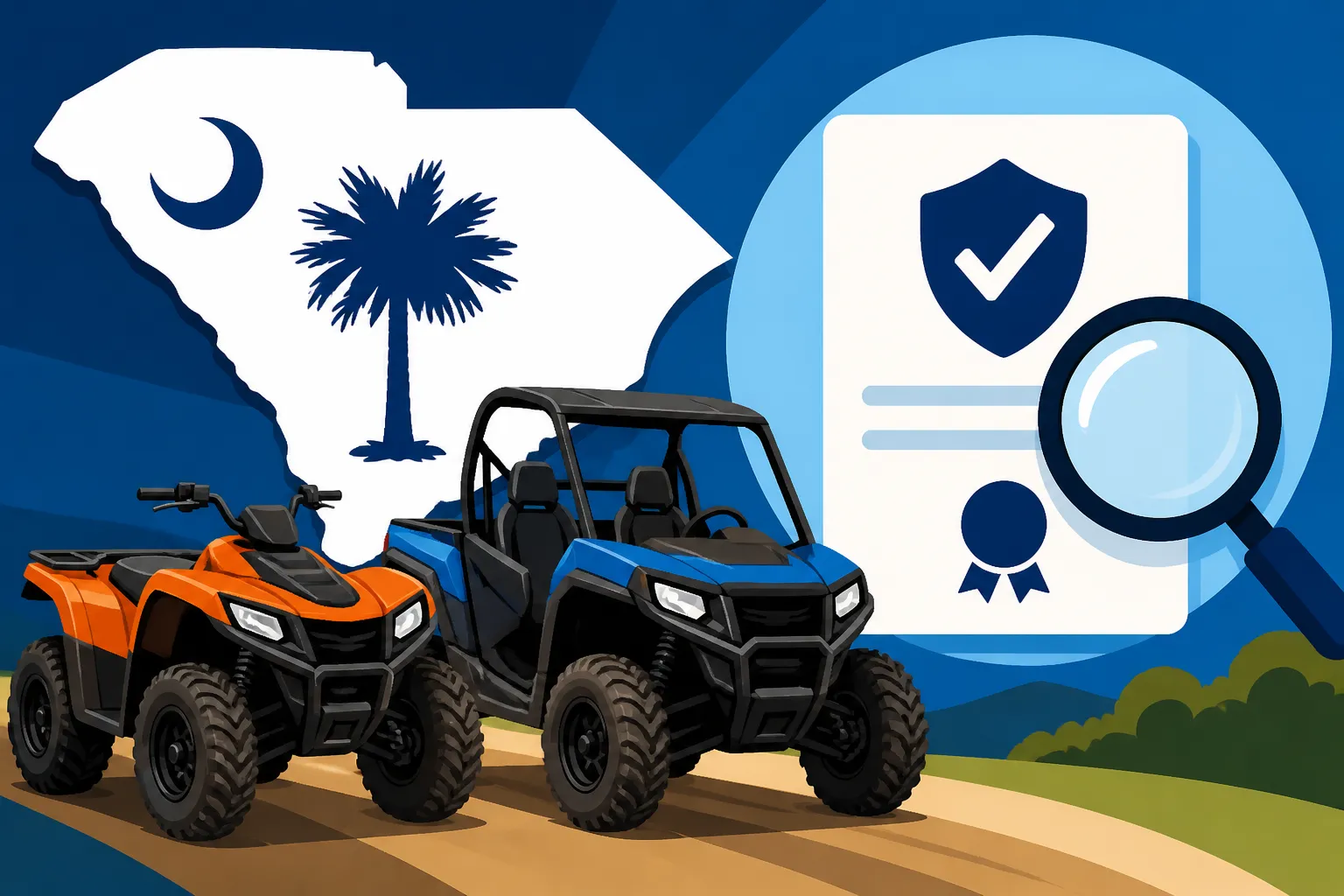
South Carolina’s ATV safety certificate is proof that a young rider completed the required safety training. It is not an ATV registration, title, driver’s license, or general permission to ride. A certificate also does not replace rules about supervision, passengers, helmets, or where the machine may be operated.
The state’s requirements apply to young ATV riders, including riders age 15 and younger. Because requirements can depend on the rider, machine, and situation, check the current rule before relying on an old certificate or assuming an exemption applies. The broader South Carolina Safety Certificate Requirements explain who needs training and when proof matters.
A certificate usually records that a rider successfully completed an approved course. It is different from a course enrollment confirmation, a payment receipt, or an email saying that a class was scheduled. If a rider has not finished the required course, a registration email or a parent’s statement is not a substitute for a completion certificate.
| Document or item | What it shows | Is it the safety certificate? |
|---|---|---|
| Course completion certificate | The rider completed an approved safety course | Yes, if it is the accepted certificate for that course |
| Course enrollment email | The rider signed up for training | No |
| Payment receipt | A course fee was paid | No |
| ATV title or bill of sale | Ownership or purchase information | No |
| Driver’s license or permit | Driving privileges for applicable vehicles | No |
| Parent’s note | A parent’s statement about training | No |
The certificate is about training, not ownership. South Carolina does not require off-road ATV registration, and a rider may need to answer ownership questions separately. For that distinction, see South Carolina Does Not Register Off-Road ATVs and [South Carolina Proof of Ownership on the Trail].
It is also important not to assume that an ATV safety certificate automatically satisfies every rule for a side-by-side or a street-driven UTV. Different vehicle categories can have different age, equipment, licensing, and insurance requirements. A certificate earned for one type of course may not cover a different vehicle or road-use situation. See South Carolina Street UTV Requirements Explained for the separate street-UTV rules.
How to find a missing certificate
There may not be one public, statewide search page where every rider can type in a name and instantly download a replacement. Course records are often held by the organization or instructor that delivered the training. Start with the provider shown on the original certificate, course receipt, confirmation email, or parent’s records.
Contact the course provider first
Look through email, paper files, and the rider’s training materials for the course name, completion date, instructor, or provider. Then contact that provider and ask how it verifies course completion and issues replacement documentation. The provider may be able to search its records and explain whether it can send another copy, provide a completion record, or direct you to the organization that manages the certificate.
Give the provider enough information to distinguish the rider from someone with a similar name. Helpful details may include:
- The rider’s full name as it appeared during the course
- The rider’s date of birth
- Approximate course date and location
- Course name or provider
- The parent or guardian’s contact information, if the rider was a minor
- Any enrollment number, certificate number, or confirmation email you still have
For a minor, the provider may require a parent or guardian to make the request or confirm the rider’s identity. Avoid sending sensitive personal details through an unverified email address or social media account. Use the provider’s official contact method.
If the rider took a course through an ATV Safety Institute provider, ask that provider how to retrieve or replace the completion record. The course must be one that meets South Carolina’s applicable requirement; a general online safety video or training from an unrelated organization may not count. The details are covered in Only an ATV Safety Institute Course Counts and South Carolina Safety Courses for Riders 15 and Under.
If the provider cannot locate the record
Ask the provider whether records were transferred, whether another organization handles certificate copies, or whether the rider can verify completion another way. If the provider has closed or changed its record system, contact the organization that administered or approved the course and ask where older records are kept.
If you still cannot confirm the certificate, contact the relevant South Carolina agency or office responsible for ATV safety requirements before the next ride. Ask a specific question: what proof is accepted for a young rider who completed training but cannot obtain the original certificate? The answer may depend on the course and the rider’s circumstances, so do not assume that a photo of an old card, a parent’s statement, or a database screenshot will be accepted.
If the record cannot be recovered, ask whether the rider needs to complete an approved course again. Repeating training may be inconvenient, but it is better than relying on paperwork that cannot be verified. Before booking, confirm that the provider and course meet South Carolina’s current requirements.
What to do before the next ride
If a ride is coming up and the certificate is missing, separate two questions: did the rider complete the required course, and can the rider show acceptable proof of that completion? A rider may have finished training but still face a practical problem if no certificate or verified record is available.
Use this process:
- Check the rider’s records. Search email, texts, paper folders, and course materials for a certificate, completion notice, or provider contact.
- Contact the course provider. Request a replacement or written verification and ask how long retrieval may take.
- Confirm what counts as proof. If the provider cannot issue the certificate, ask the appropriate state office what alternate documentation is acceptable.
- Do not treat unrelated documents as a substitute. A title, bill of sale, insurance card, or registration document does not establish course completion.
- Keep a usable copy once recovered. Save a digital copy and carry a paper copy if the rider may need to show proof during a ride or check.
A phone photo can be useful as a backup, but it is sensible to keep the original or an official replacement when available. Make sure the copy is readable: the rider’s name, course provider, completion status, and certificate details should not be cut off or blurred. If the provider sends a digital certificate, save it somewhere accessible offline instead of relying on a signal at a trailhead.
Keep the certificate with other riding paperwork, but do not confuse it with proof of ownership. A rider may need to show that the machine is lawfully possessed as well as that the rider completed training. The separate ownership question is discussed in South Carolina Machines With No Paperwork.
The certificate also does not waive the rules that apply after training. Young riders still need to follow applicable supervision and passenger restrictions, wear required protective equipment, and ride only where access is allowed. Review South Carolina Rules for a 15-Year-Old Rider and [South Carolina Rules for a Young Passenger] when planning a ride with a minor.
Common lookup problems and how to avoid them
The most common problem is searching for a single “South Carolina certificate lookup” page and assuming no result means the rider never completed training. Course records may be held by the original provider instead of appearing in a public search. Contacting the provider with identifying details is usually the most direct first step.
Another problem is using the wrong name. A rider may have enrolled under a shortened name, a different spelling, or a parent’s email address. If a search does not locate the record, tell the provider about possible variations and provide the approximate date and course location.
A certificate can also be confused with a card or record from a different safety program. Before presenting it as proof, confirm that it documents successful completion of the course required for the rider’s situation in South Carolina. A certificate from another state or an online-only program may require review. Ask the provider or state office rather than guessing.
Finally, do not wait until a trailhead check to sort out the paperwork. Requesting a replacement before the riding date gives the provider time to search its files and gives you time to clarify whether an alternate record is acceptable. If a young rider’s training status cannot be verified, postpone the ride until you have confirmed the requirement and obtained acceptable proof.
Disclaimer
This article is for general informational purposes only and does not constitute professional advice. Laws, prices and regulations vary by location and change over time. Consult a qualified professional for guidance on your specific situation.