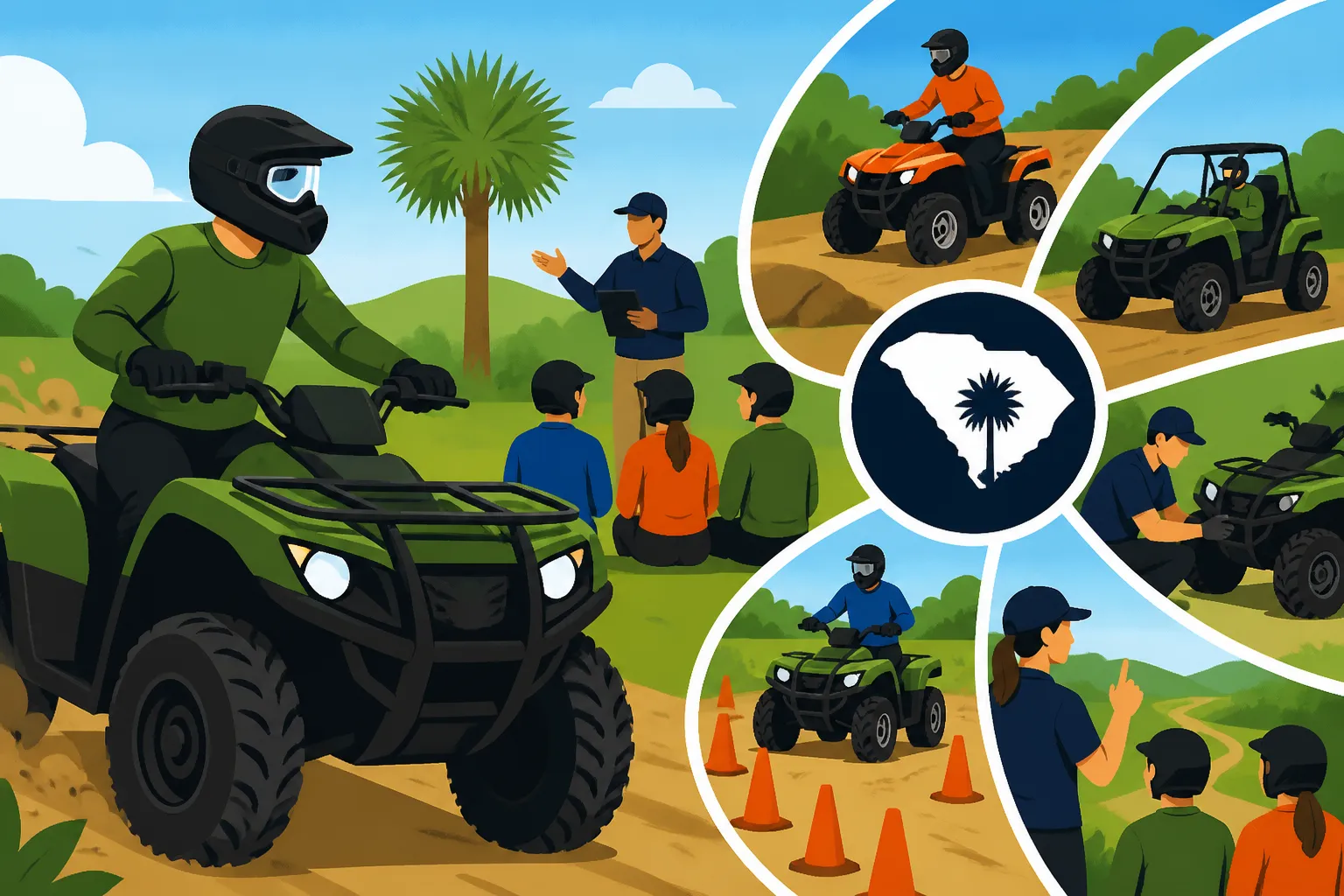
What Happens at an ATV RiderCourse Session
An ATV RiderCourse session can feel like a mystery until you know whether it is classroom training, a riding test, or both. In South Carolina, the course combines safety learning with supervised practice, but the details can vary by provider. Here’s how a typical session works, how to prepare, and what a certificate does—and does not—allow you to do.
What happens during an ATV RiderCourse
The ATV RiderCourse is designed to build safe habits, not just check off a requirement. Expect instruction on operating an ATV, followed by practical exercises on a designated riding area. The exact schedule and equipment arrangements depend on the course provider, so confirm the details when you register.
Many courses begin with an online learning component that you complete before attending the hands-on session. It covers basic safety concepts and gives you a foundation for the instructor-led portion. Check your enrollment instructions: some providers require the online work in advance, while others explain the sequence differently. The Two-Hour Online Course That Comes First
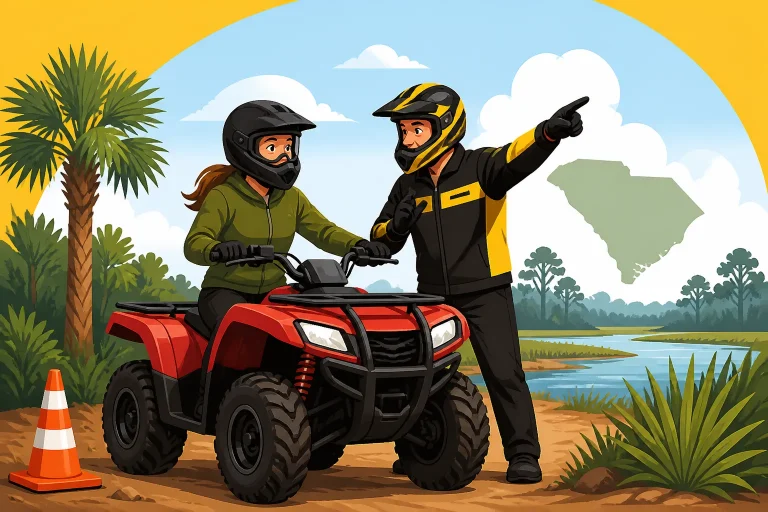
At the in-person session, an instructor typically reviews key points, demonstrates techniques, and explains how the practice area will work. The riding portion is supervised. Riders may practice starting and stopping, controlling speed, turning, braking, and maneuvering around marked features. Exercises are meant to help you build control gradually, not to encourage speed or aggressive riding.
A session may follow a structure like this:
- Check-in and equipment review. The instructor confirms participants, explains the schedule, and checks that riders have the required protective gear.
- Safety briefing. The group reviews ATV controls, riding posture, common hazards, and the rules for using the practice area.
- Instructor demonstration. The instructor shows how to approach each exercise and what safe control looks like.
- Supervised riding practice. Participants take turns completing basic skills exercises at a pace suited to the training.
- Review and course completion. The instructor may discuss the exercises, answer questions, and explain how completion is documented.
The course is not necessarily a single, identical experience everywhere. Class size, site layout, weather, the ATVs available, and the instructor’s schedule can affect how the day runs. Ask the provider how long the in-person session lasts and whether you should expect to ride continuously or wait while other participants take turns. The state’s course structure and training details are covered in South Carolina Rider Course Structure.
If you are taking the course because a young rider needs a safety certificate, confirm the exact course and completion documentation required before booking. A course with a similar name may not satisfy the same requirement. South Carolina Safety Certificate Requirements
What to bring and how to prepare
The most useful preparation is to read the provider’s instructions closely. Do not assume that every course supplies the same equipment or that you can arrive with any ATV. Providers may differ on whether participants use their own machines, a training ATV, or equipment arranged through the course. Ask before you travel, especially if you are booking for a child.
Use this checklist when you register:
| Before the session | What to confirm |
|---|---|
| Course eligibility | Minimum age, participant requirements, and whether a parent or guardian must attend |
| Online work | Whether it is required, how to access it, and when it must be finished |
| ATV arrangements | Whether the course supplies a machine or you must bring one |
| Protective gear | Helmet type, eye protection, gloves, boots, and any other required clothing |
| Site details | Address, check-in time, parking, and where the riding exercises take place |
| Weather policy | What happens if rain, heat, or another condition affects the class |
| Completion record | What proof you receive and how to request a replacement if it is lost |
Dress for controlled riding
Wear clothing that covers your arms and legs, along with sturdy footwear that protects your ankles. A helmet and eye protection are central pieces of riding protection; follow the course provider’s requirements for approved equipment. Gloves can improve comfort and grip, but they are not a substitute for a properly fitted helmet or safe riding behavior.
If you need to buy basic gear, focus on fit, protection, and compatibility with the course rules rather than choosing items by appearance. A marketplace such as Amazon may offer a wide selection, but confirm the helmet’s safety certification and sizing details before ordering. If you already own gear, bring it only if the provider says it meets the course requirements.
Avoid new boots or gloves that you have not tried on before the session. Stiff footwear can make it harder to feel the controls, and badly fitting gloves can interfere with grip. If you wear glasses, ask whether your eye protection fits over them.
Prepare your participant
A young rider should know that the course is training, not a race or a chance to show off. Explain that listening to the instructor, waiting for a turn, and following directions are part of the work. Participants who are nervous can tell the instructor before the riding exercises begin. It is better to ask for a demonstration or a slower explanation than to attempt a maneuver without understanding it.
If the rider has little or no experience, say so when you register. Providers can explain whether the class is appropriate for a beginner and whether there are prerequisites. Do not assume that a child’s age alone tells you whether they are ready to control the ATV used in training.
Plan for the day
Arrive with enough time to check in and organize your gear. Bring water, weather-appropriate clothing, and any paperwork the provider requested. Leave extra time for travel and parking; a late arrival may mean missing the safety briefing, and a provider may not be able to fit a late participant into the session.
The class may involve standing, listening, and repeating physical exercises. A rider who is sick, exhausted, or uncomfortable in the weather may have difficulty concentrating. If the participant has an injury or accessibility need, ask the provider in advance whether the site or exercises can accommodate it.
What the riding exercises teach
The hands-on portion is about establishing basic control under supervision. It is not a substitute for ongoing practice, and passing an exercise does not mean a rider is ready for every trail, road, or machine. A useful session helps participants recognize how their inputs affect the ATV and how to respond calmly when a maneuver feels unfamiliar.
Common skills may include mounting and dismounting safely, identifying controls, starting and stopping, maintaining a controlled speed, turning, and braking. Instructors may also discuss how to look ahead, keep a stable posture, and adjust riding technique to the terrain. The precise exercises depend on the course and site. Learning on a Real Quad With an Instructor
The instructor will usually explain a maneuver before participants try it. Pay attention to where to look, how to position your body, how much speed to use, and where to stop. If a direction is unclear, ask before starting. Do not copy another participant if you did not hear the explanation or cannot see the instructor’s demonstration.
The point is controlled repetition. A rider may need several attempts to feel comfortable with a basic skill. Take the time to reset between attempts, and do not increase speed just because another participant appears confident. A training area is a place to practice safe technique at a manageable pace.
What the course is not
An ATV RiderCourse is not a trail pass, a vehicle registration, or permission to ride wherever you choose. It does not grant access to private land, public riding areas, or roads. Land managers and riding parks may have their own entry requirements, and those rules are separate from course completion.
It is also not a guarantee that the participant can operate every ATV safely. Machines differ in size, controls, power, and handling. A rider trained on one ATV still needs to understand the machine they plan to use and follow the manufacturer’s age and size guidance. Course completion should support—not replace—adult judgment about whether a rider is ready for a particular machine.
If your next step is a public forest trail, check the site’s access rules separately. South Carolina forest passes and private park passes work differently, and a safety certificate does not replace either. See South Carolina Passes Cover All Four Trails for the forest-pass context, and check the riding area directly for current operating rules.
Certificates, South Carolina rules, and what completion means
A successful course may provide a certificate or other record of completion. Ask the provider what documentation is issued, whether it is paper or digital, and how long it takes to receive. Keep the record somewhere accessible and take a photo or scan for your own files. If the rider needs proof for a legal requirement, confirm that the document is the specific certificate accepted for that purpose.
South Carolina has safety-course requirements that apply to young riders in certain circumstances. The details depend on the rider’s age and where and how the ATV is being operated. Do not treat course completion as a blanket exemption from age, supervision, helmet, passenger, or operating rules. Review South Carolina Rules for a Supervising Adult and [South Carolina Rules for a Young Passenger] if a minor will be riding.
For a broader look at the certificate requirement and who it applies to, see The Safety Certificate a South Carolina Teen Needs. The practical takeaway is simple: confirm the rule that applies to the rider before choosing a course, then verify that the provider issues the required proof.
Adults should not assume that the course is mandatory for them just because it is required or recommended for a younger rider. At the same time, voluntary training can be useful for an adult who is new to ATVs, returning after a long break, or learning on a machine with different controls. South Carolina’s course information distinguishes between requirements for minors and adult training; No Certificate Needed as an Adult explains that distinction.
A certificate also does not replace other rules that apply during a ride. Riders still need to use permitted areas, follow age and supervision requirements, wear any required protective equipment, and obey restrictions on roads and trails. South Carolina ATV Age Requirements and South Carolina ATV Helmet Law can help you check those separate issues.
If you are planning a trip from another state, keep the course certificate separate from questions about visitor access or local riding rules. A course record may show training completion, but it does not automatically establish that a visiting rider meets every South Carolina requirement. Check the rules for the particular riding area and the rider’s situation before setting out.
Common questions to settle before booking
Course logistics are a frequent source of avoidable confusion. A quick call or email to the provider can clarify whether the class fits the rider, whether the correct machine will be available, and what documentation to expect. Ask direct questions and keep the answers with your registration details.
Does every course use the same ATV RiderCourse format?
No. The general purpose is safety training with supervised practice, but the schedule, site, equipment, and enrollment steps can vary. Confirm the format directly with the provider. South Carolina Course Providers
Do I need to bring my own ATV?
Do not assume either way. Some courses may have training machines available; others may require participants to bring an ATV that meets specified conditions. Ask about the machine’s size and type, fuel, transport, and any inspection or paperwork requirements before showing up.
If you are bringing a machine, ask whether the provider has limits based on engine size, condition, or rider fit. The participant must be able to reach and operate the controls safely. A machine that is too large or unfamiliar can make a basic class unnecessarily difficult.
What if a rider is nervous or struggles with an exercise?
Tell the instructor. A course is intended for learning, and asking for another explanation is better than guessing. If a participant cannot safely complete an exercise, the instructor may adjust the pace or explain what options are available. Ask the provider beforehand how it handles a rider who needs extra time or cannot complete the riding portion.
How long does the session take?
The total time depends on the provider’s online and in-person schedule, the number of participants, and local arrangements. The course may include work to complete before the riding day. Get the expected start and end times when you enroll, and leave room for the schedule to shift.
Does the certificate let me ride on South Carolina roads?
No. Course completion is not road authorization. ATV and UTV rules differ, and a machine that is legal to use off-road is not automatically street-legal. Check the applicable vehicle and road rules separately before taking any machine onto a public road.
Frequently Asked Questions
Is the hands-on portion a race or skills competition?
No. It is supervised practice focused on safe control. Riders should work at a controlled pace and follow the instructor’s directions.
Can a complete beginner take the course?
Many courses are intended to teach foundational skills, but eligibility and experience expectations vary. Tell the provider the rider’s age and experience level before registering.
Should I bring a helmet if I am unsure whether the course provides one?
Ask the provider first. If you have a suitable helmet, ask whether it meets the course’s requirements and bring it if approved. Do not rely on assumptions about shared or loaned gear.
Is a certificate enough to access a trail?
No. A certificate documents training; it does not replace a forest pass, park entry requirement, landowner permission, or other access rule.
Disclaimer
This article is for general informational purposes only and does not constitute professional advice. Laws, prices and regulations vary by location and change over time. Consult a qualified professional for guidance on your specific situation.