South Carolina Title for a Side-by-Side
When you've just bought a shiny new side-by-side or are looking to sell your trusty trail companion in South Carolina, the question of a title can feel like navigating a muddy creek bed – confusing and full of unexpected turns. Unlike passenger cars, the rules for off-road machines, including side-by-sides, aren't always crystal clear, leading many owners to wonder if they even need a title. This guide will cut through the confusion, helping you understand when and how to title your side-by-side in the Palmetto State, ensuring you're prepared for whatever the trail, or the DMV, throws your way.
Understanding Side-by-Side Titling in South Carolina
In South Carolina, the legal landscape for off-road vehicles, including side-by-sides, has its own unique characteristics. It’s not as straightforward as titling a car or truck, and this often leads to a lot of head-scratching among owners. The core distinction lies in how the state views machines intended purely for off-road use versus those that might eventually see road time.
The Optional Nature of Off-Road Titles
For many years, and still largely true for machines used exclusively off-road, obtaining a title for an ATV or side-by-side in South Carolina has been considered optional. This means if you buy a side-by-side and only ever plan to ride it on private land, at designated off-road parks like Carolina Adventure World, or on federal forest trails with the appropriate passes, the state does not mandate you get a title. It's a common practice that many riders, particularly those who've owned machines for a long time, adhere to. They simply keep their bill of sale or Manufacturer's Certificate of Origin (MCO) as proof of ownership. However, just because it's optional doesn't mean it's always the best path, and you might find yourself in a bind later if you haven't taken this step. For more on this, check out [South Carolina Titles Are Optional].
This optional status stems from the fact that these machines aren't registered for street use, and therefore, the state hasn't historically required the same level of formal documentation as it does for vehicles that operate on public roads. It can feel liberating not to have another piece of paper to worry about, but this freedom comes with its own set of potential complications down the line, especially if you ever decide to sell or if your machine is stolen.
When a Title Becomes Essential
While titling might be optional for pure off-road use, there are several key situations where a South Carolina title for your side-by-side becomes absolutely essential. Ignoring these instances can lead to significant headaches, delays, or even financial loss. The most common scenario is when you need to finance your purchase. Most lenders, whether a bank, credit union, or the dealer's finance department, will require a clear title as collateral for the loan. Without it, securing financing for a new or used side-by-side can be incredibly difficult, if not impossible. Lenders want assurance of legal ownership, and a title provides that. [Lenders That Will Not Finance an Untitled Quad] is a real hurdle for many buyers.
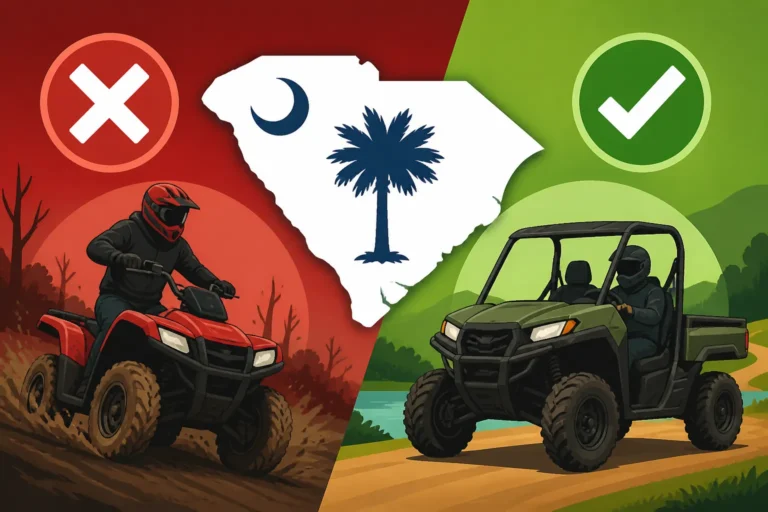
Another critical time a title is needed is if you plan to make your side-by-side street-legal. With the advent of new legislation, many side-by-side owners are exploring the option of registering their machines for limited road use. To do this, you absolutely must have a title in your name. The South Carolina Department of Motor Vehicles (DMV) will not issue a street-legal registration and license plate without first verifying and recording legal ownership through a title. This is a foundational step for anyone looking to take advantage of the recent changes allowing UTVs on certain secondary roads. Also, for insurance purposes, especially comprehensive or collision coverage, many providers prefer, and some even require, a title to properly insure your valuable asset. [Insurers That Ask for a Title First] for good reason – it proves you have an insurable interest.
Distinguishing ATVs from Street-Legal UTVs
It's crucial to understand the distinction between an all-terrain vehicle (ATV) and a utility terrain vehicle (UTV), especially concerning their street-legal status and titling requirements in South Carolina. While a side-by-side is a type of UTV, the general term "ATV" often gets used interchangeably in conversation, but legally, there can be differences. For the purpose of titling, South Carolina's optional titling provisions generally apply to both ATVs and UTVs used exclusively off-road.
However, the game changes entirely if you intend to convert your UTV (side-by-side) into a street-legal vehicle. In this instance, your machine transitions from being merely an "off-road vehicle" in the eyes of the state to a "street-legal UTV" that must meet specific equipment requirements and undergo a formal registration process. This process, which [South Carolina Street-Legal UTV Registration Arrives] to make possible, fundamentally requires a title. An off-road-only side-by-side doesn't get a license plate or biennial registration fee, but a street-legal UTV does. So, while your trail-only side-by-side might remain untitled, a UTV you want to drive on public roads will need that title as a prerequisite for registration and to receive its designated rear license plate. The requirements for titling a side-by-side are largely similar to those for an ATV, but the implication of titling changes drastically depending on whether you're staying off-road or heading to the pavement.
The Process of Titling Your Side-by-Side
Getting a title for your side-by-side in South Carolina, even when optional, is a prudent step that safeguards your investment. The process can vary slightly depending on whether you're buying new from a dealer or used from a private seller. Understanding these distinctions will make your trip to the DMV much smoother and less stressful.
Titling a New Side-by-Side from a Dealer
When you purchase a brand-new side-by-side from a dealership in South Carolina, the titling process is usually the most streamlined. Dealers are accustomed to handling the necessary paperwork and often submit it on your behalf, or at least provide you with everything you need. The most important document you'll receive from the dealer is the Manufacturer's Certificate of Origin, or MCO. This document is essentially the "birth certificate" for your side-by-side, proving it's a new machine and listing its specifications and original ownership. Without this, you cannot title a new machine.
The dealer will typically collect your personal information, the purchase price, and any applicable sales tax. They'll prepare the necessary forms, usually the South Carolina Title Application (Form 400), for your signature. Once signed, they may forward these documents directly to the DMV, or they might give them to you to submit. If you're handling the submission yourself, you'll need to take the MCO, your completed Form 400, proof of identification (like your driver's license), and payment for the title fee to your local DMV office. It's always a good idea to call ahead or check the DMV website for their specific requirements and accepted payment methods before you go.
Titling a Used Side-by-Side from a Private Seller
Buying a used side-by-side from a private seller presents a slightly different scenario, and this is where many people run into snags if they're not careful. The most critical piece of paper you'll need is the previous owner's existing title, properly assigned over to you. This means the seller must sign and date the "assignment of title" section on the back of their title, and often provide their printed name and address. If the machine was financed, ensure any lienholder's release is also attached or marked on the title. A missing signature or an incomplete assignment can halt the titling process entirely.
In addition to the assigned title, it's highly recommended, and often necessary for the DMV, to have a Bill of Sale. This document should clearly state the buyer's and seller's names, addresses, the date of sale, the purchase price, and the side-by-side's vehicle identification number (VIN). Both parties should sign and date it. If you're concerned about having all your ducks in a row for a private sale, legal document services like LawDepot offer customizable bill of sale templates that can help ensure you don't miss any crucial details. Having a robust bill of sale protects both buyer and seller. You can learn more about this specific process by looking up [South Carolina Titles After a Private Sale].
Required Documents for Titling
Regardless of whether your side-by-side is new or used, you'll need to gather a specific set of documents to successfully apply for a South Carolina title. Missing even one piece of paper can lead to frustrating delays and multiple trips to the DMV.
Here’s a general checklist of what you should have:
- South Carolina Title Application (Form 400): This is the primary form for titling any vehicle in the state. You'll fill out your personal information, vehicle details, and indicate that you're applying for a title for your side-by-side.
- Proof of Ownership:
- For a new machine: The Manufacturer's Certificate of Origin (MCO).
- For a used machine: The previous owner's properly assigned title. If the machine never had a title (because it was always used off-road and thus optional), you might need a sworn affidavit and a detailed bill of sale, often requiring additional scrutiny from the DMV. [South Carolina Proof of Ownership Without a Title] is a tough spot to be in, but not impossible.
- Bill of Sale: While not always strictly required if you have a properly assigned title, it's highly recommended. It serves as proof of purchase price and sale date, which is critical for calculating any applicable taxes. If you need a solid template, LawDepot can be a helpful resource.
- Proof of Identification: A valid South Carolina driver's license or state-issued ID card. If you're a new resident, you might need additional proof of residency.
- Payment for Fees: Be prepared to pay the titling fee. While I can't give specific figures, expect a modest charge for the title itself, separate from any registration fees if you're making it street-legal. For reference, [What a South Carolina ATV Title Costs] will give you an idea of the expense.
Navigating the DMV for a Side-by-Side Title
Visiting the South Carolina DMV can sometimes feel daunting, but with all your documents in order, the process for obtaining a side-by-side title can be relatively smooth. Once you have all your required paperwork (Form 400, MCO or assigned title, bill of sale, ID, and payment), head to your nearest DMV office. It's often helpful to go during off-peak hours if possible, though this isn't always feasible.
At the counter, a DMV clerk will review your documents, verify the VIN, and process your application. They'll also collect the title fee. This is also where you might pay any sales tax or infrastructure maintenance fee on the purchase price, if applicable and not already handled by a dealer. The DMV will issue you a receipt, and your official title certificate will typically be mailed to you within a few weeks. If you're in a hurry, some DMV offices offer an expedited service for an additional fee, allowing you to walk out with your title the same day. This can be a godsend if you're trying to quickly complete a sale or get financing. Make sure to check [South Carolina Title Applications at the DMV] for additional guidance.
Specific Scenarios and Common Questions
Life doesn't always fit neatly into a standard "new from dealer" or "used from private seller" box, and titling a side-by-side can throw some curveballs. Understanding how to handle less common situations, like inheriting a machine or dealing with missing paperwork, is crucial for any side-by-side owner in South Carolina.
Titling an Inherited Side-by-Side
Inheriting a side-by-side can be a bittersweet experience, and dealing with the title transfer often adds an layer of administrative complexity during an already difficult time. To title an inherited side-by-side, you'll generally need several documents to prove your legal right to the machine. This typically includes a certified copy of the death certificate of the previous owner, along with documentation from the probate court or an affidavit of inheritance. If there's a will, a copy of the will indicating you as the beneficiary of the side-by-side (or the estate residue) would be necessary. If the estate went through probate, letters of administration or letters testamentary appointing you as the executor or administrator will be vital.
Once you have these legal documents, you'll complete the South Carolina Title Application (Form 400), just like any other titling process, and submit it along with the previous owner's title (if one existed) and the necessary death and probate documents to the DMV. If the inherited side-by-side never had a title, the process might involve further steps to establish clear ownership for the estate before it can be transferred to you. For a deeper dive into this specific scenario, consult [South Carolina Titles for an Inherited Machine].
When Paperwork is Missing Bill of Sale or Previous Title
One of the most common and frustrating scenarios for side-by-side owners is dealing with missing paperwork. Perhaps you bought a used machine years ago with just a handshake, or the original bill of sale has simply vanished. If you don't have a previous owner's title or a solid bill of sale, titling your side-by-side becomes significantly more challenging but not necessarily impossible.
If you have no title, but proof of purchase like a canceled check or even sworn affidavits from the seller (if you can locate them) and witnesses, the DMV might consider accepting these as evidence. However, they will often require a bonded title. This process involves purchasing a surety bond for a certain value of the side-by-side, which protects the state and any potential previous owners if a claim to ownership arises later. It's an extra expense and an additional step, but it can be the only way to formally title a machine with incomplete paperwork. In some cases, a carefully drafted affidavit of ownership, which could be sourced through a platform like LawDepot, might help your case with the DMV, though they will ultimately decide what proof is sufficient. The situation addressed in [South Carolina Title Without a Bill of Sale] outlines just how tricky this can be.
Out-of-State Purchases and New Residents
Bringing a side-by-side into South Carolina from another state, whether you bought it there or are moving as a new resident, also requires specific steps. If you purchased the machine out of state, you'll need the title from that state, properly assigned to you by the seller. You'll follow the standard titling procedure at the South Carolina DMV, presenting your out-of-state title, a bill of sale, and completing Form 400. You will also be responsible for paying South Carolina's sales tax or infrastructure maintenance fee on the purchase price, even if you paid sales tax in the other state, though there might be credit for taxes paid elsewhere under specific circumstances.
For new residents moving to South Carolina with an already-owned side-by-side, the process is similar. You'll need your out-of-state title, proof of South Carolina residency, and your completed Form 400. The DMV will issue a South Carolina title in your name. It's generally a good idea to complete this process soon after establishing residency, especially if you plan to get street-legal registration later. For a comprehensive look at what's required, review [Can an Out-of-State Owner Get a South Carolina Title?].
Titling for Street-Legal UTVs
The legal landscape for UTVs in South Carolina shifted significantly with new legislation allowing properly equipped side-by-sides to be registered for limited street use. If your goal is to make your side-by-side street-legal, obtaining a South Carolina title is the foundational first step. The DMV will not process a street-legal UTV registration or issue a license plate without a clear title in your name.
Once you have the title, you'll then need to ensure your side-by-side meets all the specific equipment requirements to be considered street-legal, such as turn signals, brake lights, a horn, mirrors, and appropriate tires. After the title is secured and your machine is compliant, you can proceed with the street-legal registration application at the DMV. This involves paying a biennial registration fee and providing proof of liability insurance, which is mandatory for street-legal machines. Without a title, the journey to becoming street-legal ends before it even begins.
Benefits of Titling Your Side-by-Side (Even When Optional)
Even though titling an off-road side-by-side in South Carolina is often optional, choosing to get one anyway offers a wealth of advantages that far outweigh the minimal effort and cost. It’s about being proactive and protecting your investment from unforeseen circumstances or future complications.
Establishing Clear Ownership and Deterring Theft
One of the most compelling reasons to title your side-by-side, even if you only ride off-road, is to establish undeniable proof of ownership. A title is the strongest legal document you can hold to show that you are the rightful owner of that specific machine. In the unfortunate event that your side-by-side is stolen, having a title greatly assists law enforcement in recovering your property and prosecuting thieves. Without a title, proving ownership can become a bureaucratic nightmare, often relying on weaker evidence like a bill of sale or photographic proof, which can be much harder to verify definitively.
Furthermore, a titled machine is less attractive to thieves in some ways. While a title won't stop a determined criminal, the presence of a formal ownership document makes it significantly harder for them to resell the machine legally. A buyer who insists on a title, especially if they're trying to finance or insure it, creates a barrier for illicit sales. Having your side-by-side's VIN recorded with the state on a title certificate adds an extra layer of official tracking and verification, increasing the chances of recovery if it's taken.
Easier Resale and Financing
When it comes time to sell your side-by-side, having a title in hand makes the transaction significantly smoother and often increases its market value. Buyers are naturally more confident purchasing a titled machine because it confirms clear ownership and reduces their risk of encountering legal issues down the road. An untitled machine, even with a bill of sale, often raises red flags for potential buyers, forcing them to consider the hurdles they might face trying to title it themselves or being wary of its provenance. Many buyers are simply unwilling to deal with the potential hassle of trying to establish ownership for an untitled machine, particularly if they plan to finance it. [Why a Buyer Wants a Title in Hand] comes down to security and peace of mind.
Similarly, if a prospective buyer needs to finance their purchase, a title is almost universally required by lenders. An untitled machine might only be sellable for cash, severely limiting your pool of potential buyers and potentially driving down the sale price. By having a title already in place, you open up more financing options for your buyers, making your side-by-side a much more attractive and easily marketable asset.
Insurance and Liability Protection
While South Carolina doesn't mandate insurance for off-road ATVs or side-by-sides, many owners choose to carry coverage for their valuable machines, especially for comprehensive or collision protection. When you approach an insurance provider for such coverage, they will almost always ask for the machine's title. The title serves as definitive proof that you have an insurable interest in the side-by-side. It establishes the correct VIN and ensures that the policy is tied to the legally recognized owner. Without a title, some insurance companies may be hesitant to offer certain types of coverage, or the process of underwriting your policy could be significantly more complicated and drawn out.
Beyond comprehensive coverage, having a title can indirectly help with liability. While the title itself doesn't provide liability insurance, it's a foundational document that ensures all other official records, including insurance policies, are accurate and legally sound. Should an incident occur and questions of ownership arise, a clear title simplifies the legal and insurance claim process, making it easier to resolve disputes and ensure you receive proper compensation for damages or losses.
Avoiding Future Headaches
Proactively titling your side-by-side now can save you a world of headaches in the future. Laws and regulations can change, and what is optional today might become mandatory tomorrow. By having your title already established, you'll be well-prepared for any new requirements without scrambling to gather old paperwork or going through a potentially complex bonded title process.
Consider situations like moving to another state. Most other states do require titles for off-road vehicles, and having a South Carolina title makes transferring ownership and registration in your new state much simpler. If you decide to sell your machine to someone in a state with mandatory titling, having a title from South Carolina will significantly ease their purchase and subsequent titling process. Even if you simply decide to make your side-by-side street-legal in South Carolina down the line, having the title ready means one less bureaucratic hoop to jump through. It's a small investment of time and money now that can prevent significant frustration and potential costs down the road.
Here's a quick overview of the key differences:
| Feature | Titled Side-by-Side (SC) | Untitled Side-by-Side (SC) |
|---|---|---|
| Legal Proof of Ownership | Strongest, state-recognized document | Relies on bill of sale, MCO, or affidavits |
| Resale Value | Generally higher, easier to sell | Potentially lower, more difficult to sell |
| Financing Options | Readily available from most lenders | Extremely limited or unavailable |
| Theft Recovery | VIN on file with state, aids law enforcement | Harder to track, relies on owner-provided info |
| Insurance Eligibility | Easier to obtain comprehensive/collision coverage | Some insurers may be hesitant or require more proof |
| Street-Legal Registration | Mandatory prerequisite for UTV plates | Cannot be registered for street use |
| Future Law Changes | Already compliant with most likely future requirements | May require additional steps if titling becomes mandatory |
| Transfer to Other States | Smooth transfer to states with mandatory titling | Can be a significant hurdle for new owners in other states |
Disclaimer
This article is for general informational purposes only and does not constitute professional advice. Laws, prices and regulations vary by location and change over time. Consult a qualified professional for guidance on your specific situation.