South Carolina Riding Areas With RV Hookups
Finding a South Carolina trail that welcomes your ATV is one thing; finding a campsite where your RV can plug in nearby is another. Forest trailheads often have parking but not hookups, and campground listings can leave important details unclear. This guide explains where to start, what to confirm before you book, and how to plan a ride-and-camp weekend without an unpleasant surprise at check-in.
Best starting point for ATV riding with RV hookups
Carolina Adventure World near Winnsboro
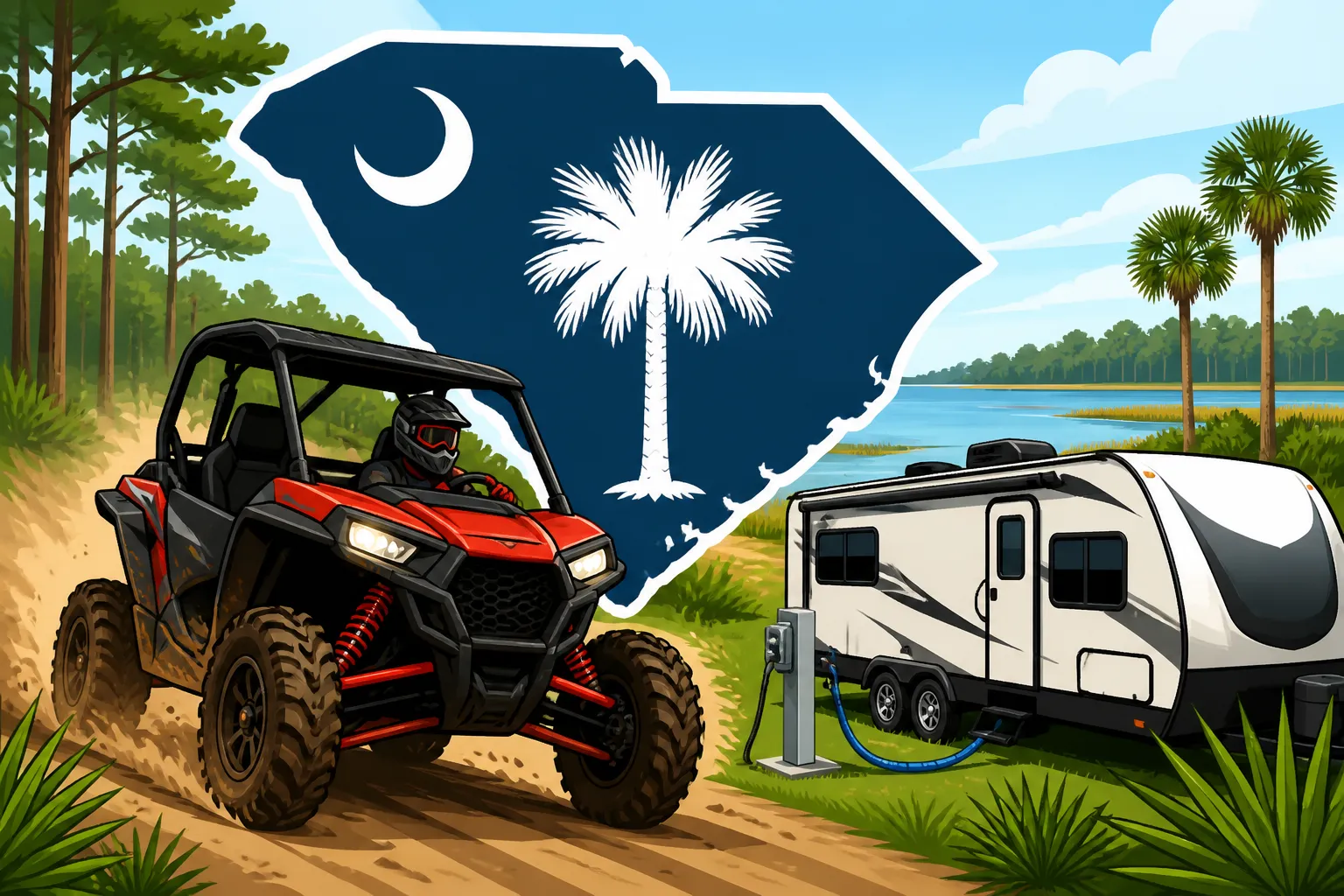
If you want to ride and camp in the same general place, Carolina Adventure World near Winnsboro is a practical first option to investigate. It’s a private riding destination with a large trail system and RV camping options, including sites listed with water and electrical hookups. That combination can simplify a weekend: you can avoid towing the machine between a separate campground and riding area, and you can settle into camp without relying on a forest trailhead for services.
The convenience is especially helpful for families, groups bringing more than one machine, and riders who prefer a predictable base. After a muddy day, being able to return to an RV site rather than pack up and drive to another town can make the trip feel much less hectic. It also gives you a place to organize helmets, tools, food, and wet gear before the next ride.
Before booking, confirm exactly what “hookups” means for the specific site you’re reserving. Ask whether it has water and electric service, what type of electrical connection is available, whether there is a sewer connection or a dump station, and whether the site can fit your RV and tow vehicle together. Hookup availability and site layout can differ, so don’t assume every site has the same services. The park’s own booking information is the place to verify current facilities, availability, and rules.
For an overview of the riding destination itself, see [Carolina Adventure World in South Carolina]. If your main concern is knowing what the trail network offers before you commit to a weekend, [Carolina Adventure World's 100 Miles] gives you a closer look at the riding side of the trip.
What to expect at a forest trailhead
South Carolina’s public forest OHV trails can be excellent places to ride, but a trailhead is not automatically an RV campground. A staging area may provide somewhere to park and unload without offering water, electricity, sewer service, or a place to stay overnight. That difference matters when you are planning a larger motorhome or traveling with a trailer and several machines.
The Enoree OHV Trail is one example of a public riding area in the Sumter National Forest. Its staging area gives riders a place to access the trail, but you should treat nearby RV services as a separate part of your planning. [Enoree OHV Trail in South Carolina] and [South Carolina's Four National Forest Trails] can help you compare public forest riding options. For information about camping near the Enoree staging area, [Brick House Campground Beside the Enoree Staging Area] is a useful lead; contact the campground directly to confirm the type of RV sites and hookups available.
Do not plan on using a trailhead parking lot as an overnight campsite unless the land manager explicitly allows it. Rules can differ between public forest sites and private riding parks, and overnight parking may be restricted even when day-use parking is available. If you’re considering another public trail, check its current camping and parking rules before you haul. [South Carolina Trails With Camping] is a useful starting point, but confirm the details for the particular campground or forest site you plan to use.
Compare your camping and riding options
RV hookups and trail access at a glance
The right choice depends on whether your priority is full-service RV camping, public-land trail riding, or staying as close as possible to a particular trailhead. Use this comparison to narrow the options, then verify the details directly before making a reservation.
| Option | Riding setup | RV hookup approach | Best for | Confirm before you go |
|---|---|---|---|---|
| Carolina Adventure World near Winnsboro | Private riding park with an extensive trail network | RV sites are listed with water and electrical service | Riders who want camping and riding in one destination | Exact site services, RV fit, reservation rules, and park requirements |
| Enoree OHV Trail and nearby camping | Public forest trail riding in the Sumter National Forest | Look for a separate campground; do not assume the staging area has hookups | Riders who prefer a forest trail experience | Overnight rules at the trailhead and current services at the campground |
| Other Sumter National Forest trail areas | Public-land riding with access rules that vary by trail | Usually requires separate research for a nearby RV park or campground | Riders comparing public trails and campgrounds | Trail eligibility, campground distance, hookup type, and seasonal closures |
| Private campgrounds near a riding area | Riding may require a drive to a separate park or trail | Depends on the campground and the site reserved | Travelers who value RV amenities over camping at the trail gate | Whether machines may be trailered or ridden on-site, plus hookup and parking details |
A listing that says “RV friendly” does not necessarily mean a site has full hookups. It may simply mean the campground can accommodate some RVs. Likewise, “water and electric” does not always mean sewer is connected at the site. Ask direct questions rather than trying to infer details from a short listing.
How to choose between a private park and a forest trail
A private riding park can make the weekend easier to organize when it offers trails and RV camping in one place. The tradeoff is that you need to follow the park’s admission, vehicle, age, noise, and camping rules. Those requirements can be different from public-forest rules. Read [South Carolina Private Park Passes and Rules] before you go, especially if your group includes children, passengers, or more than one kind of off-road vehicle.
Public forest trails can offer a different kind of ride, but the camping logistics may be less direct. You may need to choose a campground, travel to the trailhead each day, and follow the forest’s own pass and access requirements. Before making a reservation, check that the trail allows your machine. A narrow trail system may not accommodate a full-size side-by-side, even if the campground itself can fit your RV. See [South Carolina Trails That Allow Side-by-Sides] if you’re traveling with a UTV.
Also consider the shape of your trip. If you plan to ride all day and return to the same RV site, on-site or nearby camping can save time. If your group wants to explore different public trails, a centrally located campground may be more useful than one beside a single riding area. Map the campground, trailhead, fuel stops, and any required check-in location together before choosing a base.
Plan your RV and riding details before booking
Ask campground questions that prevent arrival-day surprises
A quick call or message to the campground can clear up details that an online listing may not explain. Start with the RV itself: give the length of the RV, the length of the tow vehicle, and any extra trailer you’ll bring. Ask whether the reserved site can accommodate the whole setup, not just the RV. A site that fits a camper may leave nowhere to park a truck or machine trailer.
Then ask about utilities. Confirm whether water and electricity are available at the site, whether sewer service is provided there or through a dump station, and whether you need to bring particular adapters or hoses. If you rely on air conditioning, medical equipment, or other electrical appliances, verify the site’s electrical service rather than assuming it will meet your needs. Ask about potable water, quiet hours, fire rules, and whether generators are permitted.
Finally, clarify the machine rules. Some campgrounds allow a trailer carrying ATVs but do not allow riding machines around the campground. Others may have specific parking areas for trailers or restrictions on washing muddy equipment. Ask where you can unload, how machines should be secured, and whether the campground has a designated wash area. [South Carolina Riding Areas With Showers] and [South Carolina Riding Areas With Fuel Nearby] can help you think through other practical amenities to check.
Check trail and weather conditions close to departure
Trail conditions can change after heavy rain, maintenance work, or a seasonal closure. This is particularly important in South Carolina, where clay can become slick and sticky, and a route that looked easy on a map may be difficult after wet weather. Check the riding area’s own updates before towing. [South Carolina Wet Weather Trail Closures] explains why a planned ride may not be available even when the campground remains open.
Use a map to plan the drive between your campsite and the trail entrance, but confirm access details with the operator or land manager. onX Offroad can be useful for reviewing routes and orienting yourself before a trip, but do not treat a mapped line as proof that a road or trail is open to your vehicle. Check the riding area’s rules and posted signs, and download or save the information you’ll need before heading into areas with weak cell service.
If you’re going to a public forest trail, check the current pass requirements and where passes must be displayed. If you’re going to a private park, review the park’s admission and vehicle rules. Those are separate systems, so a pass or permission for one place should not be assumed to work at another. For general destination planning, [South Carolina ATV Trails: Where to Ride] can help you compare areas before you settle on a campground.
Build a practical ride-and-camp weekend
A simple planning sequence
Start by choosing the riding area, not the RV site. Decide whether your group prefers the private-park setup near Winnsboro or a public forest trail such as Enoree. Then check that the trails are appropriate for your machines and riders. A destination that works for a narrow ATV may not suit a wide UTV, and a trailhead that accepts day-use vehicles may not have overnight camping.
Next, locate a campground that can accommodate your RV and trailer. If you want to camp at the riding destination, investigate the RV site details directly. If you are considering a nearby campground, map the route to the trail entrance and confirm whether the drive is suitable for your RV. Do not assume the shortest route shown on a phone is the easiest route for a large rig.
After you have checked availability, confirm the site’s utility connections, parking arrangement, and campground rules. Save the reservation details, driving directions, trail rules, and contact information in a place you can access without reliable cell service. onX Offroad can be one part of that preparation for reviewing your route, while the campground and trail operator remain the source for current access and facility information.
Finally, make a weather check before departure and again before unloading. If the trail closes or conditions become unsafe, use the campground as a base for a different activity rather than trying to reach a closed route. A flexible plan is often the difference between a frustrating weekend and one your group still enjoys.
Pack for both the RV and the trail
Keep camping supplies and riding gear organized separately. For the RV, bring the hoses, electrical adapters, leveling equipment, and other items needed for the hookups the campground confirms. For the machines, prepare helmets, eye protection, gloves, boots, basic tools, recovery gear, and a first-aid kit. South Carolina humidity, sudden rain, and red clay can turn a tidy setup into a muddy one quickly, so bring clothes and containers for wet gear.
If you’re traveling with children or a mixed-experience group, allow extra time for unloading, gear checks, and explaining the riding area’s rules. A rushed start can lead to forgotten safety equipment or confusion about where a trail begins. Keep the campground’s check-in instructions and the riding park’s entry requirements handy, since they may be handled separately.
A successful South Carolina ATV camping weekend comes down to matching three things: the trail, the RV site, and the rules for both. Carolina Adventure World near Winnsboro is a natural first place to investigate when you want riding and RV camping close together. For public forest riding, plan on researching camping separately and confirming services rather than assuming a staging area has hookups. Ask specific questions, check conditions before you tow, and leave room in the itinerary for the unexpected.
Disclaimer
This article is for general informational purposes only and does not constitute professional advice. Laws, prices and regulations vary by location and change over time. Consult a qualified professional for guidance on your specific situation.