South Carolina Machines Used Only on a Farm
It can be incredibly confusing to sort through all the rules and regulations for ATVs and UTVs in South Carolina, especially when your machine is a dedicated workhorse on the farm. Many folks wonder if they really need to title or register an off-road vehicle that never leaves their property. This guide is here to help you understand the specific exemptions and important considerations for machines used exclusively on farm property in the Palmetto State.
Understanding South Carolina's Farm Exemption for ATVs and UTVs
When your ATV or UTV is an essential piece of farm equipment, it often falls under specific exemptions in South Carolina law. This distinction is vital because it can save you time, money, and trips to the DMV. However, understanding what truly qualifies as a "farm machine" and the scope of these exemptions is crucial to avoid any misunderstandings or legal issues down the road.
What Qualifies as a "Farm Machine" in South Carolina?
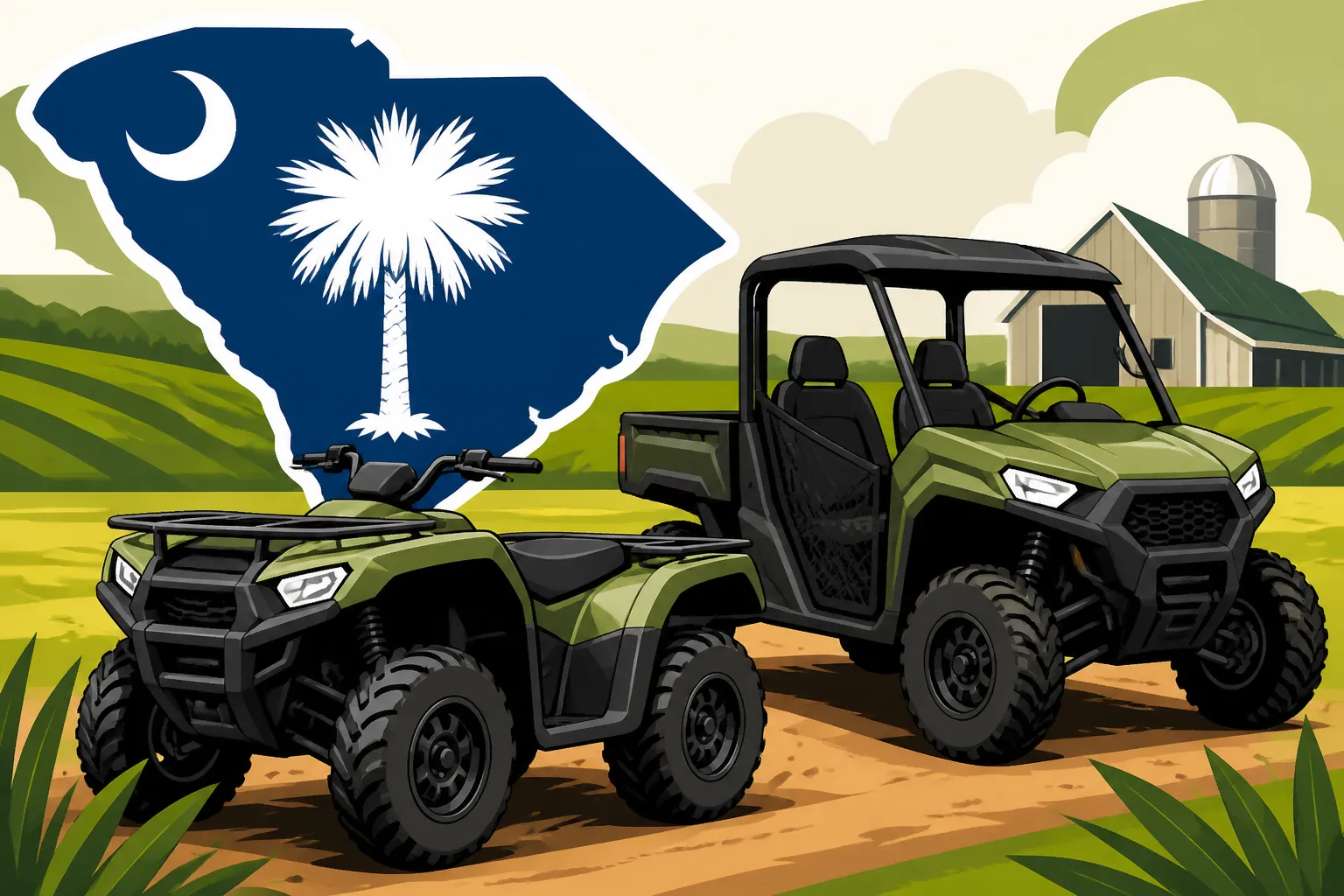
This is where the rubber meets the road, or more accurately, the tire meets the dirt. For an ATV or UTV to truly qualify for South Carolina's farm use exemption, its primary and exclusive purpose must be for agricultural activities on private land. This isn't just a casual distinction; it's outlined in [South Carolina Code Title 50 Chapter 26], often referred to as [Chandler's Law and South Carolina ATV Rules]. Think about the day-to-day operations: hauling feed, inspecting fences, moving tools, checking on livestock, or spraying fields. These are all quintessential farm tasks that align with the spirit of the exemption.
It's not about the color of your machine or whether it has a bed on the back; it's about its use. If your side-by-side is strictly confined to your sprawling pecan orchard or your cattle farm, performing duties directly related to the agricultural enterprise, then it's likely considered a farm machine. This distinction is crucial because it dictates a whole different set of paperwork—or rather, a lack thereof—compared to a machine used for recreational trail riding or even one that occasionally zips down a public road. The intent behind the law is to ease the burden on farmers, recognizing these machines as vital equipment rather than recreational vehicles needing standard road registration.
However, a word of caution: "exclusive use" is the key. If that same utility vehicle is also used to cruise down to the local fishing hole on public roads, or if it doubles as your weekend trail warrior at a park like [Carolina Adventure World in South Carolina], then it quickly loses its farm-use status. The exemption is quite strict in this regard. It’s designed for machines that are essentially tools, confined to the working landscape of the farm. Any deviation, even a short trip on a county road to a neighboring field if that road is public, can potentially invalidate the exemption and bring the machine under general ATV/UTV titling and registration requirements.
The Core Exemption: No Title, No Registration Needed
This is the big relief for many South Carolina farmers: if your ATV or UTV truly meets the "exclusively on a farm" criteria, then you generally won't need to worry about obtaining a formal title from the South Carolina Department of Motor Vehicles (SCDMV) or registering it. This means no annual registration fees, no specific license plates, and no trips to the DMV just for that workhorse of yours. The state recognizes that these machines operate in a very specific, limited environment, and the administrative burden of titling and registering them for farm use alone would be unnecessary.
This exemption is rooted in [South Carolina Farm and Ranch Exemptions] within the state's ATV laws. It treats these machines much like other farm equipment, such as tractors or combines, which are not typically titled or registered for road use unless they meet very specific criteria for limited public road travel. The focus is on the privilege of operating on public thoroughfares, which farm machines, by definition of their exemption, do not enjoy. It's a pragmatic approach to regulation, acknowledging the functional role of these vehicles in the agricultural sector.
So, for your hardworking quad or side-by-side that never leaves the fields, forests, or barns of your property, you can breathe a little easier knowing you're likely exempt from these particular state requirements. This also extends to not having to deal with things like [South Carolina Titles Are Optional] for off-road machines in general, because the farm use bypasses even that optional step. But, and this is a big "but," while you might not need a state-issued title, you absolutely still need to prove you own the machine. This brings us to the next crucial point: documentation that stays with you.
Practical Considerations for Farm Machine Owners
Even without the need for an official state title or registration, there are still important practical considerations for owning and operating an ATV or UTV exclusively on farm property. These often revolve around proving ownership, understanding limitations, and ensuring you're prepared for any scenario where the machine might leave its dedicated farm environment.
Proof of Ownership on the Farm
Just because you don't need a state title doesn't mean you don't need proof that the machine is rightfully yours. Imagine a scenario where your farmhand accidentally drives the side-by-side off the property line, or worse, it gets stolen. How do you prove it belongs to you without a title? This is where a robust paper trail becomes incredibly important. For a new machine, you'll want to keep the Manufacturer's Certificate of Origin (MCO) safely tucked away. The MCO is essentially the "birth certificate" of your machine, proving it came from the factory and was legitimately sold through a dealer. [South Carolina Requires an MCO for a New Machine] even if you don't title it right away.
For a used machine, a detailed bill of sale is your best friend. This document should include the full names and addresses of both the buyer and seller, the date of the sale, a clear description of the ATV or UTV (make, model, year, Vehicle Identification Number (VIN)), and the purchase price. A template from a service like LawDepot can be incredibly helpful for drafting a comprehensive bill of sale that covers all your bases. Having this document on hand, especially if it's notarized, provides invaluable evidence of ownership in case of a dispute or theft. Without it, trying to reclaim a stolen machine or settle an ownership issue can become a bureaucratic nightmare, even if it's just a farm machine.
Beyond the MCO or bill of sale, keep any other purchase receipts, financing documents, or service records. These all contribute to a comprehensive ownership history. Photographing the [Finding the Serial Number on an Older Palmetto Quad] and keeping records of maintenance performed by a reputable shop also adds to the legitimacy of your claim of ownership. While the SCDMV may not demand these documents for your farm machine, your insurance company, law enforcement, or even a future buyer certainly will. Think of these papers as your internal "title" for the farm, crucial for your peace of mind and protection.
When a Farm Machine Leaves the Farm
This is a critical area where many farm owners get caught out. The "farm exemption" applies only when the machine is used exclusively on farm property. What happens if you need to take your ATV or UTV to a repair shop in town, or transport it to a different farm property you own across a public road, or even sell it to a new owner who plans to use it for recreation? In any of these scenarios, the machine is no longer exclusively on the farm, and the exemption generally no longer applies.
If you need to transport the machine off your property for repairs or to another location, the safest and most compliant method is to load it onto a trailer and haul it with a licensed, registered vehicle. This way, the ATV or UTV itself is not operating on public roads, and its exempt status remains intact. However, if you're tempted to "just quickly drive it" down the road, even for a short distance, you're potentially opening yourself up to violations. [Can You Ride an ATV on the Road in South Carolina?] is usually answered with a resounding "no" for off-road machines, and farm machines are no exception to this general rule.
Should you decide to sell your farm-use ATV or UTV to someone who intends to use it recreationally or on public roads (if it meets the criteria for [South Carolina Street-Legal UTV Registration Arrives]), they will absolutely need a title. This means that even if you never titled it, you might need to go through the process of obtaining a title yourself before the sale, so you can properly transfer it to the new owner. It's a common misconception that because you didn't need a title, the next owner won't either. The new owner's intended use will dictate their titling and registration needs, and having a clear title from you will make their process much smoother. This is a key reason why it's often wise to title even an optional machine, as discussed in [Why Optional Titling Still Helps].
Essential Laws Beyond Titling and Registration
While farm ATVs and UTVs enjoy exemptions from titling and registration, they are not entirely free from other state laws. South Carolina has important statutes that govern the safe operation of these vehicles, particularly concerning minors, and it's always wise to consider insurance, even if it's not strictly mandated for your specific use.
Safety and Operation on Farm Land
Even though your ATV or UTV might be exempt from titling and registration due to farm use, it's not exempt from all laws, especially those concerning safety. South Carolina has comprehensive ATV safety laws, primarily [Chandler's Law and South Carolina ATV Rules], which aim to prevent injuries and fatalities, especially among young riders. These laws cover aspects such as age restrictions, helmet use, and supervision, regardless of whether the machine is on public or private land. For instance, children under six are generally prohibited from operating ATVs, and riders 15 and under must typically have an ATV safety certificate and wear a helmet.
Think about your own farm. Do you have younger family members or employees operating these machines? If so, understanding and adhering to [South Carolina ATV Age Requirements] and [South Carolina Helmet Rules for Young Riders] is paramount. These aren't just suggestions; they are state laws designed to protect lives. While law enforcement may not be patrolling your back forty for compliance, the spirit of these laws is about responsible operation. An accident involving a minor on your property could lead to serious legal ramifications if safety guidelines were not followed, even if the machine itself wasn't titled or registered.
It's also crucial to remember basic safe operating practices: never carry more passengers than the machine is designed for, avoid operating under the influence, and ensure the machine is in good working order. While you might be exempt from some road-focused regulations, things like [South Carolina Spark Arrester Requirements] are often about fire prevention, which is relevant whether you're on a trail or working in a dry field. Being a responsible owner and operator means prioritizing safety, always.
Insurance for Farm ATVs and UTVs
Here's another big one: just because your farm ATV or UTV doesn't need to be registered or titled doesn't mean you should skip insurance. In fact, for a piece of equipment that is likely central to your farm operations and can cost thousands of dollars to replace, insurance is a wise investment. While [Does an Off-Road Quad Need Insurance in South Carolina?] technically allows for no mandatory insurance for off-road recreational use, farm use often falls into a similar gray area for legal requirements, but a bright red area for financial protection.
Consider comprehensive coverage for theft, fire, or damage. Farms are busy places, and accidents happen. A tree limb could fall on your parked side-by-side, or it could be damaged in a barn fire. Theft is also a very real concern, especially for valuable farm equipment. Having coverage specifically for your ATV or UTV can provide peace of mind and protect your investment. Your standard homeowner's or farm insurance policy might offer some limited coverage, but it's crucial to check the specifics. Many policies have exclusions for recreational vehicles or equipment over a certain value.
Liability insurance is another non-negotiable, even on private property. If a guest, an employee, or even a trespasser is injured while operating or interacting with your farm machine, you could be held liable. Imagine a scenario where a neighbor's child is visiting and, without permission, gets on your ATV and has an accident. Without adequate liability coverage, you could face devastating financial consequences. Speaking with your farm insurance agent about specific ATV/UTV coverage is always recommended to ensure you're fully protected for all eventualities, both on and off the field.
Selling or Transferring a Farm-Use Machine
When the time comes to sell or otherwise transfer ownership of an ATV or UTV that has always been used strictly on the farm, the process differs from selling a titled vehicle. You’ll need to ensure the new owner has all the necessary documentation to prove ownership and, if needed, title the machine themselves.
Documenting a Private Sale for a Previously Untitled Machine
Selling an ATV or UTV that has been used exclusively on a farm and was never titled can feel a bit unconventional, but it's entirely manageable with the right documentation. The most critical piece of paper you'll need is a comprehensive bill of sale. This isn't just a scribble on a napkin; it needs to be a clear, unambiguous legal document. As mentioned before, a robust template from a reputable source like LawDepot can streamline this process, ensuring all necessary details are included. The bill of sale should explicitly state that the machine is being sold "as-is" and include the full VIN, make, model, year, and a clear statement from the seller confirming ownership and the machine's history (e.g., "used exclusively on private farm property, no title issued by SCDMV").
It's also a good idea to provide the buyer with any other supporting documentation you have, such as the original MCO if you still possess it, maintenance records, or previous bills of sale if you bought it used. These documents collectively create a chain of custody and ownership for the buyer. If the machine was purchased new and the MCO was never submitted to the DMV for titling, giving that MCO to the new buyer is vital. Without it, they might face significant hurdles if they decide to title the machine for their own use, especially if it's a newer model. Be transparent with the buyer about the machine's untitled status and explain why it was never titled. [Selling a Machine Without a Title in South Carolina] is certainly possible under these specific circumstances, but clarity is key.
Consider taking photographs of the machine and the VIN at the time of sale. Both parties signing the bill of sale in front of a notary public adds an extra layer of legal validity and protection for everyone involved. This might seem like overkill for a farm machine, but it genuinely simplifies things if any questions arise later regarding the transfer of ownership. Remember, your goal is to provide the buyer with enough solid paperwork so they can prove ownership and, if they choose, successfully apply for a title themselves, should their intended use require it.
Here's a quick reference table for key documents when selling an untitled farm machine:
| Document | Purpose | Essential for New Machine? | Essential for Used Machine? |
|---|---|---|---|
| Bill of Sale | Proves transfer of ownership, details sale terms, VIN, buyer/seller info. | Yes | Yes |
| Manufacturer's Certificate of Origin (MCO) | "Birth certificate" for new machines; crucial for first-time titling by a new owner. | Yes | If available |
| Maintenance Records | Demonstrates care, can support value, useful for buyer's peace of mind. | No | Yes |
| Previous Bill of Sale | Shows chain of ownership for used machines, especially if MCO is unavailable. | No | Yes |
| Photographs of Machine & VIN | Visual proof of condition and VIN at time of sale, helpful in disputes. | Yes | Yes |
| Notarization | Adds legal weight to the bill of sale, provides an impartial witness to signatures. | Recommended | Recommended |
The Buyer's Perspective: What They Need to Know
If you're on the other side of the transaction, looking to purchase a used ATV or UTV from a South Carolina farmer who never titled it, you need to be diligent. First and foremost, verify the seller's claim that the machine was indeed used exclusively on a farm and was never titled. Ask for the original MCO (Manufacturer's Certificate of Origin) if the machine was purchased new. If the seller doesn't have it, or if it's a used machine without an MCO, then a comprehensive bill of sale is absolutely essential. A bill of sale from a reputable source like LawDepot, filled out completely with the VIN and seller's information, will be your primary document for proving ownership.
When [Buying From a Private Seller in South Carolina], always inspect the machine thoroughly and verify the VIN. Make sure the VIN on the machine matches any paperwork provided. You can even check with the SCDMV to ensure the VIN hasn't been associated with a stolen vehicle, even if it's never been titled in South Carolina. While the seller may be honest, doing your due diligence protects you from potential legal headaches down the road. If the seller is hesitant to provide a proper bill of sale or any other documentation, that should raise a red flag.
Understand that if you intend to use the machine for anything other than exclusive farm use (e.g., recreational trail riding, limited public road use for street-legal UTVs), you will likely need to apply for a title yourself. This process will require the MCO or a robust bill of sale as proof of ownership. If you don't have adequate documentation, obtaining a title can be difficult, sometimes requiring a bonded title process, which is an extra hassle and expense. Be aware of your obligations and the potential costs involved in securing a title and registration for your intended use before you finalize the purchase. This is vital, as [South Carolina Titles After a Private Sale] can only be secured with proper documentation.
Disclaimer
This article is for general informational purposes only and does not constitute professional advice. Laws, prices and regulations vary by location and change over time. Consult a qualified professional for guidance on your specific situation.