Can You Ride to a Deer Stand in South Carolina?
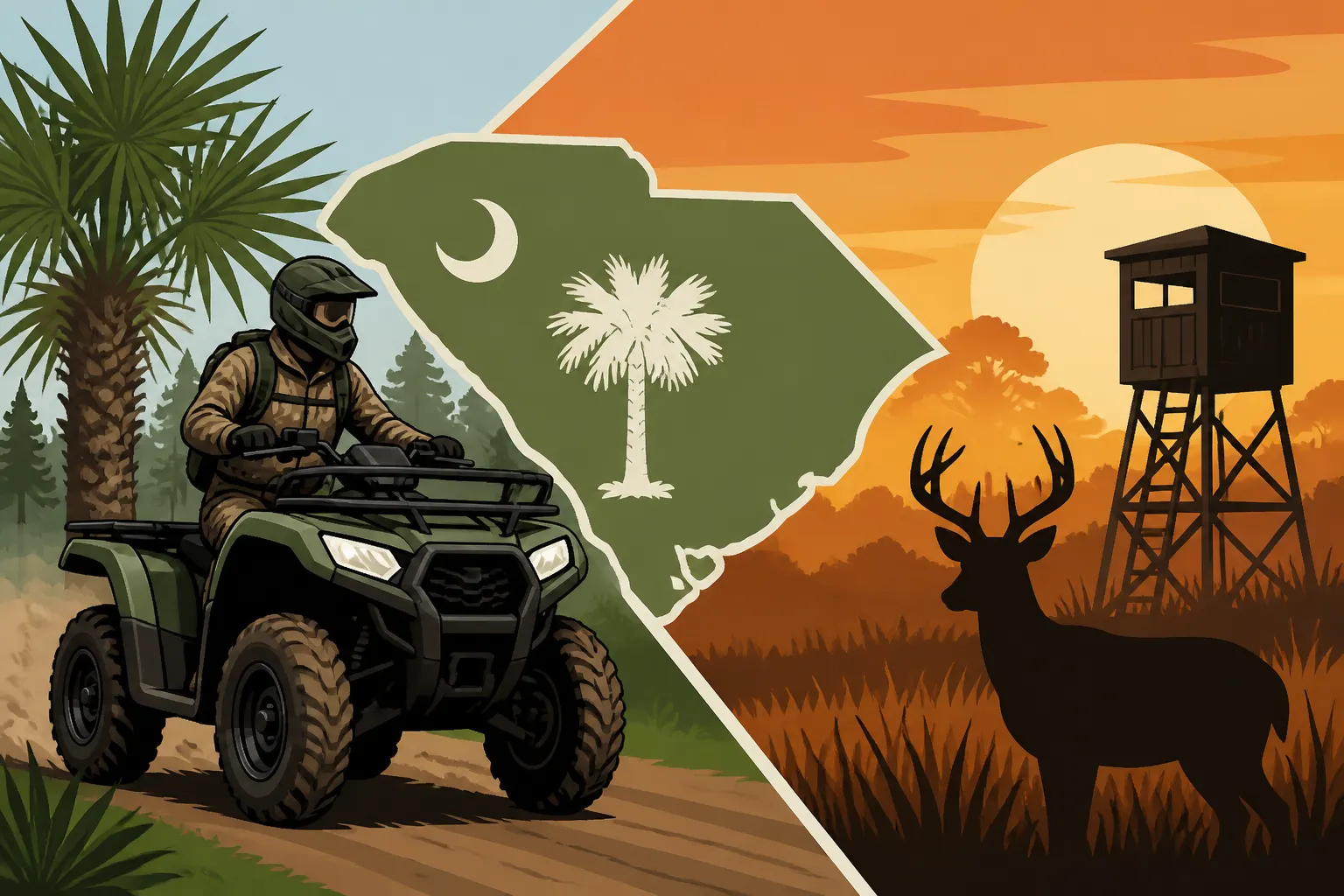
A deer stand may be on land you can hunt but still be somewhere you cannot ride an ATV. South Carolina’s hunting-related exception is not a general pass to cross property, use a wildlife area, or take an off-road machine onto a public road. The practical answer depends on who controls the land, which route you plan to ride, and what current rules apply there.
The short answer depends on the land and route
You may be able to ride to a deer stand on private land if you have permission to use the machine and the route, and if no applicable rule prohibits that use. But having permission to hunt does not automatically mean you have permission to bring an ATV, cross a neighboring parcel, or use a private timber road.
On public land, do not assume that a hunting license or a hunting-related exception allows you to ride wherever you can walk. Wildlife management areas, national forests, and other public properties each have their own access and vehicle rules. A rule allowing a machine for one purpose or on one route does not necessarily authorize riding to a stand by another route.
Public roads are a separate issue. An off-road ATV does not become road-legal because you are hunting, and an exception in an ATV law should not be read as permission to ride on any road. A street-legal UTV, where eligible and properly authorized, is a different case from an ordinary trail quad. Check the rules that apply to the specific machine and road before riding.
A useful way to think about the question is to split it into three permissions:
- Permission to hunt: Do you have a valid license or other authority to hunt at that location?
- Permission to access the land: Are you allowed to enter and use the property?
- Permission to operate the machine: Are you allowed to ride that type of ATV or UTV on that particular route?
You need the answer to all three. A yes to the first does not settle the other two. For the hunting side, review [South Carolina Hunting License and Land Access]. For the machine-specific exception, see The Hunting Exemption in South Carolina’s ATV Act.
| Where the stand is | What to establish before riding |
|---|---|
| Your own property | Whether your route crosses any other parcel, road, easement, or restricted area |
| Another person’s private land | Permission to hunt, permission to ride, and permission for the exact route |
| Timber company or leased hunting land | The current access policy, gate rules, approved roads, and any vehicle restrictions |
| Wildlife management area | The current area-specific vehicle rules; do not assume hunting access permits ATV use |
| National forest or other public land | Whether the route is an authorized motorized route, whether a pass is required, and whether hunting rules separately allow access |
| Public road | Whether that specific machine is legally authorized for that specific road; the hunting purpose alone is not enough |
If you are unsure, park at an authorized access point and walk the remaining distance. That can be inconvenient, especially before daylight or when carrying gear, but it is better than treating a hunting exception as a substitute for land access or road authorization.
What the hunting exception does and does not mean
South Carolina has an ATV law with a hunting- and trapping-related exception. That exception is why people sometimes hear that they can use an ATV while hunting. The important distinction is between an exception from particular provisions of an ATV law and a universal right to ride.
An exception does not give you ownership rights over land, create an easement, open a closed gate, or change a landowner’s access policy. It also does not automatically cancel the separate rules that apply to a wildlife management area, national forest, county road, private timber road, or other property.
Before relying on the exception, be clear about what it applies to. Ask:
- Does the exception cover the activity you plan to do, or only certain hunting or trapping uses?
- Does it apply to your type of machine?
- Does it affect only specific requirements in the ATV law, or does another rule still control the land or route?
- Does the property owner or managing agency allow motorized access?
- Are you staying on a permitted route, or planning to cross land or travel off-road?
The word “hunting” is not a shortcut through those questions. Riding to a deer stand may be connected to a hunt, but the route still matters. For example, an owner might allow you to hunt on a parcel but ask you to park at the entrance. A timber company could allow access under a lease while restricting ATVs to certain roads. A public area could permit hunting but prohibit recreational ATV use.
If the legal exception is relevant to your situation, read it alongside the rules for the property and route. South Carolina Code Title 50 Chapter 26 provides a starting point for the ATV-law framework, while South Carolina WMA Regulations for Vehicles addresses a separate set of public-land restrictions. When the wording or application is unclear, contact the agency or landowner responsible for the property rather than relying on a secondhand summary.
Hunting, retrieving game, and riding are separate activities
A ride to a stand, a ride during a hunt, and a ride to retrieve a harvested deer may sound like one continuous activity. Rules may treat land access and vehicle operation differently at each stage. Do not assume that because you were allowed to ride in to a stand, you can also use the ATV to cross another parcel or take a different route out with game.
If you plan to use the machine to retrieve a deer, confirm that the landowner permits it and that the route is allowed. On private ground, ask before the season, not after the animal is down. On public land, check the property’s vehicle rules and hunting regulations. Retrieving a Deer on Carolina Private Ground can help frame the private-land question, but it does not replace permission for your exact property and route.
A hunting license is also not an ATV permit. It may establish that you are authorized to hunt under applicable rules, but it does not by itself grant motorized access to land. The same goes for a forest riding pass: it may satisfy a trail-access requirement without granting permission to hunt, set a stand, or leave the designated route.
The exception does not make all road riding legal
A common mistake is to reason that an ATV can be used for hunting, so it must be allowed on the road that leads to the hunting property. Those are different questions. A public road has its own traffic and vehicle requirements. A private road has an owner or manager who controls access. An ATV’s intended use does not decide either question.
If a route includes a public road, identify the machine correctly. A quad, a side-by-side, and a properly authorized street-legal UTV may be treated differently. Do not assume that equipment such as lights or a license plate, by itself, makes an off-road ATV lawful on the road. For street-oriented UTV rules, see South Carolina Street UTV Requirements Explained. If your machine is not clearly authorized for the road, trailer it to an approved access point instead of riding there.
Check who controls the land
The most important practical question is often not “Am I hunting?” but “Who controls this route, and what have they allowed?” A stand can sit a short distance from a trailhead and still require crossing land with a different owner or manager.
Your own property
Owning the parcel can make permission simpler, but it does not automatically settle every route question. The machine may need to cross a public road, a utility corridor, a shared drive, a conservation easement, or a neighbor’s land to reach the stand. Check the boundaries rather than guessing from a map or a familiar path.
Be especially careful where a long-used track runs along a boundary. A route that looks like part of your property may cross a neighboring parcel or a managed forest. If the route leaves your land, get permission from the person or organization that controls that section.
Private land you have permission to hunt
Ask the landowner directly whether ATV access is allowed. Make the request specific. “Can I hunt there?” is not the same as “Can I ride my ATV from the gate along this road to the stand, and can I use it to retrieve a deer?”
Clarify:
- Which machine you will bring, including whether it is a quad or side-by-side.
- The entrance and route you will use.
- Whether you may ride before daylight or after dark.
- Whether you may take the machine off the road or trail to reach the stand.
- Whether passengers, trailers, or a second machine are allowed.
- Whether you may use the ATV to retrieve game.
- Whether there are temporary closures, wet-weather restrictions, or hunting-club rules.
Written permission is useful when access is shared or the rules are detailed. A text or email that identifies the property, route, dates, and allowed machine use can prevent misunderstandings later. If the landowner uses a formal document, follow that process. See South Carolina Landowner Permission Forms for questions to consider when permission needs to be documented.
Do not treat a gate being open as permission. A road may be open for a landowner, a forestry crew, or a leaseholder while remaining closed to other riders. A locked gate means stop; do not go around it or look for another way through without authorization.
Timber company property and hunting leases
Timberland access can be more complicated than a single landowner’s backyard. The person who leases hunting rights may not control the company’s roads, gates, or vehicle policies. Some access agreements distinguish between walking, driving a full-size vehicle, and riding an ATV. The terms can also change with logging work, fire risk, weather, or other operations.
Read the lease or access agreement and ask the person who manages the road system. Confirm whether the machine may be used, where it may travel, and what happens when a gate is closed. Do not assume that a hunting lease transfers motorized access rights. South Carolina Timber Land Access covers the broader access issue, and What a Timber Company’s Access Policy Usually Says is a useful reminder to check the controlling policy rather than relying on custom.
If a logging crew is working nearby, give their operation priority and stay out of closed areas. Heavy trucks may use the same roads, and loose soil, blind corners, dust, or active equipment can make a narrow timber road hazardous. A route that is permitted in one part of the season may not be safe or open during active work.
Wildlife management areas
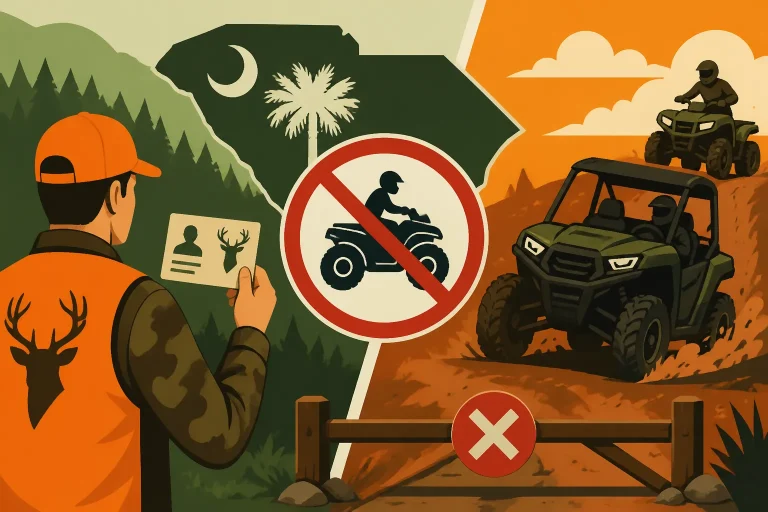
Treat a wildlife management area as a place with its own vehicle rules, not as ordinary public land. Hunting there does not automatically authorize ATV travel. South Carolina WMA vehicle restrictions can prohibit riding even when hunting is permitted, so check the rules for the specific area and do not infer motorized access from the presence of a hunting parking area or foot trail. See South Carolina WMA Riding Is Prohibited and South Carolina WMA Regulations for Vehicles.
If the rules do not clearly authorize your machine on the route you want to use, do not ride it there. Park where vehicles are allowed and walk in, or contact the managing agency for clarification. A hunting permit or license cannot override a vehicle restriction unless the applicable rule expressly says so.
Also distinguish a vehicle route from a walking route. A map may show a path, road, or access corridor that is open to pedestrians but not to motorized vehicles. A trail used by hunters on foot is not necessarily an ATV trail.
National forests and other public land
Public land often allows motorized riding only on designated routes, with access requirements that are separate from hunting rules. A pass for a designated OHV trail does not automatically let you ride off that trail to a stand. Likewise, a hunting authorization does not necessarily let you use an OHV trail without the required pass or take a machine onto a closed route.
Before going, confirm the current motorized route map, seasonal closures, pass rules, and any restrictions on off-trail travel. Check whether your machine is allowed on the trail; some trails have vehicle-type or width limits. If your plan is to leave the designated route, make sure that specific use is expressly permitted. Do not treat a trail pass as permission to cross a buffer, cut, or other restricted area.
A pass or access rule may be different for a day visit, a season, a particular rider, or a vehicle. Check the current instructions for the location rather than relying on a pass bought for another trail system or another person. South Carolina Passes Cover All Four Trails and South Carolina Pass Display Rules explain why it is worth confirming the pass details before hauling out.
Map the route before you load the machine
A route that looks simple on a phone can cross more boundaries than expected. Draw the route from the trailer parking spot to the stand, then check each segment: private drive, timber road, designated trail, public road, or path across open land. Each segment may have a different owner or rule.
Identify every route segment
Use a current map and verify it with the landowner or managing agency. Mapping apps can show roads that are gated, closed, private, abandoned, or unsuitable for motorized use. A line on a map is not proof that riding is allowed.
For each segment, write down:
- Who controls it.
- Whether motorized access is allowed.
- Which machine types are permitted.
- Whether the route is open during the dates you plan to hunt.
- Whether a pass, permit, or written permission is needed.
- Whether you must stay on the established road or trail.
- Where you can turn around or park without blocking access.
If the route crosses a property boundary, confirm that the person who gave permission controls that portion too. A hunting club member may be able to authorize access to a leased parcel but not to a neighboring owner’s driveway or a public forest road.
Avoid assuming a trail connects to the stand
A legal OHV trail may take you near the hunting area without allowing you to ride the final stretch. You may need to park at the trail’s end and walk. That is not a failure of planning; it is often the safest way to keep the ride within the authorized corridor.
Do not widen a trail to get around a mud hole, ride through vegetation to bypass a barrier, or create a shortcut to a stand. Those actions can cause damage, disturb wildlife, and violate the property’s rules. If a route is impassable, turn around or use a permitted alternative.
Treat roads separately from trails
A dirt road can still be a public road, a private road, or a restricted forestry road. Its surface does not determine whether an ATV may use it. Similarly, a two-track may be an authorized trail or merely a land-management track closed to recreational riders.
Before riding any public-road segment, confirm that the exact vehicle is allowed on that road and meets the applicable requirements. Do not rely on a hunting exemption, a trail pass, or a landowner’s permission for private property to authorize travel on a public highway. If the road status is unclear, ask the appropriate local or state authority before the trip.
For general road distinctions, see Can You Ride an ATV on the Road in South Carolina?. The key point is simple: permission to hunt on the other side of a road does not answer whether your machine can travel along or across it.
Have a walk-in backup plan
Plan where to park if riding is not allowed or a route closes. Leave enough room for other users, emergency vehicles, and land-management equipment. Do not block a gate, road, field entrance, or marked access point. If the only available parking spot is on private land, get permission for that too.
A walk-in plan is also useful if rain makes a route unsafe, a landowner changes access rules, or forestry work begins. Keep a paper copy or offline map available if you may lose cell service. A downloaded map can help with navigation, but it is not proof of right of access.
Prepare the machine, paperwork, and hunting gear
Once you have confirmed land access and a legal route, make sure the machine is ready for the conditions. A hunting trip can mean a dark start, wet grass, uneven ground, cold weather, and a loaded cargo rack. A poorly secured load or a machine that has not been checked can turn a short ride into a difficult recovery.
Carry useful proof and contact details
Keep the landowner’s permission, lease information, or relevant access confirmation available. Carry any hunting documents required for your hunt and check the current instructions from the responsible wildlife agency. If a trail pass or other access permit is required, bring it and display it as directed.
It is also practical to have the machine’s identifying information and emergency contacts accessible. Photograph the VIN or serial number before the trip and save the landowner’s phone number. These steps are useful if there is a breakdown, a boundary question, or a change to access conditions.
Do not assume that a title, registration, forest pass, or hunting document substitutes for another. Each proves or authorizes a different thing. For example, ownership paperwork may help identify your machine, while a hunting license relates to hunting and a landowner’s permission relates to access. [South Carolina Proof of Ownership on the Trail] explains why keeping ownership information available can be helpful.
Check condition and loading
Before leaving home, inspect the tires, brakes, steering, throttle, lights, fuel, and any straps or racks carrying your gear. Make sure the machine is suitable for the route and not overloaded. Keep the load low and balanced, and secure firearms and other equipment in a way that complies with applicable laws and does not interfere with safe control of the machine.
If you use a trailer, check the tie-downs, hitch, lights, and spare tire. Keep the trailer and tow vehicle parked only in a permitted area. Do not unload on a shoulder or access road where the vehicle blocks sightlines or traffic.
Carry basic tools, water, a first-aid kit, and a way to contact help. A phone may not work everywhere, so do not make it your only plan. Tell someone where you intend to hunt and when you expect to return.
Plan for visibility and wildlife
A pre-dawn ride creates visibility problems even on private roads. Use the machine’s required lighting and wear gear that makes you visible to other riders, hunters, and road users. Do not assume that a headlamp aimed forward makes you visible from the side or rear.
During hunting season, other people may be walking in the same area. Ride slowly near parking areas, gates, camps, and trail crossings. Stop if you cannot see what is ahead, and avoid noisy or unnecessary riding close to stands. If the machine’s use could disturb another hunter or compromise safe firearm handling, park farther away and walk.
For extra visibility, reflective tape or a high-visibility layer may help, but it does not replace required lights or safe riding. If you shop for practical items through Amazon, compare the product’s specifications and fit rather than relying on a listing title alone. Gear should not snag on controls, block hearing, or interfere with safe firearm transport.
Keep firearms separate from machine operation
A firearm should be secured and handled safely during transport. Do not ride with a firearm positioned where it could fall, catch on vegetation, or interfere with steering and braking. Follow current hunting and firearms rules for the location, including any restrictions that apply to loaded firearms or transport.
At the stand, unload or handle firearms according to safe practice before getting on or off the machine. Never use the ATV as a reason to rush through a crossing, climb onto a stand while armed unsafely, or ride beyond visibility. If you are hunting with another person, agree on where firearms will be carried and how you will communicate before either person starts the machine.
A cargo box, scabbard, or case can help keep equipment stable, but it is not a substitute for checking the law and using a secure setup. Amazon can be a place to compare storage options, but confirm the dimensions, mounting method, and compatibility with your particular machine before buying.
Common situations and what to do
“The landowner said I can hunt there”
Ask whether that permission includes riding, the route, and parking. If the owner says yes to hunting but has not discussed the ATV, get clarification before bringing it. If a route crosses land the owner does not control, get permission from that owner as well.
“I have permission, but the gate is closed”
Stop and contact the landowner or manager. A closed gate may indicate a temporary closure, active work, a safety issue, or a standing access rule. Do not go around it, move a barrier, or follow another vehicle through unless you have clear authorization.
“The stand is on a WMA”
Check the current rules for that exact area. Do not assume an ATV is allowed because hunting is allowed or because another hunter arrived by machine. If motorized access is not expressly permitted, park in an authorized location and walk.
“I bought a pass for the forest trail”
Confirm that the pass covers the location, rider, vehicle, and dates, and stay on routes open to your machine. A pass for a designated trail does not necessarily permit riding off trail to a stand or using a separate road. Check current pass and route instructions before setting out.
“The deer is down, and the ATV would make retrieval easier”
Check the access rules before moving the machine. A hunting-related exception should not be treated as blanket permission to cross property, leave a designated route, or enter a closed area. On private land, get the landowner’s approval. On public land, follow the agency’s current vehicle and game-retrieval rules. If motorized retrieval is not allowed, use a permitted method.
“I only need to travel a short distance on the road”
Distance does not decide whether the road use is legal. Confirm that the exact machine may use that road and meets the applicable requirements. If you cannot confirm that, trailer the machine or park at a lawful access point and walk.
“Other hunters ride there every season”
Past practice is not reliable permission. Access rules change, land ownership can change, and a route used by one leaseholder may not be open to others. Ask the current owner or manager and check current agency rules. A local habit is not a substitute for authorization.
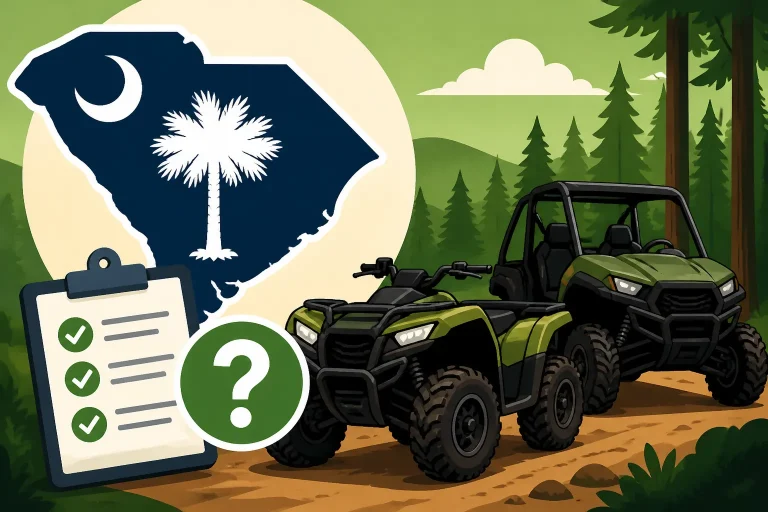
A practical pre-ride checklist
Use this checklist before each hunt, especially if you are visiting unfamiliar land or riding a route you have not used recently.
- Confirm hunting authority. Check the current license, season, and property-specific hunting requirements with the appropriate wildlife agency.
- Confirm land access. Make sure you have permission to enter, hunt, park, and use the exact route.
- Confirm ATV access separately. Ask whether your specific type of machine is allowed and whether there are route, time, or weather restrictions.
- Check public-land rules. For a WMA, national forest, or other public property, check the current location-specific vehicle rules and any pass requirements.
- Map the whole route. Identify boundaries, gates, public-road sections, parking areas, and a walk-in alternative.
- Check the machine and load. Inspect the controls, brakes, tires, lights, fuel, tie-downs, and cargo.
- Plan for low visibility and weak service. Carry appropriate visibility gear, an offline or paper map, basic supplies, and an emergency contact plan.
- Recheck access before departure. Look for closures or changed instructions and contact the landowner or manager if anything is unclear.
If you cannot answer who controls the route or whether motorized access is permitted, do not ride that segment. Calling ahead may take a few minutes; sorting out a trespass or vehicle complaint in the field is much harder. For specific questions, contact the land manager or wildlife agency responsible for the property and describe the machine, route, and purpose plainly.
The safest working rule is: a right to hunt is not automatically a right to ride. Ride only where the controlling owner or agency allows your machine, stay on the approved route, and treat public-road use as a separate legal question. When those pieces do not line up, leave the ATV at an authorized parking area and walk to the stand.
Disclaimer
This article is for general informational purposes only and does not constitute professional advice. Laws, prices and regulations vary by location and change over time. Consult a qualified professional for guidance on your specific situation.