South Carolina Hunting Season and Trail Access
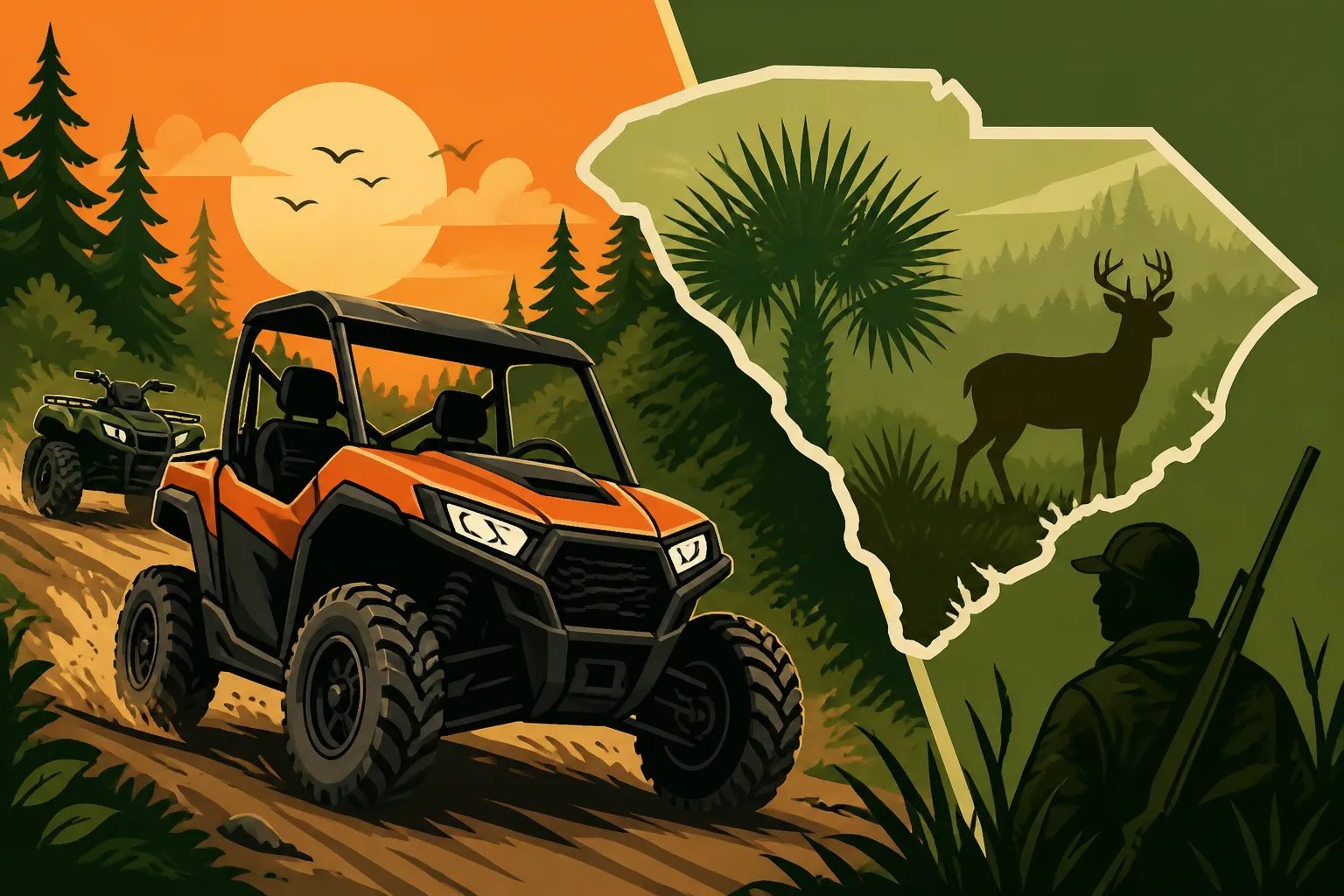
A fall ride in South Carolina can put you on the same forest roads and trail networks used by hunters, but hunting season does not make every route open to ATVs or UTVs. Access depends on who manages the land, whether the route is designated for your machine, and whether temporary closures or hunting rules apply. This guide explains how to check before you ride.
How hunting season affects ATV and UTV trail access
Hunting activity does not automatically close every trail
A forest can have both riding routes and hunting areas, so hunting season does not necessarily mean all nearby trails are closed. A designated OHV trail may remain open while hunting takes place elsewhere in the forest. But access can change because of temporary closures, maintenance, weather, fire danger, or land-management rules.
That overlap is worth taking seriously. Hunters may be walking away from a vehicle, carrying equipment, or using a narrow forest road at dawn or dusk. A rider coming around a bend quickly may not see them until the last moment. Slow down, watch for people and parked trucks, and avoid assuming that a quiet trail is empty.
Check the relevant land manager’s notices before leaving home, then check again close to your ride. A route shown as open on a map may have a temporary closure notice, and trail conditions can change after heavy rain. For a broader checklist, see [South Carolina Trail Conditions Before You Haul] and [South Carolina Wet Weather Trail Closures].
The land manager matters more than the season
The same riding plan can be allowed in one place and prohibited a short distance away. National Forest OHV routes, state Wildlife Management Areas, private timberland, and private riding parks do not share one set of access rules. A hunting license, permission to hunt, or ATV exemption does not automatically grant permission to ride wherever you can see a trail.
This is especially important around Wildlife Management Areas. South Carolina WMAs generally do not allow recreational ATV riding, and the fact that hunting is permitted there does not make the area a public OHV trail system. Check the specific property rules before taking a machine onto a WMA. [South Carolina WMA Riding Is Prohibited] explains why these areas should not be treated like open riding land.
On National Forest land, focus on routes designated for the vehicle you are bringing. A gravel road that looks suitable for a UTV is not automatically an authorized OHV route, and a narrow trail may have a width restriction. The rules for public land differ from private parks, where the operator sets its own access conditions. For a useful overview of the public-land distinction, read [South Carolina Public Land Compared to Private].
Hunting exemptions are not a pass to ride anywhere
South Carolina law includes hunting- and trapping-related exemptions in its ATV rules, but riders should not read an exemption as blanket permission to use any road, trail, or parcel of land. It does not replace landowner consent, a land manager’s rules, or posted restrictions. If you plan to use a quad as part of a hunt, confirm both the legal exemption and the property’s vehicle-access policy.
For example, a hunter may have permission to hunt private land but still need separate permission to bring an ATV across it. A timber company may allow foot access during a particular period while keeping roads closed to motor vehicles. A public area may allow hunting while prohibiting recreational machine use. [South Carolina Hunting and Trapping Exemptions] and [South Carolina Hunting License and Land Access] offer useful background, but always check the rules for the specific property.
Where you can ride during South Carolina hunting season
National Forest OHV trails
South Carolina has designated OHV opportunities in the Sumter and Francis Marion National Forests. Routes such as Enoree, Cedar Springs, Parsons Mountain, and Wambaw have different settings and access details, so do not assume that one trail’s rules apply to another. Confirm the permitted vehicle type, trail status, pass requirements, and any posted seasonal restrictions before you tow out.
The designated route is the key. Stay on the marked trail rather than turning onto an appealing woods road or following tire tracks into an unmarked area. During hunting season, an unmarked route may lead into a hunting area, a restricted road, or private land. The overview at [South Carolina's Four National Forest Trails] can help you narrow down your options, while [South Carolina National Forest OHV Passes] covers the pass side of planning.
Mapping tools can help you orient yourself, especially where a forest road network is confusing. Some riders use onX Offroad to review route layers and keep track of their position, but treat any app as a planning aid rather than final authorization. Compare what you see in onX Offroad with the official trail map and current notices, and follow signs on the ground if a route is closed or restricted.
Wildlife Management Areas and other public hunting land
A WMA is not the same thing as a public OHV trail. These areas are managed primarily for wildlife and outdoor activities governed by site-specific rules. A trail-like track on a map, or a gate that happens to be open, does not establish that recreational ATV or UTV use is permitted.
If your hunt is on a WMA, check the vehicle rules for that specific property and plan to park only where allowed. Do not ride through a WMA to reach a nearby forest trail unless the route is expressly open to your machine. A riding route that crosses or borders different land types can be especially easy to misread, so check boundaries before you set off.
A map app may show roads or tracks without making clear whether the land is open to motorized recreation. onX Offroad can be useful for seeing your position and nearby mapped routes, but confirm access against the managing agency’s rules. When the map and a posted sign appear to disagree, stop and follow the posted restriction until you can clarify it.
Private timberland and hunting leases
Private land access depends on the owner’s permission. That permission should be specific enough to cover the activity you intend to do: hunting, riding, or both. If you are invited to hunt a property, ask whether you may drive or ride a quad, which roads are allowed, where you can park, and whether access changes during active logging or other work.
A hunting lease may have its own rules that are stricter than general state law. One club might allow a machine on designated interior roads, while another may limit access to certain members or prohibit recreational riding altogether. Respect gates, signs, and closed roads. A gate being open for a logging crew or landowner does not mean it is open to visitors.
Get permission in writing when possible, and carry it with you. It can prevent an awkward dispute if a landowner, lease manager, or officer asks why you are on a road. For additional guidance, see [Carrying Written Landowner Permission in South Carolina] and [South Carolina Timber Land Access].
| Land type | What to confirm before riding | Common planning mistake |
|---|---|---|
| National Forest OHV trail | Trail status, permitted machine, pass, closures, and posted limits | Treating every forest road as an authorized OHV route |
| Wildlife Management Area | Property-specific vehicle rules and any authorized access | Assuming a hunting license allows recreational ATV use |
| Private timberland or hunting lease | Owner or lease permission for both hunting and motorized access | Assuming permission to hunt includes permission to ride |
| Private riding park | Park rules, operating conditions, age rules, and vehicle limits | Assuming public-land rules apply at a privately operated park |
How to plan a safe ride while hunters are in the woods
Check access and closures in a practical order
A quick search for a trail name is not enough when hunting activity and temporary closures may affect access. Use a repeatable check so you are not relying on an old social post or a map pin that does not show the current situation.
- Identify the land manager. Determine whether the route is in a National Forest, WMA, private property, or a private park.
- Confirm that your machine is allowed. Check whether the route accepts an ATV, side-by-side, or other vehicle of your width and type.
- Look for official closure and condition notices. Review the managing agency’s latest information before loading the machine.
- Check the pass or permit requirement. A trail pass and permission to access land are separate questions; having one does not prove the other.
- Review the route and boundaries. Use an official map where available and keep track of where authorized riding ends.
- Recheck just before departure. If rain, maintenance, or hunting operations could affect access, confirm again before you haul.
onX Offroad can help with route orientation and location awareness, particularly when several roads or trail segments meet. Still, use it alongside official maps and signs rather than as the sole source for access decisions. If a route is unclear, choose a clearly designated trail instead of testing the boundary.
Ride as though someone may be around the next bend
During hunting season, visibility and speed deserve extra attention. Slow down near trail intersections, road crossings, blind curves, parked vehicles, and places where hunters might walk in from a pullout. Avoid unnecessary noise and give people plenty of room. If you see a hunter, stop or pass cautiously when there is enough space and a clear view.
Do not ride through a hunting setup or approach a person in the woods just to ask whether a road is open. If you are uncertain about access, turn around and check with the land manager or property contact. Keep headlights and required equipment in working order, and make sure passengers understand that a forest road is not a place to stand in the path of a moving machine.
Visibility matters for riders too. Wear conspicuous riding gear, particularly when you are crossing or sharing an area with active hunters. Hunting clothing requirements depend on the activity and location, so do not assume that a particular color rule applies everywhere; check the rules for the specific hunt and property. [South Carolina Blaze Orange in Hunting Season] is a helpful related topic.
Decide whether riding to a deer stand is allowed
Riding a quad to a deer stand can sound like a simple way to carry gear, but the answer depends on the land and the route. On private land, the owner or lease manager must allow motorized access. On public land, the applicable agency rules determine whether a machine can travel on a road or trail and where it may be parked. A hunting-related exemption does not itself create a route through otherwise closed land.
Ask the land manager whether the machine can be used on the specific route, not just whether ATVs are allowed somewhere on the property. Clarify whether you can ride to the stand, leave the vehicle at a designated parking area, or use it only to transport equipment under defined conditions. Do not ride cross-country through vegetation or around a closed gate to get closer. For more on this specific question, see [Can You Ride to a Deer Stand in South Carolina?].
Common mistakes that can spoil a hunting-season ride
Assuming a map proves legal access
Digital maps are valuable for planning, but a mapped line may represent a road, track, property boundary, or route that is not open to your machine. Maps can also lag behind temporary closures. Use them to understand the area, then confirm the route with the official manager and signs at the trailhead.
A sensible approach is to have both an official map and a navigation aid available. If you use onX Offroad, save the area before you lose cell service and know how to locate yourself without relying on a live connection. But do not let a line on a screen override a gate, a closure notice, or a clear boundary marker.
Treating a hunting license as a vehicle permit
A hunting license concerns hunting privileges; it is not a general vehicle permit. It does not necessarily authorize ATV use on public land, private land, a timber road, or a trail system. Likewise, a forest OHV pass does not grant hunting access or permission to cross private property.
Keep the permissions separate in your planning. Ask: Am I allowed to hunt here? Am I allowed to bring this machine here? Is the particular route open today? Where may I park? Clear answers to all four questions are much safer than relying on a broad assumption.
Riding after conditions or access have changed
Heavy rain can make a trail unsafe or lead to closures. A road may also be closed for forestry work or other management activity. Avoid riding around a barrier or using a muddy bypass to get around a blocked section; doing so can damage land and create a serious access problem for everyone.
If your preferred trail is closed, have a backup route that is confirmed open and permits your machine. Check [South Carolina Trail Conditions Before You Haul] before a long drive, especially if you are heading toward Enoree, Cedar Springs, Parsons Mountain, or Wambaw. A few minutes of checking can save a wasted tow, an uncomfortable encounter with a landowner, or a citation.
Disclaimer
This article is for general informational purposes only and does not constitute professional advice. Laws, prices and regulations vary by location and change over time. Consult a qualified professional for guidance on your specific situation.