Carolina Adventure World in South Carolina
Carolina Adventure World can turn a South Carolina weekend into a full day of trail riding, but the trip takes more than loading the machines and following a map. Riders need to check which vehicles and trails fit their plans, understand park rules, prepare for changing conditions, and sort out camping or lodging before leaving home. This guide walks through the practical details so your visit is safer and less stressful.
What to expect at Carolina Adventure World
A private riding destination near Winnsboro
Carolina Adventure World is a private off-road riding destination near Winnsboro in Fairfield County, within reach of Columbia and other parts of the Midlands. It offers a very different experience from riding on a public forest trail: you are visiting a managed property, so access, fees, operating rules, permitted vehicles, and available amenities are set by the park.
That distinction matters when you are planning a first visit. A state or national forest may have a particular pass system and designated public trail network; a private riding park has its own admission process and rules. Before you hitch up the trailer, check the park’s current information for entry requirements, reservations, vehicle eligibility, and what is open. The rules can affect practical details such as whether a passenger is allowed, which safety gear is required, and whether a particular machine can use the trails you have in mind.
The area also makes a useful base for a weekend in central South Carolina. If you are driving from Columbia, Greenville, Charleston, or farther away, think about the whole trip: travel time, fuel stops, trailer parking, overnight plans, and the return drive after a physically demanding day. Riders comparing destinations can start with [South Carolina ATV Trails: Where to Ride], then narrow down whether a private park suits their group better than a public trail.
A large trail system still needs a plan
Carolina Adventure World is commonly described as having about 2,600 acres and roughly 100 miles of trail. Those numbers give a sense of scale, but they do not mean every mile will suit every rider or vehicle. Terrain, trail width, riding difficulty, current closures, and machine restrictions all affect what you can actually use on a particular day.
For a newer rider, a large property can feel exciting and slightly overwhelming at first. It is easy to get carried along by a group that wants to cover as much ground as possible, only to find that the pace or terrain is uncomfortable. Start with a realistic route, agree on a turnaround point, and check how your group will stay together. A leisurely ride with a new operator is a different plan from a long loop with experienced riders.
It also helps to treat published mileage as a broad description rather than a promise that every trail is open or accessible. Conditions and access can change, and route information may be updated. Ask the park about current trail availability and use its official map or guidance for navigation. For more context on the property’s scale, see [Carolina Adventure World's 2,600 Acres] and [Carolina Adventure World's 100 Miles].
Choosing trails for your machine and experience
Match trail choice to the least experienced rider
When a group includes different ages and skill levels, build the day around the rider who needs the most support. That does not mean everyone has to stay on the easiest route all day. It means choosing a first ride that gives the newer rider room to learn the machine, understand how the group communicates, and become comfortable with the park before attempting more demanding terrain.
A family may include a child on a youth quad, a parent on a full-size ATV, and another adult driving a side-by-side. Their comfort levels and machine capabilities are not automatically interchangeable. Before setting out, confirm that the park allows each vehicle on the intended route and that the young rider meets the park’s age and equipment rules. South Carolina law and private-park rules are separate layers: meeting one does not necessarily satisfy the other.
A useful approach is to agree on a simple plan before the engines start. Pick a route suitable for the least experienced participant, establish a regroup point, and decide what to do if someone wants to stop. If your group has children, read [South Carolina Trails for Kids] and confirm the park’s own age, supervision, and passenger rules. A relaxed first loop can build confidence; a long, unfamiliar route can make the day stressful for everyone.
Confirm that your vehicle is allowed on the route
ATVs, side-by-sides, and dirt bikes differ in width, seating, handling, and the way they move through narrow or uneven terrain. A trail that works well for one category of machine may not be open to another. Before traveling, confirm the park’s current vehicle rules, including any restrictions based on machine type, dimensions, passenger capacity, or trail designation.
This is especially important for owners of wider side-by-sides. A machine may fit comfortably on an open route but be unable to pass a narrow gate or use a trail built for smaller vehicles. Do not assume that a vehicle being allowed on the property means it can use every route. Ask about the trails your machine can access and check whether any special equipment or inspection is required at the entrance.
If you are comparing Carolina Adventure World with forest riding, remember that access rules vary by location. Public forest trails may have their own width limits and vehicle-specific restrictions. A park visit is not a substitute for checking rules elsewhere, and being able to ride a machine at one property does not make it legal on a road or public trail. [South Carolina Trails That Allow Side-by-Sides] can help you think through the differences, but confirm the details for the specific destination before you go.
Use a map as a planning tool, not a guarantee
A map helps you understand the layout, identify landmarks, and discuss a route before the group separates. It is particularly useful when riders are arriving in different vehicles or when some people plan a shorter ride while others continue. Review the map together at the staging area, and make sure everyone knows what the chosen route looks like and where the group intends to regroup.
Digital navigation tools, including onX Offroad, can be helpful for organizing route ideas and keeping track of a ride. Still, do not assume a downloaded map proves that a route is open, permitted for your machine, or suitable for current conditions. Use the park’s information as the authority on access, and keep a clear plan for what to do if a device loses signal, runs out of battery, or displays information that does not match posted signs.
Before you leave the staging area, make sure each group has a way to communicate and knows the basic boundaries of the ride. A phone may work well in one part of the property and poorly in another. Consider carrying a charged phone, a power bank, and a paper or offline map where appropriate. Whatever tool you use, stop safely to check it rather than navigating while moving.
Preparing for the ride
Check park rules and conditions before loading up
A smooth trip begins with a short checklist at home. Confirm the park’s opening information, access procedures, vehicle eligibility, reservation requirements, and any temporary trail closures. Then check what the park expects riders to bring, such as identification, safety equipment, proof of permission for minors, or documents related to the machine. Requirements can differ from what you are used to at another riding area.
Weather deserves its own check. Rain can change traction and visibility, while heat increases the risk of dehydration and fatigue. A forecast for Winnsboro may not tell you exactly how a particular trail will feel after recent rain. Mud can hide ruts, standing water can obscure holes, and slick surfaces can make familiar hills more difficult. For an overview of what to check before a drive with a trailer, see [South Carolina Trail Conditions Before You Haul].
Call or check the park’s official channels close to departure if conditions could affect access. This is not wasted effort: finding out about a closure or policy change before a long tow is much easier than learning it at the gate. You can also use that contact to ask questions that a general map may not answer, such as whether your machine class is allowed on a specific trail area or whether a reservation is needed for camping.
Inspect the machine and trailer
Give the machine a practical pre-ride check rather than relying on the fact that it ran well the last time it was used. Look over tires for damage and pressure, check the brakes and throttle, confirm that the steering moves freely, and make sure lights work where required. Inspect the chain or belt area according to the manufacturer’s guidance, and look for fluid leaks, loose fasteners, or anything that could become a problem on the trail.
Carry basic items that fit your machine and the day: drinking water, a first-aid kit, gloves, eye protection, a small tool kit, and any spare parts or recovery gear appropriate to the vehicle. A side-by-side may have room for more equipment than a quad, but extra storage can encourage people to bring unnecessary weight. Secure everything so it cannot shift or fall off if the machine bounces over rough ground.
Do not forget the trailer and tow vehicle. Check tire condition and pressure, hitch connection, safety chains, lights, and load security. Confirm that the machine is strapped down at suitable points and cannot move forward, backward, or sideways during transport. If your trailer has been sitting for months, a quick inspection before departure can prevent a breakdown on the way to the park. A roadside problem with a loaded trailer can end the riding day before it begins.
Pack for South Carolina heat, rain, and changing terrain
South Carolina riding conditions can feel very different depending on the season, time of day, and recent weather. In warm weather, riders may underestimate how quickly sun, humidity, and physical effort add up. Start hydrated, bring more water than you expect to need, and take breaks before anyone is exhausted. A rider who waits until they feel unwell may already be behind on fluid and rest.
Pack clothing for protection rather than just comfort. Long sleeves, durable pants, gloves, sturdy footwear, and eye protection help reduce exposure to dust, branches, and flying debris. A helmet that fits correctly is essential for appropriate riding; check both the park’s policy and the rules that apply to each rider. A thin rain layer can also be useful, but avoid clothing that can snag on controls or moving parts.
Dust, mud, and water crossings can leave everyone colder, wetter, or dirtier than expected. Bring a change of clothes and a bag for wet gear, and keep phones, keys, and essential documents protected. If your group includes children, pack snacks and a backup layer so a minor discomfort does not become the main event of the day. Planning for ordinary problems—thirst, rain, a loose strap, a tired rider—often makes the difference between a pleasant outing and an early departure.
Making a full day or weekend work
Plan your arrival, staging, and first ride
Give yourself time to arrive, unload, handle check-in, and understand the park layout before setting off. Rushing from the trailer to the trail can lead to skipped safety checks and confusion about where your group is going. If this is your first visit, treat the first few minutes as orientation time: locate the staging area, restrooms, services, and any places the park identifies as important for riders.
Agree on a meeting point in case the group gets separated. If there are multiple machines, make sure every rider knows who is leading and who is bringing up the rear. Choose a pace that allows the group to stay together without pressuring the least experienced rider. A group that stops at intersections to regroup is usually safer and less frustrating than one that assumes everyone can keep up.
Leave a little flexibility in the day. A planned route may take longer than expected because the group stops to check directions, help a rider, or take a break. It is better to ride a manageable portion of the property and finish with energy than to keep pushing until everyone is tired. If someone in the group wants a longer challenge, discuss whether the park’s rules and the group’s communication plan allow a split into separate, clearly organized rides.
Decide whether to camp or stay nearby
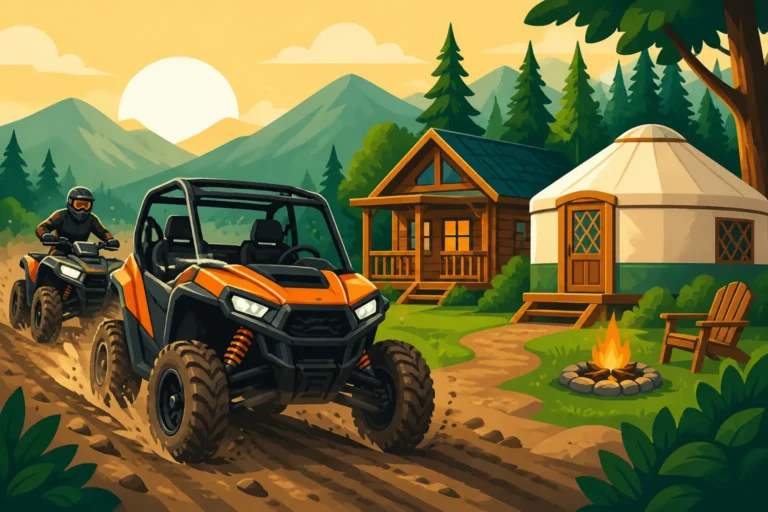
An overnight stay can make a visit more relaxed, especially for riders traveling a long distance or hoping to ride on more than one day. Carolina Adventure World has been associated with camping options, including sites with water and power, as well as cabins and yurts. Availability, amenities, access rules, and booking arrangements can vary, so confirm current details directly with the park before building a weekend around a specific accommodation.
Camping is convenient, but it changes what you need to pack. Bring bedding, towels, suitable footwear, food, and any personal items not supplied with the accommodation. If you are staying in a tent or bringing an RV, check what the site supports and whether there are restrictions involving hookups, generators, pets, quiet hours, or campfires. Never assume that a facility’s general description covers every detail that matters to your setup.
A cabin or yurt may suit a group that wants shelter without hauling a full camping setup, while a tent or RV can give you more control over your own arrangements. Compare the options based on your group’s needs, not just convenience. See [Cabins and Yurts at Carolina Adventure World] and [South Carolina Trails With Camping], then verify current availability, amenities, and rules before you travel.
Budget for more than admission
The cost of a ride is not limited to entry. Include fuel for the tow vehicle and machines, food, lodging, protective gear, machine maintenance, and any park-specific fees that apply. If you are bringing a group, agree in advance on how shared expenses will be handled. That avoids awkwardness when one person books accommodations while others assume they are paying separately.
Ask the park to clarify what admission covers and what may be separate. Do not rely on an old screenshot, a friend’s past visit, or a price remembered from another season. Check current terms on the park’s own page, including whether reservations, camping, or other services are handled separately and whether refunds or changes are possible if weather affects your plans.
It is also wise to set aside a small amount for the unexpected: a replacement strap, a meal after a longer ride, or an extra night if travel conditions change. This does not require elaborate budgeting. A simple list of expected expenses helps you avoid the common surprise of realizing that the “day trip” involves more than fuel and entry. If you are comparing private parks, compare what each option actually includes rather than looking at one fee in isolation.
| Planning item | What to confirm before departure |
|---|---|
| Vehicle access | Machine types allowed, any width or passenger restrictions, and which routes are suitable |
| Entry and reservations | Check-in process, booking requirements, and what admission includes |
| Trail status | Current closures, weather-related changes, and park guidance on conditions |
| Safety rules | Required helmets, protective equipment, age rules, and supervision requirements |
| Camping or lodging | Availability, amenities, check-in details, and rules for your setup |
| Transport | Trailer parking, tie-downs, tow-vehicle readiness, and fuel stops |
| Navigation | Park map, meeting points, offline access, and a group communication plan |
Riding responsibly at a private park
Follow posted rules and respect other riders
A busy riding area works best when people share the trail with patience. Keep to the park’s posted directions, slow down where visibility is limited, and avoid surprising other riders around corners or near staging areas. Give people room to pass only when the location and park rules make it safe. A little courtesy prevents many of the unpleasant encounters that can turn a fun day into an argument.
Before your ride, discuss the group’s expectations about speed, stopping, and passing. Riders may have very different ideas about what counts as a comfortable pace. Make it clear that nobody has to follow a route or speed that feels unsafe. If someone is uncomfortable, stop somewhere safe and adjust the plan rather than pressuring them to keep going.
Also leave the property as you found it. Use designated parking and camping areas, dispose of waste properly, and do not create new paths or ride around closures. Respect quiet-hour and campground rules if you are staying overnight. For more on the habits that help riders get along, read [South Carolina Trail Etiquette Locals Expect]. Good etiquette is not complicated; it is consistent attention to the fact that other people are there to enjoy the day too.
Ride within your ability and the machine’s limits
Experience does not eliminate risk. A familiar hill can become slippery after rain, a rut can be deeper than it appears, and a machine that feels stable at low speed can behave differently under acceleration or braking. Approach unfamiliar terrain cautiously and leave space to stop. If you are uncertain about a feature, get off the machine and assess it safely rather than letting pride make the decision.
Do not assume that a more powerful or larger machine is automatically easier to control. A side-by-side has different handling and visibility from a quad, while a youth machine is designed for a different rider and purpose. Carry only the number of occupants the machine is built and approved to carry. Follow the manufacturer’s instructions and the park’s rules, and do not modify equipment in a way that makes it unsafe or unsuitable for the route.
Fatigue also affects judgment. Heat, noise, dust, and concentration can wear riders down even when they have not covered a great distance. Take breaks, drink water, and check in with the group. If a rider is distracted, uncomfortable, or struggling to control the machine, end the ride or choose an easier route. A sensible retreat is a good decision, not a failure.
Handle problems calmly and know when to stop
If a machine has a mechanical issue, move it out of the active riding line if it is safe to do so. Turn it off, identify the problem, and avoid trying a risky trail-side repair that could cause another injury. Make sure the rest of the group knows where you are and does not disappear while someone is dealing with the breakdown. If the park provides a specific procedure for breakdowns or emergencies, follow it.
For an injury, prioritize safety and get help through the park’s established process. Do not move someone with a possible serious injury unless staying in place presents an immediate danger. Keep the area clear, ask someone to guide responders if needed, and share useful details such as location, number of people involved, and the type of assistance required. A calm, organized response is more useful than a crowd gathering around the injured person.
Weather can also be a reason to stop. Thunder, poor visibility, extreme heat, or rapidly worsening trail conditions can change a ride from manageable to hazardous. Give the group permission to call it early. Before setting out, make sure everyone knows how to contact the park or emergency services and where the group will meet if conditions force a change of plan.
Making the most of the visit
Use the first visit to learn the property
On a first trip, resist the urge to cover everything. Spend time learning how the property is laid out, how the park marks routes, where you can safely stop, and which parts are a good fit for your machine. Once you understand the basic setup, future visits become easier to plan and the group can choose more ambitious routes with better context.
Take note of what worked and what you would change. Maybe the group needed more water, a different trailer arrangement, a shorter first loop, or an earlier start. Write down practical details while they are fresh: where you parked, how long the ride felt, what gear proved useful, and what questions you still have for the park. That simple record is more useful than relying on memory several months later.
If you are using onX Offroad or another navigation tool, treat your first visit as an opportunity to learn how it behaves in the area. Save useful locations and routes only in ways that match park rules, and do not share route information as if it guarantees access for other vehicles or future visits. Pair digital notes with the park’s official map and instructions so your personal planning does not replace current access guidance.
Build a repeatable routine for future rides
A simple routine reduces last-minute stress. The night before, confirm the park’s information, charge devices, gather safety gear, and load the machine only after checking straps and tie-downs. In the morning, inspect the tow vehicle and trailer, verify the route and weather plan, and tell someone outside the riding group where you expect to be and when you plan to return.
For groups, keep the same basic communication habits every time. Identify the lead and sweep riders, set a pace that matches the least experienced person, and agree on stops and regroup points. If the group splits, make sure each smaller group has a capable leader, a map, a communication plan, and a clear return time. These habits are useful whether you are at Carolina Adventure World or another destination.
Finally, keep the difference between private-park riding and public-road use clear. A park visit does not automatically give an ATV or UTV permission to travel on nearby public roads. Road rules, registration requirements, insurance, and equipment standards are separate questions. If your trip involves using public roads, check the rules for that specific use instead of assuming that a park’s access policy applies beyond its property.
Check details again before every trip
It is tempting to treat a successful first visit as a permanent template. But trail access, park procedures, weather, and facility availability can change. A weekend that worked well in one season may require a different plan in another. Before each visit, confirm the details that could affect your group: which machines are permitted, whether a reservation is needed, current lodging availability, and any notices about closures or conditions.
This is particularly valuable when you are bringing guests or organizing a larger group. A quick message to everyone with the meeting time, equipment list, map, and basic rules helps prevent confusion at the gate. Ask each rider to confirm that their machine is ready and that they understand what safety gear to bring. A clear plan is much easier to adjust than a vague one.
The goal is not to overcomplicate a day outdoors. It is to handle the small uncertainties before they become big frustrations: a machine that cannot use the planned route, a missing helmet, a full campground, or a group that becomes separated. With a little preparation, Carolina Adventure World can be an enjoyable place to explore South Carolina off-road riding at a pace that suits your crew.
Disclaimer
This article is for general informational purposes only and does not constitute professional advice. Laws, prices and regulations vary by location and change over time. Consult a qualified professional for guidance on your specific situation.