Riding Under the Influence on Private Land
A few drinks around a backyard fire can turn into a dangerous ride faster than people expect, especially when an ATV or UTV is sitting nearby. Private property does not automatically make impaired riding safe or exempt from every South Carolina law. This guide explains the legal uncertainty, the risks that remain, and practical ways to keep an off-road gathering from ending in a crash or charge.
Can you get a DUI on private land in South Carolina
Private property is not an automatic legal shield
It is tempting to think that DUI laws apply only on public roads. That assumption can be risky. South Carolina’s DUI law addresses driving a motor vehicle within the state while impaired; the fact that a ride takes place on private property does not, by itself, guarantee immunity from a DUI investigation or charge.
What happens in a particular case can depend on the machine, the circumstances, and how the relevant statutes apply. An ATV, side-by-side, and street-legal UTV may not be treated identically for every legal purpose. Where the machine was driven, whether it crossed onto a public road, whether someone was injured, and what evidence is available can all matter. A private gravel lane can also connect to a public road, creating a situation that is less clear-cut than “we stayed on our property.”
That is why it is unwise to rely on a broad rule such as “you can’t get a DUI on private land.” The more useful safety rule is simpler: do not operate an ATV or UTV after drinking or using impairing drugs, whether the route is a public street, a trail, a farm, or your own yard. For a broader look at how impaired operation may intersect with off-road machines, see [South Carolina DUI Law and Off-Road Machines].
Other rules can still apply off-road
Even when a ride stays on private property, other laws may remain relevant. Depending on the circumstances, that could include laws involving injury, reckless conduct, property damage, alcohol-related offenses, or operating a machine in a prohibited place. Permission to ride addresses access to the land; it does not necessarily settle questions about safe operation or legal responsibility.
The ATV-specific rules also deserve attention. South Carolina’s requirements can vary with a rider’s age, the type of property, and the activity taking place. Some exceptions are narrow and tied to defined circumstances. Don’t assume that “private land” makes every age, equipment, or safety rule disappear. The distinctions are covered in [South Carolina Private Property Exemptions] and [South Carolina ATV Age Requirements].
A landowner’s permission is important, too, but it is not a substitute for knowing the property boundaries. A rider who leaves a field, crosses a neighboring tract, or enters a road may create a separate problem, particularly if permission was limited to a specific area. Before a group ride, identify the approved route and make sure everyone knows where the property ends.
An ATV crash can create consequences beyond a DUI charge
An impaired ride can lead to serious injuries even at low speeds. ATVs can roll, throw a rider, or collide with trees and other obstacles; UTVs can overturn or trap occupants. Alcohol and drugs can reduce balance, judgment, reaction time, and the ability to assess terrain. A familiar field does not remove those risks.
If a crash happens, responders and investigators may look at how it occurred, whether anyone was hurt, and whether someone was impaired. Insurance coverage can also become complicated. An insurer may ask for details about the machine’s use, the location, the operator, and the circumstances of the crash. Don’t assume that a private-property incident will be treated as a routine claim. For next steps after a collision, see [South Carolina Accident Reporting for an ATV Crash] and [Making an Insurance Claim After a Collision].
What counts as impaired riding
Alcohol is not the only concern
Alcohol is an obvious risk, but it is not the only substance that can interfere with safe riding. Cannabis, some prescription medicines, sleep aids, and other drugs can affect coordination, alertness, or judgment. Combining substances can make impairment harder to recognize, even for someone who feels relatively normal.
A person may also underestimate how long impairment lasts. “I had a drink a while ago” is not a dependable safety test, and feeling confident is not the same as being unimpaired. The same goes for a rider who is tired, overheated, dehydrated, or distracted. Those conditions can compound the effects of alcohol or medication, especially during a long ride or in rough terrain.
If a medication label warns against driving or operating machinery, take that warning seriously. If you are uncertain how a medication affects you, do not ride until you have reliable guidance from a qualified health professional. There is no practical benefit to trying to judge impairment while holding the throttle.
Legal impairment and safe operation are not identical questions
A person can be unsafe to ride even if they believe they are below a legal threshold or have not been tested. The legal question of whether someone meets a statutory definition is different from the real-world question of whether that person can safely control a machine.
ATVs require balance and active body movement. Riders may need to shift their weight, respond to ruts, brake on uneven ground, and avoid obstacles quickly. UTV drivers still need to steer, judge distance, use seat belts, watch for passengers, and respond to changing terrain. Even a short ride from a barn to a campsite can involve a slope, a ditch, a gate, or another person walking nearby.
The safest approach is not to calculate how much someone can drink and still ride. It is to decide before the gathering that anyone who has consumed alcohol or an impairing drug will not operate a machine. That removes the pressure to make a difficult judgment later.
A passenger can be put at risk even if they are sober
An impaired driver creates risks for passengers as well as other people on the property. A passenger may not be able to control speed, stop the vehicle, or prevent a rollover. In an ATV designed for one rider, carrying an extra person can also create a separate safety problem.
Before anyone climbs aboard, check that the machine is designed for the number of occupants and that passengers have appropriate protective equipment. A UTV’s seat belts should be used as intended, and occupants should remain seated with hands and feet inside the vehicle. A passenger should not treat a familiar driver or a short trip as proof that the ride is safe.
If children are present, keep them away from machines that are being used by adults who have been drinking. A responsible adult should supervise them and keep keys out of reach. For related age and passenger considerations, read [South Carolina Rules for a Child Passenger].
How to prevent impaired riding at a private-property gathering
Set a no-riding-after-drinking rule before the first drink
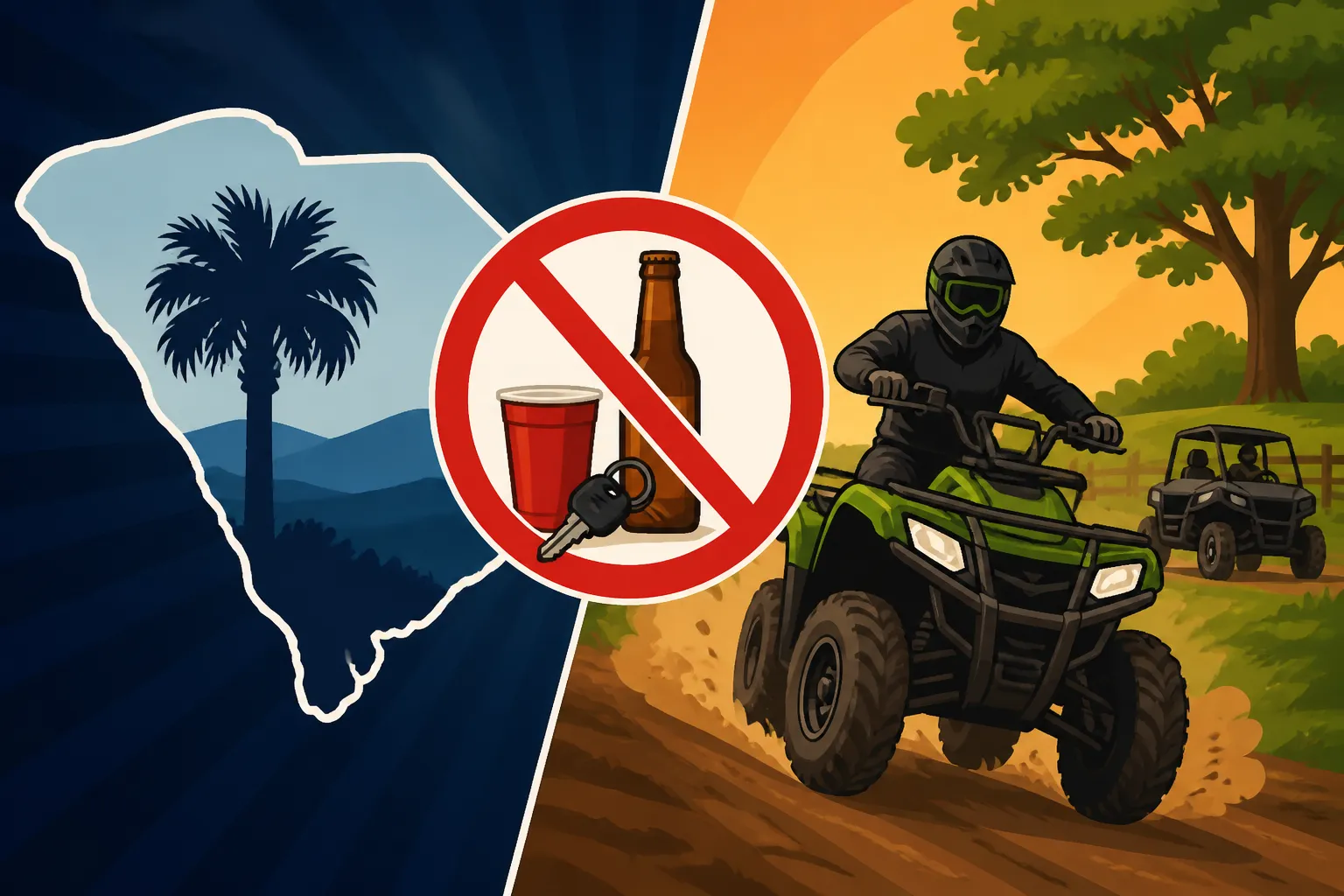
It is much easier to prevent an impaired ride than to stop one after someone has been drinking. At a family gathering, hunting camp, or weekend ride, agree on the rule before alcohol is served: anyone who drinks does not operate an ATV or UTV for the rest of the event.
Make the plan concrete. Name a sober operator for necessary trips, arrange a ride home if needed, and keep machine keys with a designated person. If guests are staying overnight, don’t assume that sleeping for a few hours automatically makes someone fit to ride in the morning. A person who is still impaired, exhausted, or unwell should not operate machinery.
A written or spoken rule can also make it easier for a host to intervene. Instead of arguing about whether someone “seems fine,” the host can point to the agreement everyone made earlier. The goal is not to embarrass a guest; it is to avoid a preventable injury.
Separate alcohol from machine access
A practical setup can reduce temptation. Park machines away from the main gathering area, keep keys secured, and avoid leaving a running ATV or UTV available for casual trips. If guests need transportation between parts of a property, arrange a sober driver before the event starts.
For a large gathering, make it clear who is permitted to operate each machine and where riding is allowed. A simple route briefing can cover property boundaries, hazards, speed expectations, and places where people may be walking. It should also make clear that the designated operator must remain sober.
Protective equipment matters, but it does not make impaired riding safe. A properly fitted helmet and suitable clothing can reduce some injury risks; they cannot restore reaction time or judgment. Likewise, a windshield, roof, or other accessory is not a substitute for sober operation. Riders considering comfort or protective accessories from brands such as SuperATV should treat those products as equipment choices, not as permission to ride after drinking. Check the machine’s requirements and the landowner’s rules as well; [South Carolina ATV Equipment Requirements] offers related context.
Choose another way to get around
If someone has been drinking, the answer is to use a sober alternative—not to take a slow ride, stay close to the house, or ask a passenger to watch out. Depending on the property, alternatives may include walking with a sober companion, using a vehicle operated by a sober driver, or staying where you are until it is safe to leave.
For hosts, it helps to plan for the awkward moment in advance. You can say, “I’m holding the keys because we agreed no one rides after drinking,” rather than debating a guest’s level of impairment. If a person is determined to ride, ask another sober adult to help prevent access to the machine and move bystanders out of the way. If there is an immediate danger, contact emergency services.
If an impaired-riding incident happens
Put safety and medical care first
After a crash, do not focus first on blame or paperwork. Check whether anyone is responsive, look for serious bleeding, and call emergency services when someone may be injured. Avoid moving a person with a possible head, neck, or back injury unless staying in place presents a greater immediate danger. If the machine is unstable or leaking fuel, keep people away and tell responders what happened.
A person who is intoxicated or injured should not drive away from the scene. Arrange a sober ride or wait for emergency responders. If someone is threatening to get back on a machine, try to keep other people clear and seek help rather than putting yourself in the path of a moving vehicle.
When speaking with responders, be accurate and avoid guessing about details you do not know. Preserve the scene when it is safe to do so, and note who was operating the machine and where the incident occurred. If the crash involved property beyond the host’s land, document that fact without trying to investigate or confront anyone.
Handle questions about the machine and the land carefully
After the immediate emergency is addressed, establish whose machine was involved and who had permission to operate it. Keep purchase or ownership records available if relevant; proof of ownership can help clarify who owns the machine, though it does not answer every question about responsibility. See [South Carolina Proof of Ownership on the Trail] for more on carrying ownership information.
If law enforcement asks questions, remain calm and do not obstruct an investigation. If you are facing a possible criminal charge, speak with a qualified South Carolina attorney before trying to explain legal conclusions or make assumptions about what the law covers. Statements made in the stressful moments after a crash can have consequences, so it is sensible to get legal guidance.
Insurance questions may arise even if the crash happened on private property. Contact the relevant insurer and follow its claim process, but do not assume that a policy covers every use or every operator. Keep records of the incident, medical care, repair estimates, and communications. The policy’s terms and the facts of the incident will matter.
Make the next gathering safer
Once the immediate issue is resolved, review what made the incident possible. Were keys left on an unattended machine? Was the riding boundary unclear? Did the group lack a sober driver? Could the host have arranged sleeping space or transport? These are practical questions, not a reason to shame someone who was hurt.
A useful private-property riding plan can include:
- A no-riding-after-drinking rule.
- A named sober operator for any necessary machine use.
- Secured keys and a designated place to park machines.
- Clear boundaries and routes that stay within authorized land.
- Appropriate helmets, seat belts, and passenger limits.
- A plan for medical help and sober transportation.
When a ride is planned on a designated trail or other public riding area, confirm access rules and local requirements before unloading. [South Carolina ATV Trails: Where to Ride] can help readers explore the separate question of where riding is permitted. If you are fitting or maintaining a machine for lawful riding, accessories from brands such as SuperATV may be part of an equipment discussion, but they do not change the core rule: a rider who has been drinking should not operate it.
The most dependable way to avoid impaired-riding injuries and legal complications is to keep alcohol and machine operation separate. Private land can feel informal and familiar, but a rollover, collision, or investigation can make the consequences very real. Keep the keys with a sober person, arrange another way to get around, and make the decision before anyone drinks.
Disclaimer
This article is for general informational purposes only and does not constitute professional advice. Laws, prices and regulations vary by location and change over time. Consult a qualified professional for guidance on your specific situation.