South Carolina Registration Questions From Visitors
Heading to the Palmetto State for some outdoor adventure with your ATV or UTV can be incredibly exciting, but the patchwork of laws and local rules can feel like trying to navigate a swamp without a map. Many visitors arrive assuming their home state's registration requirements will apply, only to find South Carolina has its own unique way of doing things, which can lead to confusion and even fines. This guide is here to untangle the South Carolina rules, helping you understand exactly what paperwork you need for your off-road machines, street-legal UTVs, or golf carts when you're just visiting.
Do Visitors Need to Register Their Off-Road ATVs or UTVs in South Carolina?
One of the biggest head-scratchers for folks coming from out of state is South Carolina's approach to off-road vehicle registration. In many places, if you own an ATV or UTV, you're required to register it with your state's DMV or equivalent agency, even if you only ever plan to ride it on trails or private land. You might have a sticker or a small plate from your home state on your machine, signifying that you've done your due diligence.
Understanding South Carolina's Unique Stance on Off-Road Machines
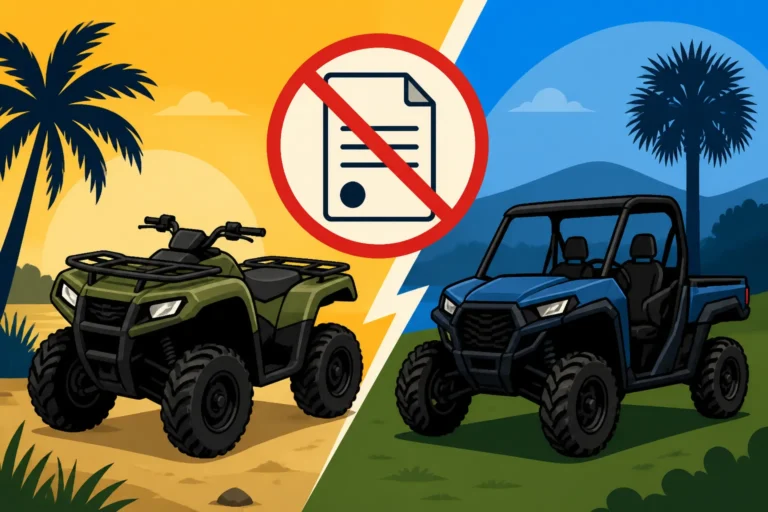
So, you load up your quad or side-by-side, drive down to South Carolina, and start looking for the local DMV to figure out what you need to do. Here's where it gets interesting – and often, surprisingly simple for off-road machines. South Carolina does not require registration for traditional off-road ATVs or UTVs that are only used for off-road recreation. That's right, no trip to the DMV for a tag or sticker if you're sticking to designated trails, private property, or off-road parks. This is a common point of relief for many visitors who've braced themselves for more bureaucracy. We even have a specific post that dives deeper into this: [South Carolina Has No Off-Road ATV Registration].
This lack of an off-road registration requirement sets South Carolina apart from many other states that use registration fees to fund trail systems or manage their off-highway vehicle populations. While it simplifies things in one sense, it can also lead to a false sense of security regarding other rules. Just because you don't need to register it doesn't mean there aren't other laws you need to follow, especially concerning safety, age limits, and where you can actually ride. It's easy to assume "no registration" means "no rules," but that's definitely not the case.
For example, if you're used to Wisconsin's annual OHV sticker or Michigan's ORV license plate, the absence of a similar system in South Carolina can feel a bit odd. You might wonder how the state keeps track of off-road vehicles or if there are hidden fees you're missing. The reality is that for purely off-road use, South Carolina focuses more on operator safety laws and private land permissions than on a statewide registration database. So, while you won't need to register your trail quad, you will need to make sure you're riding legally and safely according to local and state statutes.
What About Titles for Out-of-State Machines?
Okay, so no registration for off-road machines, but what about titles? Your home state might issue a title for your ATV or UTV, much like a car title, proving ownership. Do you need a separate South Carolina title when you're just visiting? The good news here largely mirrors the registration situation. If your ATV or UTV is titled in your home state and you intend to use it exclusively off-road while in South Carolina, you generally do not need to obtain a South Carolina title. Your existing proof of ownership from your home state is usually sufficient. This saves you another potential trip to the SCDMV.
The key here, again, is the "off-road" distinction. South Carolina has an optional titling system for off-road vehicles. This means even residents aren't always required to title their machines if they only use them off the pavement. For a visitor, this policy extends to their machines as well, as long as their primary use remains off-road. You can find more details on this in our article: [Can an Out-of-State Owner Get a South Carolina Title?]. This optional titling can be a double-edged sword; while it reduces immediate paperwork, it can also make proving ownership harder in certain situations, like if your machine is stolen or if you decide to sell it privately in South Carolina.
However, if you're bringing a machine into South Carolina with plans that might involve future street use (even if it's not yet street-legal), or if you anticipate becoming a resident and want full proof of ownership on file, then acquiring a South Carolina title might become a consideration. For now, as a visitor sticking to trails and private land, your out-of-state title or equivalent proof of ownership is generally accepted. Just be sure to keep it with you, or at least accessible, in case you need to prove your machine isn't stolen or that it legitimately belongs to you. Proof of ownership is crucial, and having a document like a bill of sale or a title from your home state is always a good idea. Sometimes, a general legal document service like LawDepot can provide customizable bill of sale forms if you're trying to solidify proof for a machine that might have less formal paperwork.
Navigating Street-Legal UTV Registration for Visitors
While traditional off-road ATVs and UTVs don't require registration in South Carolina, there's a significant exception that has changed the game in recent times: street-legal UTVs. This is where many visitors can get tripped up, especially if their home state doesn't have a similar classification or if they're used to riding their UTV on country roads without issue back home.
The Specifics of South Carolina's Street-Legal UTV Law
South Carolina has introduced specific legislation that allows certain UTVs to be registered and licensed for street use, much like a car or truck. This is a relatively new development and a huge win for many riders who wanted to connect trails or access amenities without trailering their machines. However, with this privilege comes the responsibility of registration, just like any other motor vehicle on public roads. If you're visiting and you've modified your UTV to meet street-legal requirements in your home state, and you intend to drive it on South Carolina's public roads, you absolutely must comply with South Carolina's street-legal UTV registration process. You can learn more about this exciting development in our post, [South Carolina Street-Legal UTV Registration Arrives].
This means your out-of-state street-legal registration might not be enough. While many states have reciprocity agreements for standard vehicle registrations (like your car's license plate), UTV laws can vary wildly. South Carolina defines what qualifies as a street-legal UTV, including specifications for width, weight, and safety equipment, as well as an age requirement for drivers. If your UTV meets these specs, you'll need to go through the SCDMV process to get a South Carolina street-legal UTV license plate. The fees for this registration are biennial, meaning you pay every two years, which is outlined in [South Carolina's Biennial Street UTV Fee]. This is a critical distinction that many visitors, accustomed to less stringent rules, often miss.
Even if you only plan a short visit, if your UTV is going to touch pavement, even for a short stretch between private properties or to grab some lunch, it needs to be properly registered and plated in South Carolina. Trying to rely solely on your home state's "street-legal" status without South Carolina's specific plate can lead to a roadside stop and potential citations. It’s always best to be proactive and understand these requirements rather than assuming your out-of-state compliance will transfer seamlessly.
What Documents Visitors Need for Street UTV Registration
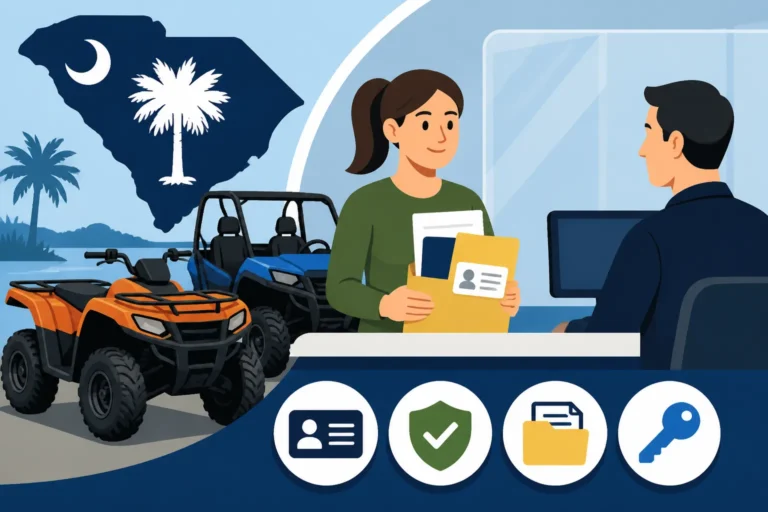
So, you've decided to register your street-legal UTV in South Carolina for your visit. What do you need to bring to the SCDMV? The process for an out-of-state machine is similar to what a resident would face, but with an emphasis on proving prior ownership and compliance. You'll need:
- Proof of Ownership: This is typically your out-of-state title. If your home state doesn't issue titles for UTVs, or if you bought it from a private seller with only a bill of sale, you'll need a robust paper trail. A detailed bill of sale, perhaps one you can draft with a service like LawDepot to ensure it covers all legal bases, will be essential. If it's a new machine, you'll need the Manufacturer's Certificate of Origin (MCO).
- Proof of Insurance: South Carolina requires liability insurance for any street-legal vehicle, and your street-legal UTV is no exception. You'll need to provide proof of current liability insurance that meets South Carolina's minimum coverage requirements. Don't forget this crucial step, as you won't get a plate without it. Our article [South Carolina Insurance Proof at Registration] has more details.
- Valid Driver's License: The person registering the UTV must have a valid driver's license. For visitors, this will be your driver's license from your home state.
- Completed Application Form: The SCDMV will have a specific form for titling and registering vehicles. You'll typically indicate on this form that you're applying for both title and registration for a street-legal UTV.
- Payment for Fees: Be prepared to pay the applicable titling and registration fees. These fees are usually modest compared to the cost of the machine, but they are mandatory.
It's a good idea to call the specific SCDMV office you plan to visit ahead of time to confirm their exact requirements for out-of-state street-legal UTVs, as policies can sometimes have local nuances or be updated. Better safe than sorry when dealing with state agencies!
The Process at the SCDMV for Out-of-State Street UTVs
Once you have all your documents in order, heading to the SCDMV is the next step. For visitors, this can sometimes feel a bit daunting, especially if you're not familiar with the local processes. The key is to be patient and have all your paperwork meticulously organized. When you arrive, you'll fill out the necessary application forms for both titling and registration. Even if you're just visiting, the SCDMV will issue you a South Carolina title (if your machine isn't already titled in a way they recognize for street use) and a license plate, along with a registration card. Many of these details are covered in our guide on [South Carolina Title Applications at the DMV].
The clerk will review your proof of ownership, verify your insurance, and process your application. They'll also check your driver's license. If all documents are in order and your UTV meets the physical requirements (which are usually attested to on the application, not through a physical inspection at the DMV), you'll pay the fees, and they'll issue your plate and registration card. Remember, this plate signifies your UTV is legally allowed on South Carolina public roads that have a posted speed limit of 55 mph or less.
It’s important to understand that if your UTV is already titled in your home state, the South Carolina title will essentially be a new record of ownership within South Carolina's system, linking it to your visitor registration. This doesn't invalidate your home state title but establishes the necessary legal framework for street use within South Carolina. The entire process is designed to ensure that any vehicle operating on public roads, regardless of where its owner hails from, adheres to the state's safety and financial responsibility laws.
Golf Cart Permits: A Common Visitor Question
Beyond ATVs and UTVs, another popular vehicle for visitors, especially in South Carolina's many beautiful coastal towns, is the golf cart. These seemingly innocuous vehicles are often seen zipping around neighborhoods and beach access roads, and many visitors bring their own or rent them for their stay. However, just like other vehicles, golf carts have their own specific set of rules, and obtaining a permit is a common requirement for visitors.
South Carolina's Golf Cart Permit Requirement for Road Use
If you're planning to use your golf cart on any public road in South Carolina, even if it's just to get from your rental house to the beach or the community pool, you must obtain a South Carolina Golf Cart Permit. This isn't optional, and ignoring it can lead to fines. This requirement often surprises visitors, especially those from states where golf carts are allowed on certain roads without formal registration. Our detailed article, [South Carolina Golf Cart Permit Rules], explains these regulations thoroughly.
The permits come with specific restrictions: golf carts can generally only be driven during daylight hours, within a certain radius (often 4 miles) of your home or rental property, and on secondary roads with a speed limit of 35 mph or less. They are absolutely not allowed on primary highways or interstates. These rules are in place to ensure safety, as golf carts are not designed to keep up with faster traffic or offer the same level of protection as a conventional car. Even if your golf cart is electric and silent, its presence on public roads requires adherence to these rules.
Coastal towns, in particular, are vigilant about golf cart permits and compliance because they see a high volume of visitor traffic and often have local ordinances supplementing state law. You'll frequently see local law enforcement monitoring golf cart activity, especially during peak tourist season. So, while it might seem like a small detail, getting that permit is a big deal if you want to avoid a vacation-spoiling ticket.
How Visitors Can Obtain a Golf Cart Permit
Getting a golf cart permit as a visitor is a relatively straightforward process, though it still requires a trip to the SCDMV or a designated office. Here's what you'll typically need:
- Proof of Ownership: A bill of sale is usually sufficient here. If you've just bought the golf cart, or if you're renting it for an extended period and need the permit yourself, make sure you have solid paperwork. Again, a service like LawDepot can help you generate a clear and comprehensive bill of sale if you're dealing with a private transaction.
- Proof of Insurance: You'll need to show proof of liability insurance for the golf cart. This is a non-negotiable requirement for road use.
- Valid Driver's License: The person applying for the permit must have a valid driver's license from their home state.
- Application Form: Complete the golf cart permit application form provided by the SCDMV.
- Payment for Fees: There's a small fee for the permit, which is typically quite affordable. You can see the details of this cost in [Buying a Golf Cart Permit for $5].
The permit is usually a decal that you'll affix to the golf cart, often on the front left fender. It's valid for five years. Even if you're only visiting for a week, you'll need this permit if you plan to drive the golf cart on public roads. Many rental companies will handle the permit for you, but if you bring your own or purchase one during your stay, the responsibility falls on you. Be sure to check with your rental provider if they handle the permit or if it's your responsibility to avoid any surprises. Our post [South Carolina Golf Cart Permit Steps] walks you through the details.
Important Rules and What to Carry on the Trail or Road
Understanding the registration and permit requirements is just one piece of the puzzle. As a visitor, it's equally crucial to know what documentation to carry with you and to be aware of general riding rules, whether you're on a deep woods trail or a coastal back road. Ignorance of the law, even as a visitor, is rarely an excuse that holds up well with law enforcement.
Essential Documentation for All Riders
Regardless of whether you're riding an unregistered off-road ATV, a plated street-legal UTV, or a permitted golf cart, certain documents are essential to carry with you or have immediately accessible. Think of it like carrying your car's registration and insurance card – it's just good practice and legally required in many situations.
- Proof of Ownership: For any machine, always have some form of proof of ownership. For off-road ATVs, this might be your out-of-state title, an MCO, or a detailed bill of sale. For street-legal UTVs, it's your South Carolina title and registration card. For golf carts, it's your bill of sale and permit. This is vital if you're stopped or if there's any question about the machine's legitimacy. LawDepot can be a useful resource for creating official-looking bills of sale or affidavits if your current proof of ownership is informal.
- Proof of Insurance: If your machine requires insurance (street-legal UTVs and golf carts), always carry proof. For off-road machines, while not legally required, carrying insurance information is still a good idea if you have a policy, especially if you ever need to file a claim.
- Valid Driver's License/ID: You, as the operator, should always carry your valid driver's license from your home state. For younger riders, a state-issued ID or even a learner's permit might be relevant, depending on age and machine type.
A South Carolina deputy can absolutely ask to see these documents, whether you're on a trail, a public road, or even private land if there's a reason for a stop. Being prepared can save you a lot of hassle. We cover more on what officers may ask for in [What a South Carolina Deputy Can Ask to See] and [What Papers to Carry on a Back Road].
General Riding Rules and Safety for Visitors
Beyond permits and registration, South Carolina has a comprehensive set of rules governing ATV and UTV use, especially concerning safety, age, and where you can ride. As a visitor, these are critical to understand to ensure a safe and legal trip.
For off-road ATVs and UTVs:
- Age Restrictions & Helmets: South Carolina's "Chandler's Law" is very specific about who can ride, what age they must be, and helmet requirements for younger riders. For example, riders under 16 must wear a helmet. If you have younger riders, make sure you're up to speed on these rules. Our article [Chandler's Law and South Carolina ATV Rules] goes into great depth.
- Private Property: Always have permission to ride on private land. "No trespassing" signs are to be respected, and simply assuming land is open to public riding can lead to serious legal trouble.
- Forest Lands: If riding on National Forest OHV trails, you will need a special pass. These are separate from any registration or titling and are generally required per rider or per machine for day or season use. Always check trail conditions and pass requirements before heading out.
For street-legal UTVs:
- Roads: Stick to secondary roads with speed limits of 55 mph or less. Interstates are off-limits.
- Equipment: Your UTV must have all the required safety equipment, including headlights, taillights, brake lights, turn signals, mirrors, a horn, and seatbelts.
- Operator Age: Drivers must be at least 17 years old and hold a valid driver's license.
For golf carts:
- Time of Day: Only operate golf carts during daylight hours.
- Radius: Stick to the designated radius (typically 4 miles) from your residence or rental property.
- Speed Limits: Only on roads with a speed limit of 35 mph or less.
Visitor Considerations for South Carolina Riding
| Vehicle Type | Registration/Permit Required for Visitors? | Where Can You Ride? | Key Documents to Carry | Important Visitor Rule to Note |
|---|---|---|---|---|
| Off-Road ATV/UTV | No (if purely off-road) | Private land, designated OHV trails | Home state title/MCO/bill of sale | Strict age and helmet laws (Chandler's Law) apply. |
| Street-Legal UTV | Yes (SC registration required for road use) | SC secondary roads (55 mph or less), OHV trails | SC title/registration, insurance, DL | Must comply with SC's street-legal UTV specs & get SC plate. |
| Golf Cart | Yes (SC permit required for road use) | SC secondary roads (35 mph or less), specific radius | Bill of sale, insurance, SC permit, DL | Daylight use only, limited to specific radius from residence. |
Always double-check local ordinances in the specific town or county you're visiting, especially in popular tourist destinations like Myrtle Beach, Hilton Head, or Charleston, as they might have additional restrictions or designated golf cart zones. Being informed and prepared will ensure your South Carolina adventure is full of fun and free of unexpected legal headaches.
Disclaimer
This article is for general informational purposes only and does not constitute professional advice. Laws, prices and regulations vary by location and change over time. Consult a qualified professional for guidance on your specific situation.