South Carolina Title Compared to Georgia
Moving an ATV or UTV across state lines, especially between South Carolina and Georgia, can feel like navigating two entirely different worlds when it comes to paperwork. What's perfectly fine in one state can cause a major headache in the other, leaving owners scratching their heads about titles, registration, and proof of ownership. This guide will walk you through the distinct titling philosophies of South Carolina and Georgia for your off-road machines, helping you understand what's required and how to avoid common pitfalls whether you're buying, selling, or just moving your ride.
The Philosophical Divide: Optional vs. Mandatory Titling
Right out of the gate, South Carolina and Georgia diverge significantly in how they view titles for ATVs and off-road vehicles. This difference isn't just a minor technicality; it impacts everything from private sales to financing and even how easily you can prove you own your machine.
South Carolina's Approach to ATV Titles
For many years, South Carolina has taken a very hands-off approach to titling most off-road vehicles, particularly ATVs. In the Palmetto State, titles for ATVs are generally considered optional. This means that while you can apply for a title for your quad, the state doesn't legally require you to do so to own or operate it on private land. This can be a double-edged sword for owners. On one hand, it simplifies the initial purchase process and reduces some administrative burden. You don't have to immediately rush to the DMV after buying a new quad or even a used one. On the other hand, the absence of a mandatory title can lead to complications.
Without a title, proving ownership can sometimes be trickier, especially in cases of theft or when trying to sell the machine to an out-of-state buyer who expects a title. While [South Carolina Titles Are Optional], many savvy riders still choose to title their machines precisely for these reasons. It provides a clear, state-issued document of ownership that can be invaluable. Think about it: if your machine gets stolen, having a title makes it much easier for law enforcement to track and return to you. It also gives peace of mind to potential buyers, signaling a legitimate sale and clear chain of custody. You can learn more about why many still choose to title their machines in [Why Optional Titling Still Helps].
Georgia's Mandatory Titling for Off-Road Vehicles
Just across the Savannah River, Georgia operates under a fundamentally different system. In Georgia, titles for off-road vehicles, including most ATVs and UTVs, are generally mandatory. This means that if you own an off-road machine in Georgia, the state expects you to have a title for it, issued by the Georgia Department of Revenue. This system is designed to create a clear record of ownership for every machine, much like how cars are titled.
The rationale behind mandatory titling is primarily rooted in theft prevention and establishing a solid proof of ownership. A title acts as the official certificate, detailing the vehicle's identification number (VIN), owner information, and any liens on the machine. This makes it significantly harder for stolen machines to be resold and helps protect buyers from inadvertently purchasing a stolen vehicle. For a Georgia resident, purchasing an ATV or UTV, whether new or used, will almost always involve a titling process that must be completed promptly after the sale. This difference is one of the biggest challenges for buyers and sellers operating between the two states.
UTVs and Street-Legal Status: A Diverging Path
Beyond the core titling of off-road machines, the classification and road-legal status of UTVs have also seen recent changes, particularly in South Carolina, creating another point of divergence between the two states.
South Carolina's New Street-Legal UTV Registration
South Carolina recently ushered in a significant change for UTV owners with the introduction of street-legal UTV registration. This new law, effective at a specified future date, allows qualifying UTVs to be registered and licensed for use on certain public roads. This is a game-changer for many UTV enthusiasts in the state, opening up new opportunities for recreational use and commuting on secondary roads. You can find detailed information about this process in [South Carolina Street-Legal UTV Registration Arrives].
For a UTV to be considered street-legal in South Carolina, it must meet specific equipment requirements, such as headlights, tail lights, turn signals, mirrors, a horn, and a windshield. Once these conditions are met and the machine is registered, it will receive a license plate, much like a car. This new registration naturally involves a titling component, as the state will issue a title alongside the registration for these specific street-legal UTVs. It's a distinct category from the optional titling for traditional off-road ATVs, and it's a testament to the growing popularity and utility of side-by-sides.
Georgia's Broader UTV Road Access (with nuances)
Georgia, while not having a specific statewide "street-legal UTV" registration class quite like South Carolina's new program, has historically allowed more localized and nuanced access for UTVs on public roads. Many counties and municipalities in Georgia have enacted local ordinances that permit UTVs on certain roads within their jurisdictions, often with speed limits or specific operating hours. These local rules can vary widely, making it crucial for UTV owners in Georgia to check with their specific county or city government before riding on public roads.
Generally, these local allowances are not tied to a statewide "street-legal" registration or title, but rather to the inherent titling of the UTV as an off-road vehicle and adherence to local traffic laws. This patchwork of rules means a UTV might be perfectly legal on a small town's roads in one part of Georgia but completely prohibited in another, even if both are considered "off-road" in their titling. The key difference here is the comprehensive, statewide framework South Carolina is putting in place versus Georgia's more decentralized, local approach to UTV road access.
Practical Implications for Riders and Buyers
The differences in titling philosophies between South Carolina and Georgia create very real challenges and considerations for anyone buying, selling, or simply moving their off-road machines between the two states.
Buying or Selling Across State Lines
Imagine you're a South Carolina resident eyeing a sweet deal on a used side-by-side in Georgia. You find the perfect machine, agree on a price, and then the seller presents you with a Georgia title. "Great!" you think, "Solid proof of ownership." But what if the tables are turned? What if you're a Georgia resident trying to buy an ATV from a South Carolina seller, and they tell you they don't have a title because it's optional in SC? This is where things get complicated.
A Georgia buyer must have a title to register their ATV or UTV in Georgia. If you buy an untitled machine from South Carolina, you'll need robust proof of ownership to apply for a title in Georgia. This typically means a detailed bill of sale signed by both parties, notarized if possible, and potentially other supporting documents like previous registration forms or sworn affidavits. Conversely, a South Carolina buyer might appreciate a Georgia title for the extra proof of ownership, but it's not a legal requirement for them to obtain an SC title.
When you're dealing with a private sale, especially one crossing state lines, strong documentation is your best friend. Even if South Carolina doesn't mandate a title, a comprehensive bill of sale is crucial for both parties. Resources like LawDepot offer customizable bill of sale templates that can cover all the necessary details, protecting both the buyer and the seller. This becomes particularly important if you are [Selling a Machine Without a Title in South Carolina] or engaging in [Buying From a Private Seller in South Carolina]. Don't rely on a handwritten note on a napkin; get proper documentation.
Insurance and Financing Considerations
Beyond the DMV, the titling differences can also impact how you secure insurance and financing for your off-road machine. Lenders, almost without exception, require a title to secure a loan for an ATV or UTV. A title provides them with a legal claim to the asset until the loan is paid off, protecting their investment. If you're looking to finance an untitled machine from South Carolina, you might find it extremely difficult, if not impossible, to get a traditional loan. This is a common hurdle for buyers, and it's why [Lenders That Will Not Finance an Untitled Quad] is a real concern for many.
Similarly, insurance companies often prefer or even require a title, particularly for comprehensive or theft coverage. While liability insurance might be available for untitled machines, having a title streamlines the process and can be essential if your policy needs to make a claim for theft or major damage. [Insurers That Ask for a Title First] are common, as it helps them verify ownership and simplifies the claims process. If you ever need to file a claim, clear proof of ownership from a title makes everything much smoother.
Key Differences at a Glance
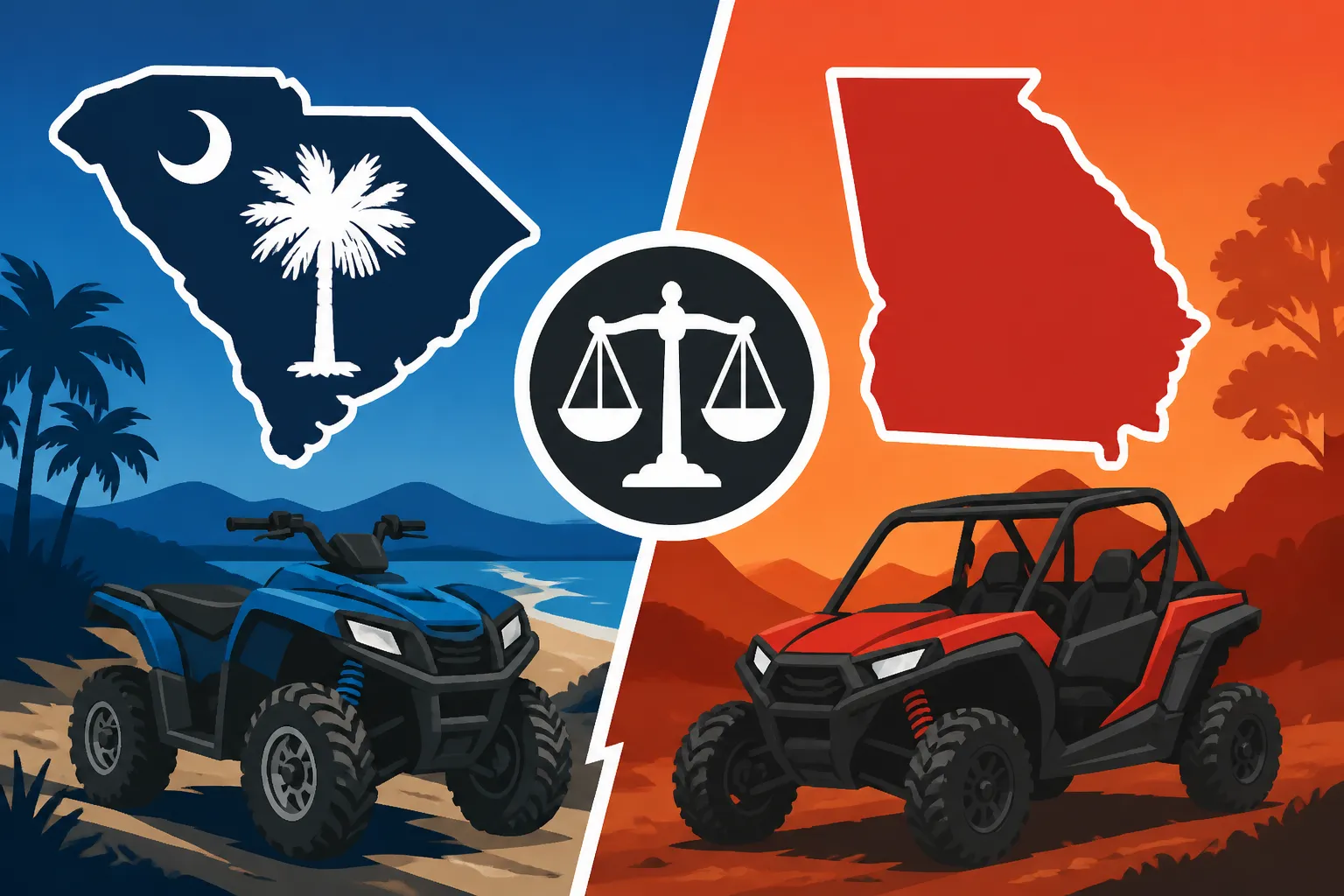
To quickly summarize the core distinctions between South Carolina and Georgia regarding ATV and UTV titling and registration, here's a helpful comparison:
| Feature | South Carolina | Georgia |
|---|---|---|
| ATV Titling | Optional (for most off-road ATVs) | Mandatory (for most off-road ATVs) |
| Street-Legal UTV Reg. | Specific statewide program with dedicated title/plate (starting from a specified future date) | Local ordinances dictate road access; no uniform statewide street-legal UTV class |
| Proof of Ownership | Bill of Sale, MCO, or Optional Title | Mandatory Title, Bill of Sale, MCO |
| Lender Requirements | Loan for untitled ATV difficult | Title generally required for loans |
| Insurance Requirements | Title often preferred/required for comprehensive coverage | Title often preferred/required for comprehensive coverage |
| Out-of-State Purchase | GA buyer needs strong paperwork (Bill of Sale) for SC untitled machine to get GA title | SC buyer may benefit from GA title, but not required for SC titling (if chosen) |
Navigating the Paperwork: Tips for Cross-Border Owners
Understanding the differences is one thing, but knowing how to practically navigate them is another. Whether you're moving, buying, or selling, here are some actionable tips.
When Moving from Georgia to South Carolina
If you're relocating to South Carolina from Georgia and bringing your ATV or UTV with you, the process is generally straightforward from South Carolina's perspective. Since South Carolina views ATV titling as optional, you won't be required to obtain a new SC title for your previously Georgia-titled ATV. You can simply continue to possess your Georgia title as proof of ownership. However, if you want a South Carolina title, you can apply for one. The SC DMV will accept your Georgia title as valid proof of ownership to issue you a new [South Carolina Title for a New Resident].
For a UTV that was titled in Georgia and you wish to make it street-legal in South Carolina, you would follow the specific steps for the new street-legal UTV registration, using your Georgia title as part of the ownership documentation. This will involve meeting the equipment requirements and applying for the new SC street-legal UTV title and registration.
When Moving from South Carolina to Georgia
This scenario presents more of a challenge. If you're moving from South Carolina to Georgia with an ATV or UTV that was never titled in SC (because it was optional), you'll need to work diligently to establish proof of ownership in Georgia to obtain a mandatory Georgia title. A mere bill of sale from a decade ago might not cut it on its own.
You'll need the most robust documentation possible. This includes:
- A comprehensive, notarized bill of sale from your purchase. If you don't have one, consider creating a detailed affidavit of ownership using a service like LawDepot.
- The original Manufacturer's Certificate of Origin (MCO) if you bought the machine new.
- Any past registration documents (though SC doesn't register off-road ATVs, so this may not apply).
- Proof of insurance coverage in your name.
- Photos of the machine, especially showing the VIN.
The Georgia DMV will scrutinize these documents carefully. It's often helpful to contact the Georgia Department of Revenue's Motor Vehicle Division before you move to understand their specific requirements for titling an off-road vehicle from a state where titles are optional. They hear these [South Carolina Title Questions the DMV Hears] often and can provide guidance.
Proactive Steps for Any Owner
Regardless of which state you call home, or if you frequently cross state lines, being proactive about your ownership documentation is critical.
- Always have a robust Bill of Sale: Even for South Carolina machines where a title is optional, a detailed bill of sale is your primary line of defense as [South Carolina Proof of Ownership Without a Title]. It should include the full names and addresses of buyer and seller, the date of sale, the purchase price, a complete description of the ATV/UTV (make, model, year, VIN), and signatures of both parties. Using a reputable template from a service like LawDepot can ensure all bases are covered.
- Keep the MCO: If you bought your machine new, hold onto the Manufacturer's Certificate of Origin (MCO). This is the original birth certificate of your vehicle and is crucial for initial titling in any state.
- Document everything: Take photos of your VIN, keep copies of insurance policies, and maintain a file of all purchase and service records. This paper trail can be invaluable if you ever face a challenge to your ownership.
- Consider Titling in SC Anyway: Even if it's optional, getting a South Carolina title for your ATV can provide an extra layer of security and make future sales or moves less complicated, especially if you ever consider selling to a Georgia resident.
The key takeaway here is that while South Carolina and Georgia have different approaches to off-road vehicle titling, the smart owner always prioritizes clear, verifiable proof of ownership. This diligence saves you time, money, and stress down the road.
Disclaimer
This article is for general informational purposes only and does not constitute professional advice. Laws, prices and regulations vary by location and change over time. Consult a qualified professional for guidance on your specific situation.