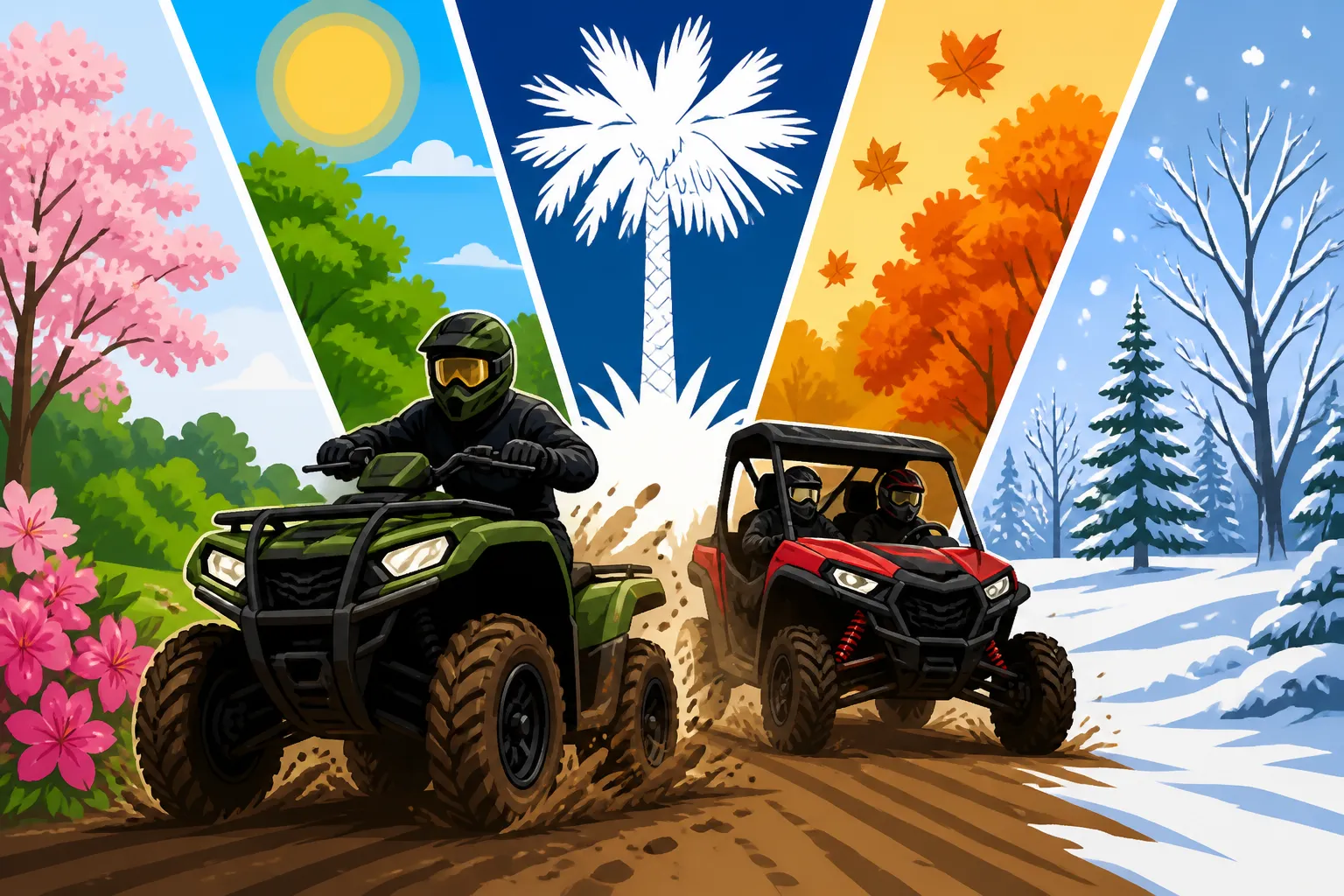
South Carolina Trails Open Year-Round
A trail that looks open on a map may be closed for the season, muddy after heavy rain, or unavailable on the day you finally get the trailer loaded. In South Carolina, “open year-round” does not always mean open every day. This guide explains how to find riding options throughout the year, check access before you leave, and avoid a wasted trip.
What year-round riding means in South Carolina
Open all year does not mean open every day
South Carolina has public forest trails and privately operated riding areas, but their access rules are different. A trail may be available during every season yet still close for maintenance, wet conditions, hunting activity, or other management reasons. A private park may welcome riders throughout the year but only on selected operating days, or it may temporarily restrict access after poor weather.
It helps to separate three questions before planning a ride: Is this trail open during the season you want to visit? Is it open on your specific date? Is it open to your type of machine? A route that answers yes to the first question might still be a no for the other two.
That distinction matters especially in winter and early spring, when a sunny day at home can follow a week of rain in the riding area. A closure can protect the trail from damage, so arriving at a closed gate is frustrating—but riding around it is not a workaround. Check the operator’s or land manager’s latest notices rather than relying on an old forum post or a map pin alone.
Public forest trails and private parks follow different schedules
South Carolina’s national forest OHV trails are managed public riding areas, not unrestricted roads that stay available on demand. Their seasons, permitted vehicle types, and temporary closures can vary. Start with the relevant [South Carolina's Four National Forest Trails] and confirm the rules for the specific trail system you plan to ride.
Private parks offer a different kind of access. A park may have a longer operating season, facilities such as camping or wash areas, and trail options for different vehicle types. But admission rules, opening days, weather decisions, and machine restrictions are set by the operator. [South Carolina Private Park Passes and Rules] is a useful next read if you are comparing park access with public-land riding.
| Riding option | What “year-round” may mean | What to confirm before leaving |
|---|---|---|
| National forest OHV trail | The riding area may have a recurring season, but not necessarily 12-month access | Seasonal dates, current closures, machine limits, pass requirements |
| Private riding park | The park may operate in multiple seasons but on scheduled days | Calendar, reservations, weather status, vehicle and age rules |
| Informal dirt or timber road | Access may depend on the landowner and road conditions | Written permission, gate status, permitted route, current land-use rules |
South Carolina riding options to investigate
National forest OHV trails
South Carolina’s designated forest trails are a good place to start if you want marked routes and public-land riding. The state’s trail systems include different settings and vehicle restrictions, so do not assume that a route suitable for a dirt bike will also accept a full-size side-by-side. Trail widths, surface conditions, and management rules can vary even within the same general region.
For instance, you might be planning a Saturday ride near the Enoree area and see several routes marked on a map. Before towing there, verify the current trail status, the vehicle class allowed, and any pass requirements. If you are considering a side-by-side, use [South Carolina Trails That Allow Side-by-Sides] to narrow your choices, then confirm the details with the land manager. A trail being open to OHVs does not automatically mean every OHV fits.
A map can help you understand where trails are, but it should not be your final authority on access. Tools such as onX Offroad can help with route planning and identifying nearby trail networks, but check current land-manager notices for closures and rules. For another overview of what to bring and where to look, see [South Carolina ATV Trail Map Downloads].
Private parks for a more flexible trip
A private riding park may be the more practical choice if you want to plan around a particular weekend, ride with a group, or have facilities close by. Carolina Adventure World near Winnsboro is one option riders may consider. Its extensive trail network can make it appealing for a full day or weekend, but check the park’s own operating calendar and machine rules before you set out. You can also read [Carolina Adventure World's 100 Miles] for more detail about that destination.
“Open all year” still does not guarantee that every trail is open on every visit. Parks may adjust operations because of rain, maintenance, special events, or other conditions. If you are traveling from Charleston, Greenville, or another part of the state, confirm access directly before loading the trailer. A quick check can save you a long drive to a closed gate.
Private-park access also comes with its own planning details. Ask whether you need to reserve ahead, what passes or vehicle fees apply, whether camping is available, and whether the trails fit your machine and experience level. If camping is part of the plan, [South Carolina Trails With Camping] can help you explore that angle.
How to check a trail before you haul
Verify access and machine rules
Use a simple check before every trip, even if you have ridden the same area before. First, identify the exact trail or park—not just the nearest town. Then check the land manager’s or operator’s current information for seasonal dates, temporary closures, and operating days. Confirm whether your machine is allowed, since restrictions can depend on vehicle type, width, or trail designation.
Next, review any access requirements. Public forest riding may involve a pass or other rules; private parks may have admission procedures, age policies, and vehicle requirements. Keep the relevant details handy, especially if you are organizing a group. If one person assumes that a pass covers everyone or every machine, the mix-up can hold up the entire ride.
Planning apps can make route research easier. onX Offroad can be useful for reviewing mapped routes and building a plan, but a map does not replace a current closure notice or permission from the land manager. Treat the app as a planning aid, then verify the final access details through the official channel.
Check weather, surfaces, and closures
Rain affects South Carolina trails differently depending on the soil, drainage, and location. A route that is manageable after a brief shower may become deeply rutted or unsafe after prolonged rain. Wet ground can also prompt temporary closures intended to prevent damage. Check [South Carolina Wet Weather Trail Closures] and [South Carolina Trail Conditions Before You Haul] when the forecast has been unsettled.
Do not rely only on the weather in your own town. Conditions near a forest trail or park can be quite different from conditions at home, and recent rainfall may matter more than the sky on ride day. If an official update is unclear, contact the site before you leave. That is especially worthwhile when you are traveling a long distance or bringing several riders.
If a trail is closed, respect the closure and make a backup plan. Keep a second approved riding area in mind, but verify its access separately; a nearby road or forest route is not automatically open to recreational riding. Never bypass a barrier or treat a closed trail as an invitation to find an alternate route through the woods.
Plan for a ride in every season
Choose the right destination for your group
The best year-round option depends on what you want from the day. A family on youth machines may need a different setting from a group bringing full-size UTVs. A beginner may prefer a clearly marked, manageable route, while experienced riders might be looking for more challenging terrain. Check trail difficulty and machine suitability before choosing a destination, not after arriving.
Think through the practical details too: trailer parking, fuel nearby, cell coverage, food, water, and a place to clean muddy gear. If you are riding with friends, agree on a meeting point and a plan for someone who gets separated. In forest areas, cell service can be unreliable, so consider carrying an offline map or a paper backup alongside your phone. onX Offroad may help with advance route planning, but download or prepare what you need before you reach a dead zone.
It is also worth checking local etiquette and site rules. Yield on narrow trails, stay on marked routes, and give other users room. [South Carolina Trail Etiquette Locals Expect] is helpful reading if you are new to a riding area or bringing a group that has not ridden together before.
Keep a backup plan and confirm close to departure
Make your final status check shortly before you leave, especially after heavy rain or during a season when access can change. Confirm the park or trail is open, your machine is permitted, and any pass or reservation requirement is handled. Save the official contact details and the address or staging-area directions, rather than relying only on a map search that may lead to the wrong entrance.
A backup plan does not have to mean a second trail. It can be a later departure, a different approved park, or a rescheduled ride. If your main destination is closed, do not assume that a nearby timber road, wildlife area, or unmarked track is legal to ride. Access depends on land ownership and specific rules, and getting permission is essential where required.
For a first visit, arrive with enough time to read posted notices and sort out passes before unloading. Check the machine’s fuel, tires, lights, and basic recovery gear while you are still at the staging area. A little preparation can turn an uncertain trip into a much smoother day—whether you ride in summer heat, a crisp fall weekend, or a mild winter stretch.
Disclaimer
This article is for general informational purposes only and does not constitute professional advice. Laws, prices and regulations vary by location and change over time. Consult a qualified professional for guidance on your specific situation.